


What is a recruitment agency agreement?
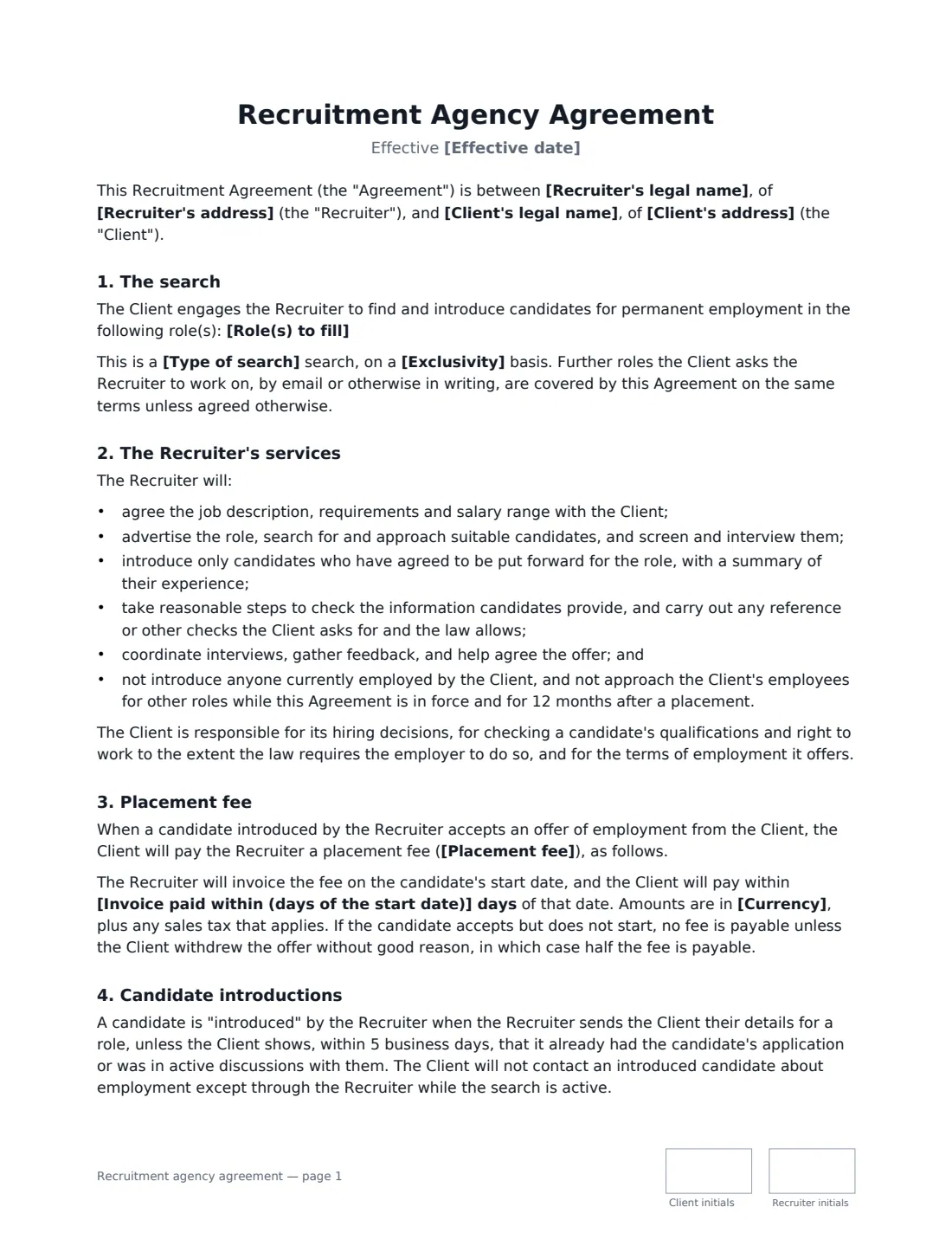
A recruitment agency agreement (often called terms of business) is the contract between an employer and a recruiter it engages to find permanent hires. It answers the questions that cause most recruiter-client disputes: when a fee is earned, how much it is, what happens if the new hire leaves after a few weeks, and whether the client can hire a candidate the recruiter introduced without paying.
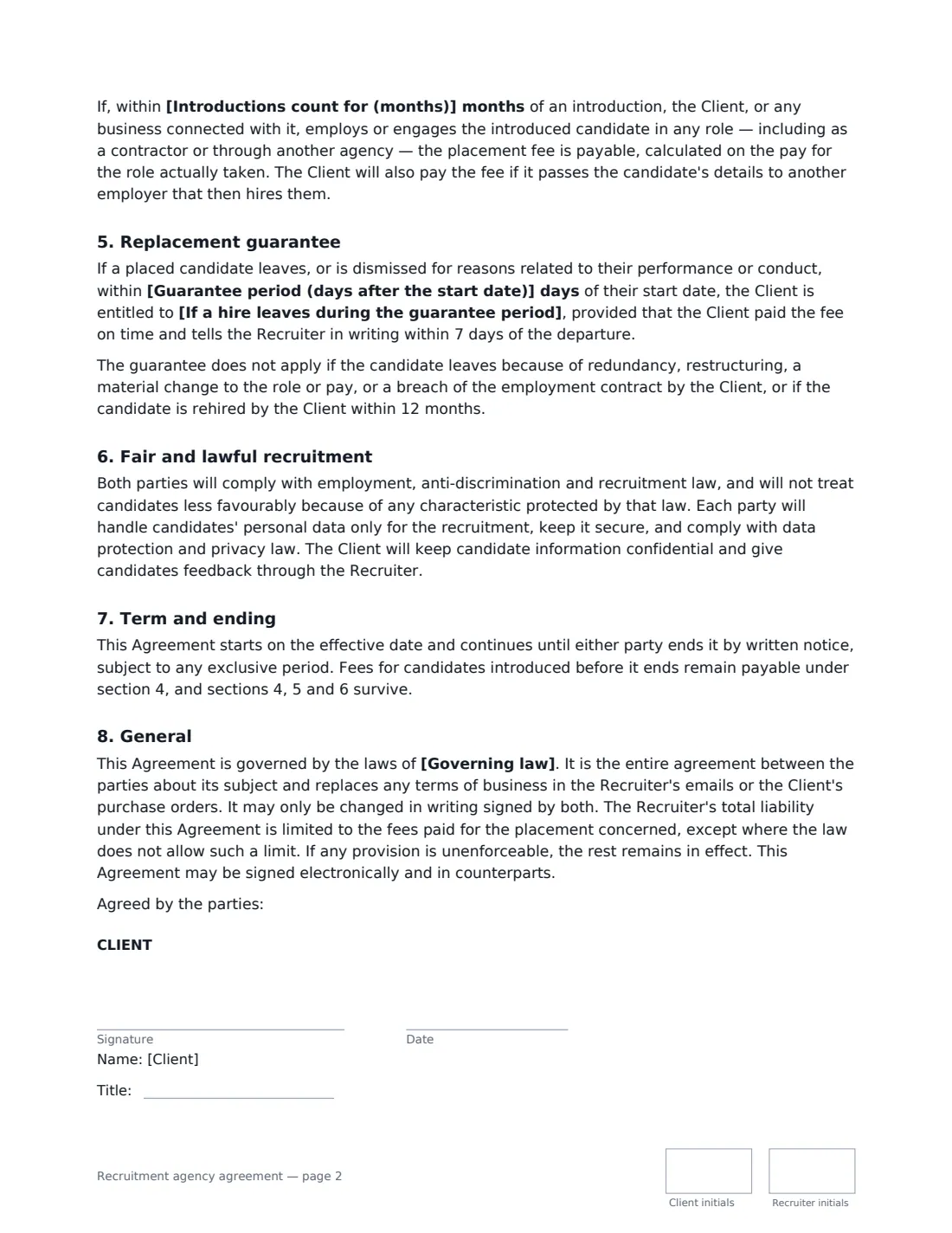
This template covers the roles and whether the search is contingent or retained, exclusive or not, the recruiter's services, a placement fee as a percentage of first-year base salary or a fixed fee, a retainer credited against the fee, when a candidate counts as introduced and how long that lasts, a replacement guarantee (free replacement, partial refund, or both), fair and lawful recruitment and candidate data, a liability cap and ending the agreement.
- Best for
- Recruitment agencies, headhunters and independent recruiters placing permanent staff
- Signed by
- The recruiter and the client, each with a job title
- Fee
- % of first-year base salary or a fixed fee, contingent or retained
- Length
- 3 pages, initialled on every page
When to Use a recruitment agency agreement
- A recruiter starting work with a new client
- An employer engaging an agency for a hard-to-fill role
- A retained executive search with a fee paid up front
- An exclusive search for a limited period
- Replacing inconsistent emailed terms with one signed agreement
What You Fill In
20 blanks, then the name and email of each person who signs: client, recruiter.
1 The parties
- Effective date*
- Recruiter's legal name*
- Recruiter's address
- Client's legal name*
- Client's address
2 The search
- Role(s) to fill*
- Type of search* contingent (fee only on a successful hire) · retained (part of the fee paid up front)
- Exclusivity* non-exclusive · exclusive for the period below
- Exclusive period (days)
3 Fees
- Currency*
- Placement fee* a percentage of first-year base salary · a fixed fee per hire
- Fee percentage
- Fixed fee per hire
- Retainer paid up front
- Invoice paid within (days of the start date)*
4 Guarantee
- Guarantee period (days after the start date)*
- If a hire leaves during the guarantee period* one free replacement search · a partial refund of the fee on the scale below · a free replacement or, if none is found within 60 days, a partial refund
- Refund scale
5 Other terms
- Introductions count for (months)*
- Governing law*
6 Who signs
- Client signature and date, job title, initials on every page · The employer hiring through the recruiter.
- Recruiter signature and date, job title, initials on every page · The recruitment agency or independent recruiter.
What the recruitment agency agreement Covers
- The search
- The Recruiter's services
- Placement fee
- Candidate introductions
- Replacement guarantee
- Fair and lawful recruitment
- Term and ending
- General
Using the recruitment agency agreement, step by step
1 Describe the roles and search
List the roles, number of hires, location and salary range. Choose contingent (fee only on a hire) or retained (part paid up front), and non-exclusive or exclusive for a number of days.
2 Set the fee
Choose a percentage of first-year base salary or a fixed fee per hire, and enter the figure. For a retained search, add the retainer, which is credited against the first placement fee. Set how many days after the start date the invoice is due.
3 Choose the guarantee
Set the guarantee period and what the client gets if a hire leaves within it: one free replacement, a partial refund, or a replacement with a refund if none is found within 60 days. Describe the refund scale if one can apply.
4 Set how long introductions count
Choose how many months after an introduction a hire still earns your fee. The client has 5 business days to show it already knew a candidate.
5 Send for signature
Send it to the hiring manager or HR lead. The signed copy is filed in Files — refer to it in each CV email.
Tips Before You Send It
- Some places regulate recruitment fees, candidate consent and agency licensing. Check the rules where you and your client operate.
- Always get a candidate's permission before sending their details to a client — the template requires it.
- Be clear about what's in "base salary". The template excludes bonuses, commission, benefits and equity.
- For retained searches, agree milestones for any further instalments in writing.
Sign It Online In Minutes
- Fill in the blanks. Names, dates and amounts go straight into the agreement — the preview shows exactly where.
- Name who signs. Tick “This is me” for your own part. VergeHR builds the PDF with every signature, date and initials box on the right line, and you can check or move anything before sending.
- Send it. Each signer gets a secure link and signs from any device — no account needed. The signed PDF, with an audit trail and a Certificate of Completion, is filed in Files and emailed to everyone.
Recruitment agency agreement: frequently asked questions
What is the difference between contingent and retained recruitment?
In a contingent search the recruiter is paid only if the client hires a candidate they introduced. In a retained search part of the fee is paid up front to start the search, usually for senior or specialist roles, and the rest on a hire.
What happens if the new hire leaves early?
If they leave or are dismissed for performance or conduct within the guarantee period, the client gets the replacement or refund you chose, provided it paid the fee on time and tells the recruiter within 7 days. The guarantee doesn't apply to redundancies, restructuring or changes the client makes to the role.
Can the client hire an introduced candidate later without paying?
Not within the period you set. Under the template, if the client hires an introduced candidate in any role — including as a contractor or through another agency — within that many months of the introduction, the placement fee is payable.
Is a recruitment agreement signed online binding?
In most countries, including the US (ESIGN Act and UETA), the UK, the EU (eIDAS) and Canada, an electronic signature is generally valid for an ordinary commercial contract like this one. VergeHR keeps an audit trail and a Certificate of Completion with the signed PDF as evidence of who signed and when.
Is this template free?
Yes. The template is free to use with the eSignature app in VergeHR, and the people you send it to don't need a VergeHR login to sign.