

What is a revenue sharing agreement?
A revenue sharing agreement records how two parties split the money earned from one product, service or deal: a course creator and the platform that hosts it, a software company and a reseller, two businesses running a joint event, or a maker and a shop selling their goods. It is narrower than a partnership — each side keeps its own business, and only the revenue from the named source is shared.
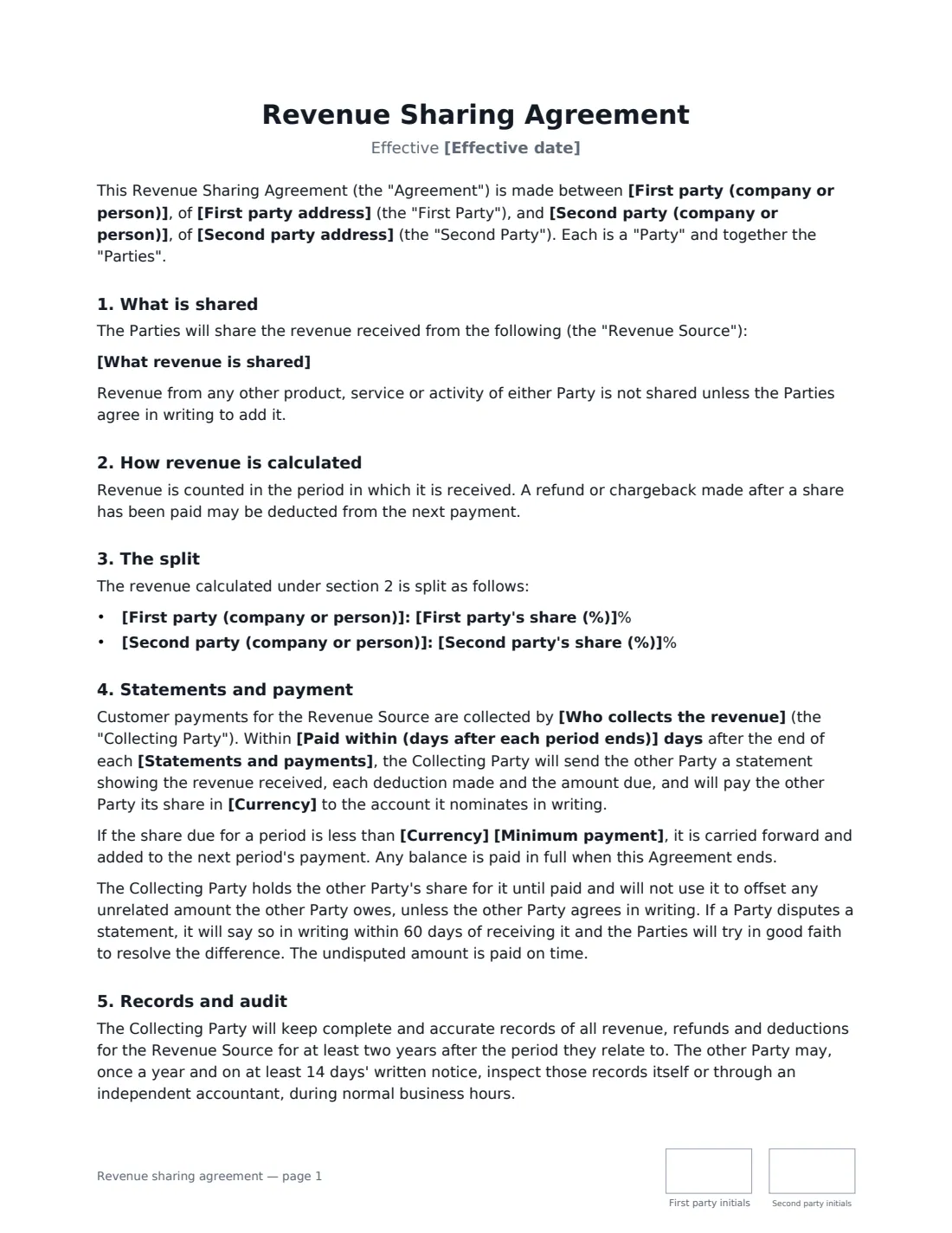
The template covers the points that cause most disputes later: exactly which revenue is shared, whether the split is on gross or net revenue (and which deductions are allowed), each party's percentage, which side collects the money and sends statements, how often payments are made, a minimum payment, record keeping and an audit right, taxes and withholding, what each side contributes, confidentiality, and what happens to revenue that arrives after the agreement ends.
- Best for
- Joint products, co-created courses, reseller and platform deals, joint events
- Signed by
- Both parties — usually an authorised person at each business
- Split
- Your percentages, on gross or net revenue, paid monthly or quarterly
- Length
- About 3 pages, initialled on every page
When to Use a revenue sharing agreement
- A course creator and a platform or publisher sharing course sales
- A software company and a reseller or integration partner sharing subscription revenue
- Two businesses co-hosting an event and splitting ticket and sponsorship income
- A designer licensing a product line to a retailer for a share of sales
- Creators or agencies sharing income from a jointly produced product
What You Fill In
22 blanks, then the name and email of each person who signs: first party, second party.
1 The parties
- Effective date*
- First party (company or person)*
- First party address
- Second party (company or person)*
- Second party address
2 The revenue
- What revenue is shared*
- Split is calculated on* Net revenue · Gross revenue
- Other agreed deductions (net revenue only)
3 The split
- First party's share (%)*
- Second party's share (%)*
4 Statements and payment
- Who collects the revenue* the First Party · the Second Party
- Currency*
- Statements and payments* calendar month · calendar quarter
- Paid within (days after each period ends)*
- Minimum payment
- Audit: collector pays the cost if underpaid by more than (%)*
5 Each party's role
- What the first party contributes
- What the second party contributes
6 Term
- End date
- Notice to end the agreement (days)*
- Keep sharing after the end for (months)
- Governing law*
7 Who signs
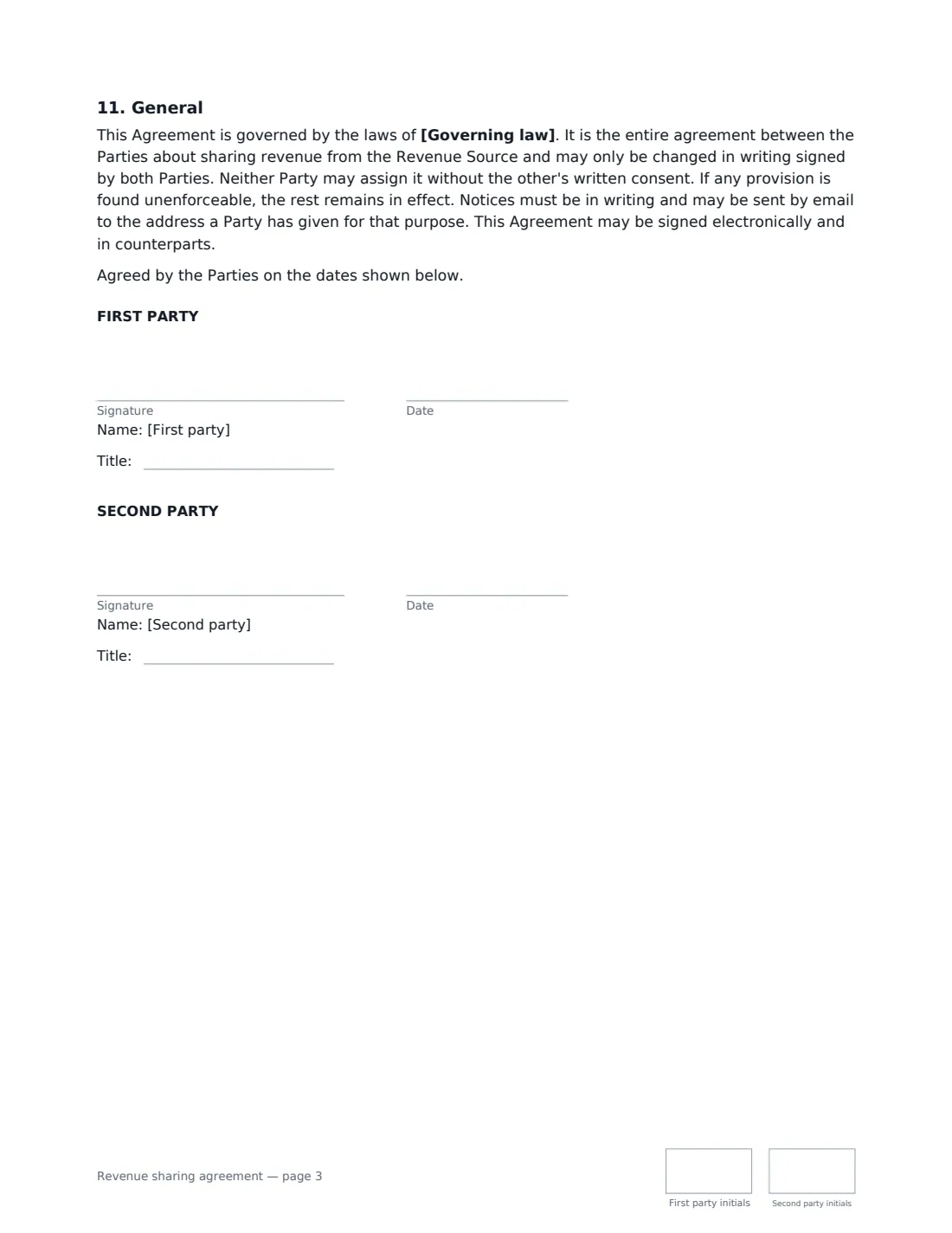
- First party signature and date, job title, initials on every page · Usually the party that collects the revenue and pays out the other's share.
- Second party signature and date, job title, initials on every page
What the revenue sharing agreement Covers
- What is shared
- How revenue is calculated
- The split
- Statements and payment
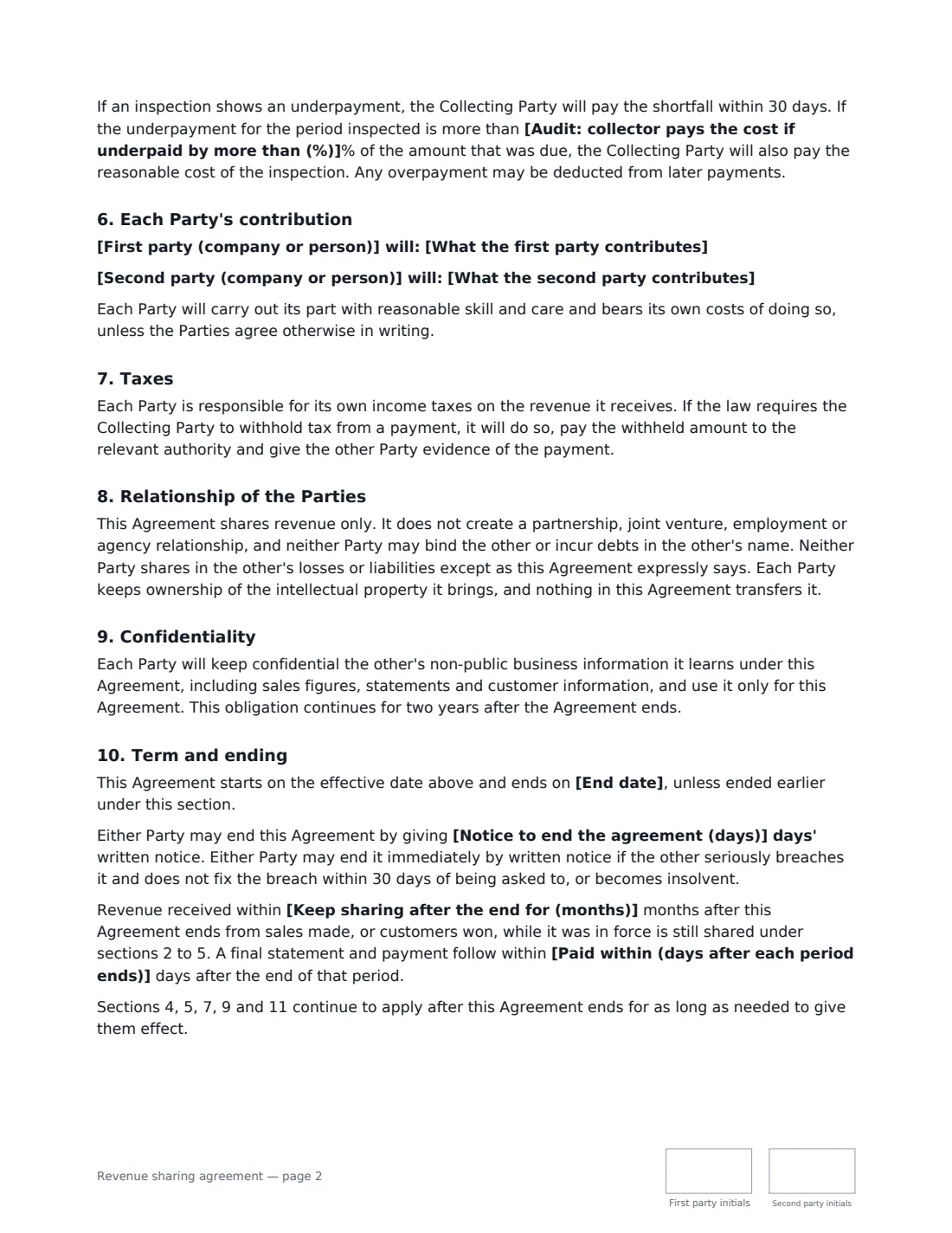
- Records and audit
- Each Party's contribution
- Taxes
- Relationship of the Parties
- Confidentiality
- Term and ending
- General
Using the revenue sharing agreement, step by step
1 Name the revenue source precisely
Only revenue from the source you describe is shared, so be specific: the product name, the channels it is sold through, and anything excluded. "All sales of the online course 'Bookkeeping for Makers' through any channel" is far clearer than "course revenue".
2 Choose gross or net, and the percentages
Gross revenue is simplest to check: only refunds, chargebacks and sales taxes come off. Net revenue also deducts payment processing fees, plus any other deductions you list — only those. Enter each side's percentage; they should add up to 100.
3 Decide who collects and how often you settle up
One party collects the money, keeps the records and pays the other its share with a statement after each month or quarter. Add a minimum payment if small amounts should roll over, and set the audit threshold above which the collector pays for an inspection.
4 Set the term and send
Leave the end date empty for an open-ended arrangement that either side can end on notice. Add a tail period if revenue from customers won during the agreement should still be shared for some months after it ends. Then name the signers and send.
Tips Before You Send It
- Agree now how refunds made after a payout are handled — the template deducts them from the next payment.
- If either party brings intellectual property, the template leaves ownership where it is. Put any licence you need in writing too.
- Revenue sharing can have tax consequences, including withholding on payments across borders. Check with an accountant before the first payout.
- Keep the statements the collecting party sends. Together with the signed agreement, they are your record if a payment is ever disputed.
Sign It Online In Minutes
- Fill in the blanks. Names, dates and amounts go straight into the agreement — the preview shows exactly where.
- Name who signs. Tick “This is me” for your own part. VergeHR builds the PDF with every signature, date and initials box on the right line, and you can check or move anything before sending.
- Send it. Each signer gets a secure link and signs from any device — no account needed. The signed PDF, with an audit trail and a Certificate of Completion, is filed in Files and emailed to everyone.
Revenue sharing agreement: frequently asked questions
Is a revenue sharing agreement the same as a partnership?
No. This template says expressly that it shares revenue only and does not create a partnership, joint venture or agency, and neither party can bind the other or share its losses. If you are going into business together more broadly, a partnership agreement is the better fit.
What is the difference between gross and net revenue here?
Gross revenue is everything received for the revenue source, less only refunds and chargebacks actually paid and sales taxes collected for a tax authority. Net revenue also deducts payment processing fees and any other deductions you list in the agreement.
Can the other side check the numbers?
Yes. The collecting party must keep records, and the other party may inspect them once a year on 14 days' notice. Any underpayment found must be paid within 30 days, and if it is more than the percentage you set, the collecting party also pays the reasonable cost of the inspection. A disputed statement must be raised in writing within 60 days.
Is an electronically signed revenue sharing agreement binding?
Electronic signatures are generally valid for ordinary commercial contracts like this one in the US (ESIGN Act and UETA), the UK, the EU (eIDAS) and Canada. VergeHR keeps an audit trail and a Certificate of Completion with the signed PDF.