

What is a company vehicle use agreement?
When you hand an employee the keys to a company car or van, you are trusting them with an expensive asset that also carries your insurance, your fleet reputation and, often, your liability to third parties. A company vehicle use agreement puts the rules in writing before anything goes wrong: what the vehicle may be used for, who else may drive it, how fuel works, who pays the parking ticket, and what happens after an accident.
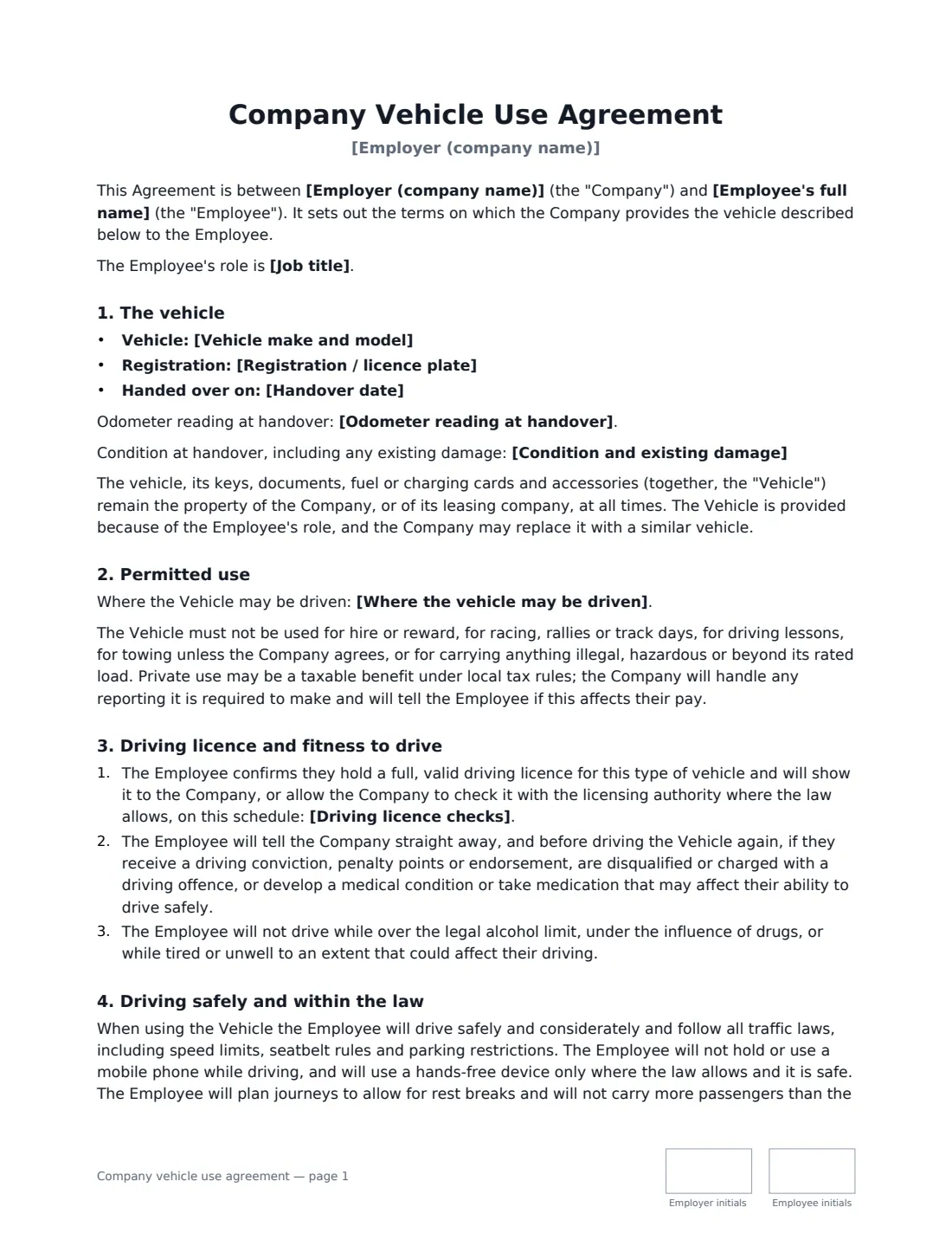
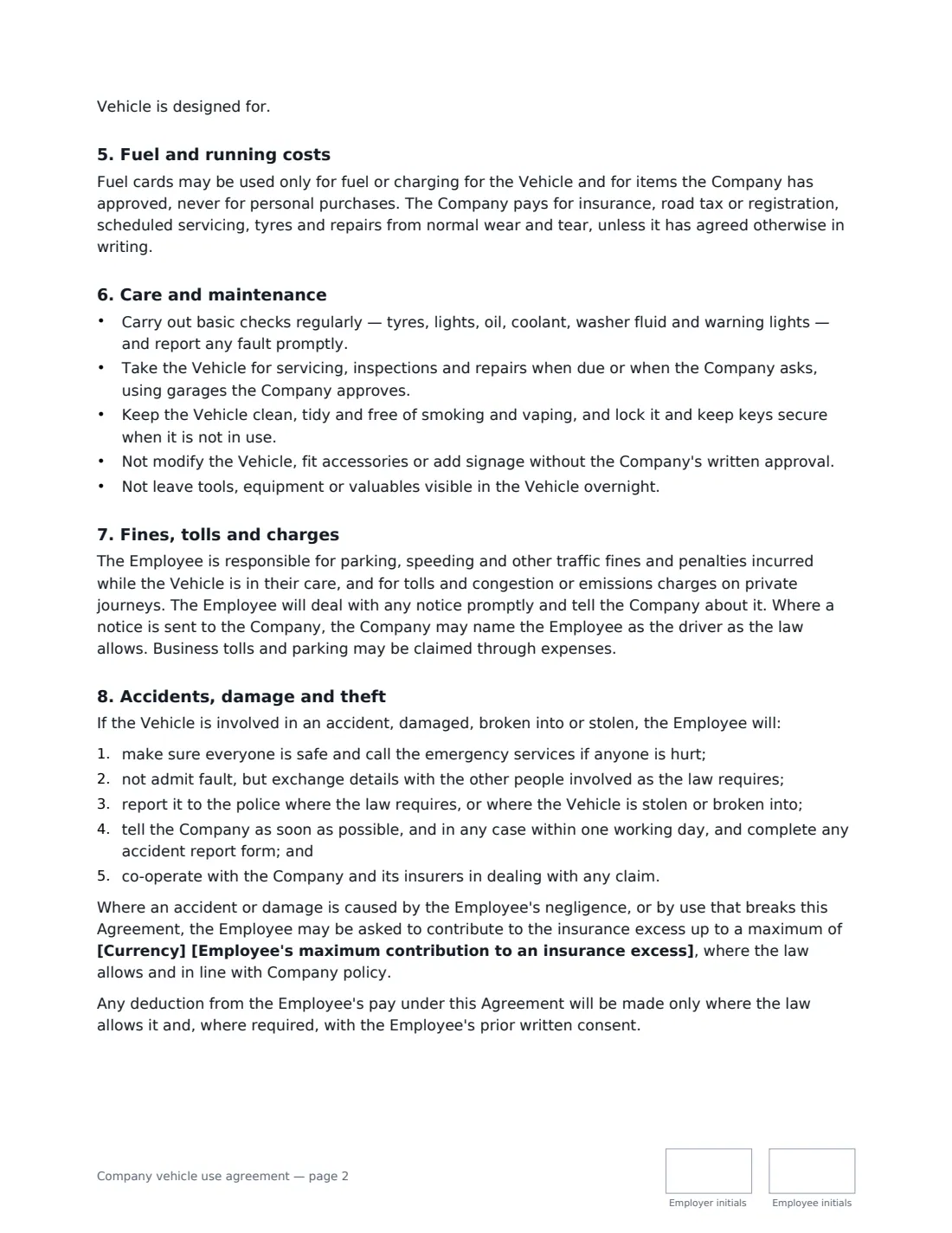
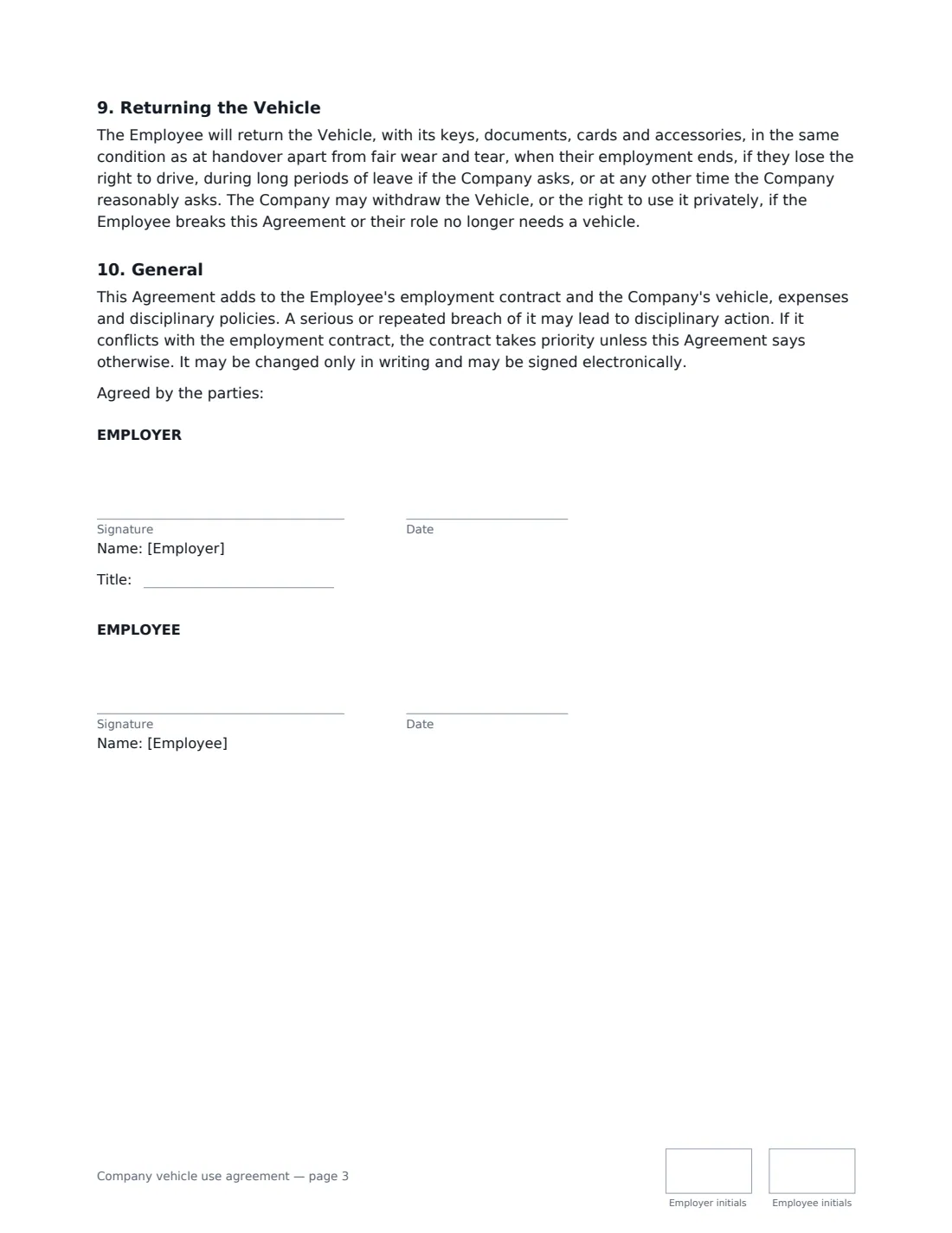
This template records the vehicle, registration, handover date, odometer reading and any existing damage. You choose whether private use is allowed (business only, business and commuting, or reasonable private use), who else may drive, how fuel or charging is paid for, how often you check the driving licence, and whether a tracker is fitted. It covers safe and legal driving, maintenance, fines and tolls, what to do after an accident or theft, an optional cap on the employee's contribution to an insurance excess, returning the vehicle, and a safeguard that any pay deduction happens only where the law allows.
- Best for
- Company cars and vans assigned to a named employee
- Signed by
- The employer (fleet or HR manager) and the employee
- Choices
- Private use, other drivers, fuel arrangement, licence check frequency, tracking
- Length
- 3 pages, initialled by both on every page
When to Use a company vehicle use agreement
- Giving a sales rep or field engineer a car with private use as a benefit
- Assigning a van to a tradesperson who takes it home overnight
- Replacing an employee's vehicle and recording the new registration and condition
- Setting out who pays fines, tolls and congestion charges
- Introducing telematics and telling drivers what it records and why
What You Fill In
17 blanks, then the name and email of each person who signs: employer, employee.
1 The parties
- Employer (company name)*
- Employee's full name*
- Job title
2 The vehicle
- Vehicle make and model*
- Registration / licence plate*
- Handover date*
- Odometer reading at handover
- Condition and existing damage
3 Use of the vehicle
- Permitted use* Business and reasonable private use · Business use and commuting only · Business use only
- Who else may drive it* Nobody else · Other employees authorised by the Company · Named additional drivers approved by the Company
- Named additional drivers
- Where the vehicle may be driven
4 Costs
- Fuel or charging arrangement* Fuel card for business fuel; private fuel repaid by the employee · Fuel card for business and private fuel · Employee pays and claims business fuel through expenses
- Currency
- Employee's maximum contribution to an insurance excess
5 Licence and monitoring
- Driving licence checks* Every 6 months · Every 12 months · At handover and when the Company asks
- Is a tracker or telematics device fitted?* Yes · No
6 Who signs
- Employer signature and date, job title, initials on every page · Someone authorised to allocate company vehicles, such as a fleet or HR manager.
- Employee signature and date, initials on every page · The employee the vehicle is assigned to.
What the company vehicle use agreement Covers
- The vehicle
- Permitted use
- Driving licence and fitness to drive
- Driving safely and within the law
- Fuel and running costs
- Care and maintenance
- Fines, tolls and charges
- Accidents, damage and theft
- Returning the Vehicle
- General
Using the company vehicle use agreement, step by step
1 Record the vehicle at handover
Enter the make, model and registration, the handover date and odometer reading, and note existing damage — scratches, missing spare, number of keys. This protects the employee from being blamed later and gives you a baseline for the return.
2 Decide on private use and other drivers
Choose business only, business and commuting, or reasonable private use. Then decide whether anyone else may drive: nobody, other authorised employees, or named drivers such as a spouse — who must be covered by your insurance.
3 Pick the fuel arrangement
Three common set-ups are built in: a fuel card for business fuel with private fuel repaid, a fuel card for all fuel, or the employee pays and claims business mileage through expenses. The matching clause is printed automatically.
4 Set licence checks, tracking and excess
Choose how often you check the licence. Say whether a tracker is fitted — if so, a clause explains what it records and why. Optionally set a maximum the employee may contribute to an insurance excess after an accident caused by their negligence.
5 Sign and file
Both of you sign and initial each page online. The signed agreement is filed in Files, ready for the next licence check or the day the vehicle comes back.
Tips Before You Send It
- Check the driving licence before handover, not after. Record it in Files alongside the signed agreement.
- Private use of a company car, and free private fuel, are taxable benefits in many countries. Ask your accountant how they are treated where you are.
- Whether you can recover fines or an insurance excess from pay depends on local employment law — the template limits deductions to what the law allows.
- Take dated photos of the vehicle at handover and attach them to the envelope.
Sign It Online In Minutes
- Fill in the blanks. Names, dates and amounts go straight into the agreement — the preview shows exactly where.
- Name who signs. Tick “This is me” for your own part. VergeHR builds the PDF with every signature, date and initials box on the right line, and you can check or move anything before sending.
- Send it. Each signer gets a secure link and signs from any device — no account needed. The signed PDF, with an audit trail and a Certificate of Completion, is filed in Files and emailed to everyone.
Company vehicle use agreement: frequently asked questions
Can I make the employee pay for accident damage?
The template lets you set an optional cap on the employee's contribution to the insurance excess where an accident is caused by their negligence or by use that breaks the agreement, and only where the law allows. Rules on recovering costs from employees differ widely, so check before you rely on it.
Do I need to tell employees about a vehicle tracker?
In many places, yes — and it is good practice everywhere. Choose "Yes" for telematics and the agreement explains what is recorded, what it is used for, and that it is handled under your privacy notice and data protection law.
Is an electronically signed vehicle agreement valid?
Electronic signatures are generally valid for ordinary employment agreements like this in the US (ESIGN Act and UETA), the UK, the EU (eIDAS) and Canada. VergeHR adds an audit trail and a Certificate of Completion to the signed PDF.
What if the employee's role changes and they no longer need the vehicle?
The agreement lets the company withdraw the vehicle, or private use of it, if the role no longer needs a vehicle or the agreement is broken, and requires it to be returned with keys, documents and cards.