

What is a consignment agreement?
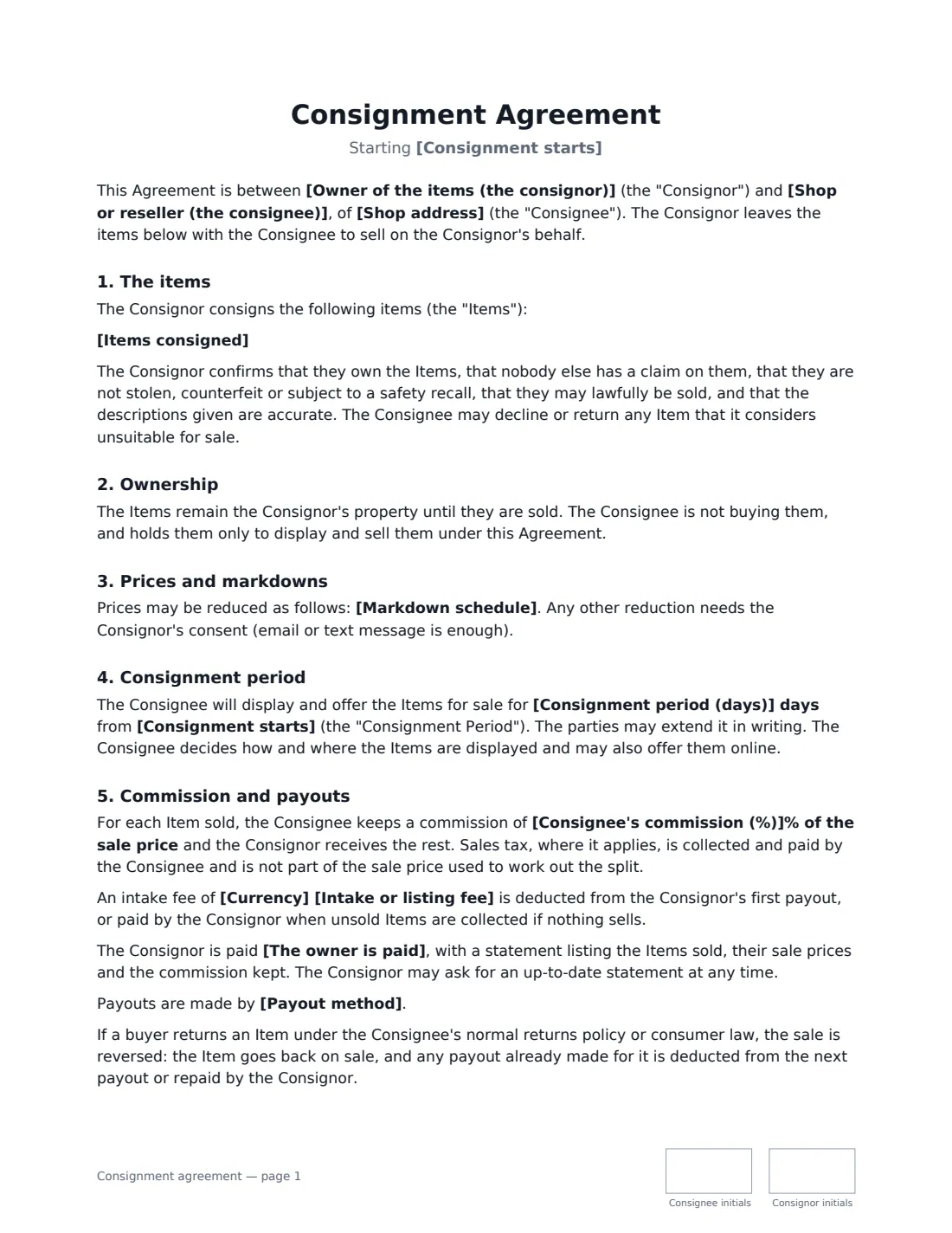
In a consignment arrangement the owner of an item (the consignor) leaves it with a shop, gallery or reseller (the consignee), who displays and sells it and keeps a share of the sale price. The owner keeps ownership until the item sells. It's common for furniture, vintage and designer clothing, art, antiques, musical instruments and sports equipment — and without a written agreement, disagreements about prices, payouts and unsold items are common too.
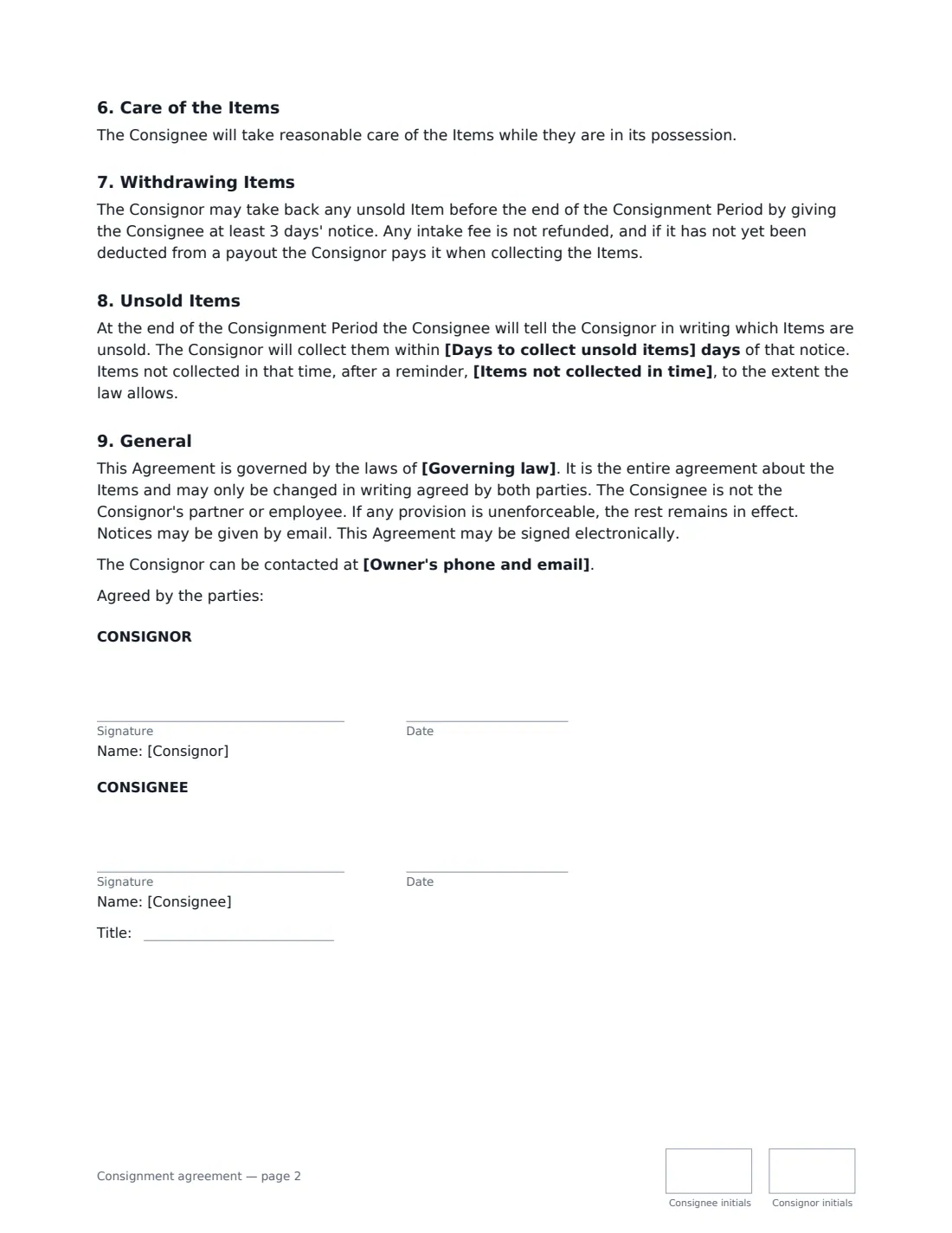
This template lists the items with their condition and agreed prices, and lets you choose who sets prices and whether there's a markdown schedule (otherwise the shop can't cut a price once an item is on sale without the owner's consent). It sets the consignment period, the commission percentage, any intake fee, when and how the owner is paid, and what happens when a buyer returns an item. You choose who carries the risk of loss or damage in the shop, and what happens to items the owner doesn't collect at the end. The owner confirms they own the items and may lawfully sell them.
- Best for
- Consignment and resale shops, galleries, vintage and furniture stores, private owners
- Signed by
- The owner (consignor) and the shop (consignee)
- Money terms
- Commission %, optional intake fee, payout schedule, statements on request
- Length
- About 2 pages, initialled on every page
When to Use a consignment agreement
- A resale boutique taking in designer clothing, handbags or shoes
- A furniture or antiques shop selling pieces for private owners
- A gallery showing and selling an artist's work on commission
- A music or sports shop selling second-hand equipment for customers
- An owner leaving items with a local shop while moving house
What You Fill In
18 blanks, then the name and email of each person who signs: consignee, consignor.
1 The parties
- Shop or reseller (the consignee)*
- Shop address
- Owner of the items (the consignor)*
- Owner's phone and email
2 The items
- Items consigned*
- Selling prices are* the prices listed above · set by the Consignee after consulting the Consignor · set by the Consignee at its discretion
- Markdown schedule
3 Period
- Consignment starts*
- Consignment period (days)*
4 Money
- Consignee's commission (%)*
- Currency*
- Intake or listing fee
- The owner is paid* within 14 days after each sale · within 30 days after each sale · once a month, for the previous month's sales · at the end of the consignment period
- Payout method
5 Unsold items and risk
- Loss or damage in the shop* the Consignee is responsible · the items are at the Consignor's own risk
- Days to collect unsold items*
- Items not collected in time* become the Consignee's property · are donated to charity by the Consignee
- Governing law*
6 Who signs
- Consignee signature and date, job title, initials on every page · The shop, gallery or reseller that displays and sells the items.
- Consignor signature and date, initials on every page · The owner of the items being sold.
What the consignment agreement Covers
- The items
- Ownership
- Prices and markdowns
- Consignment period
- Commission and payouts
- Care of the Items
- Withdrawing Items
- Unsold Items
- General
Using the consignment agreement, step by step
1 List the items
One per line: what it is, its condition (with any flaws) and the agreed price. For a long list, write "See the attached item list" and attach it to the envelope.
2 Decide pricing and markdowns
Choose whether the listed prices apply or the shop sets them. If you use a markdown schedule — for example 20% off after 30 days — write it in; otherwise any reduction needs the owner's consent.
3 Set the split and payouts
Enter the shop's commission percentage and any intake fee, then pick when the owner is paid. Each payout comes with a statement of what sold, for how much and the commission kept.
4 Agree the end of the period
Set the consignment period, how many days the owner has to collect unsold items after notice, and what happens to items left behind. Then add both signers and send.
Tips Before You Send It
- Photograph each item on intake and keep the photos with the signed agreement in Files.
- Choose the loss-or-damage option deliberately — the default makes the shop responsible for items in its care.
- Rules on abandoned property can require extra notice before uncollected items become the shop's. Check local rules.
- Sales tax is kept out of the split: the commission is worked out on the sale price before tax.
Sign It Online In Minutes
- Fill in the blanks. Names, dates and amounts go straight into the agreement — the preview shows exactly where.
- Name who signs. Tick “This is me” for your own part. VergeHR builds the PDF with every signature, date and initials box on the right line, and you can check or move anything before sending.
- Send it. Each signer gets a secure link and signs from any device — no account needed. The signed PDF, with an audit trail and a Certificate of Completion, is filed in Files and emailed to everyone.
Consignment agreement: frequently asked questions
Who owns consigned items?
The owner (consignor) does, until each item is sold. The shop holds them only to display and sell them under the agreement.
What commission is normal for consignment?
It varies widely by type of goods and shop, so the template leaves it as a blank you fill in. Agree it before intake and write it into the agreement.
What happens if an item is stolen from the shop?
You choose. With the default, the shop pays the owner what they would have received had the item sold at its current price. The alternative leaves items at the owner's risk, with the shop responsible only for its own negligence.
Can a consignment agreement be signed electronically?
Yes. Electronic signatures are generally valid for ordinary contracts like this in the US (ESIGN Act and UETA), the UK, the EU (eIDAS) and Canada. VergeHR keeps an audit trail and a Certificate of Completion with the signed PDF.