

What is a artwork loan agreement?
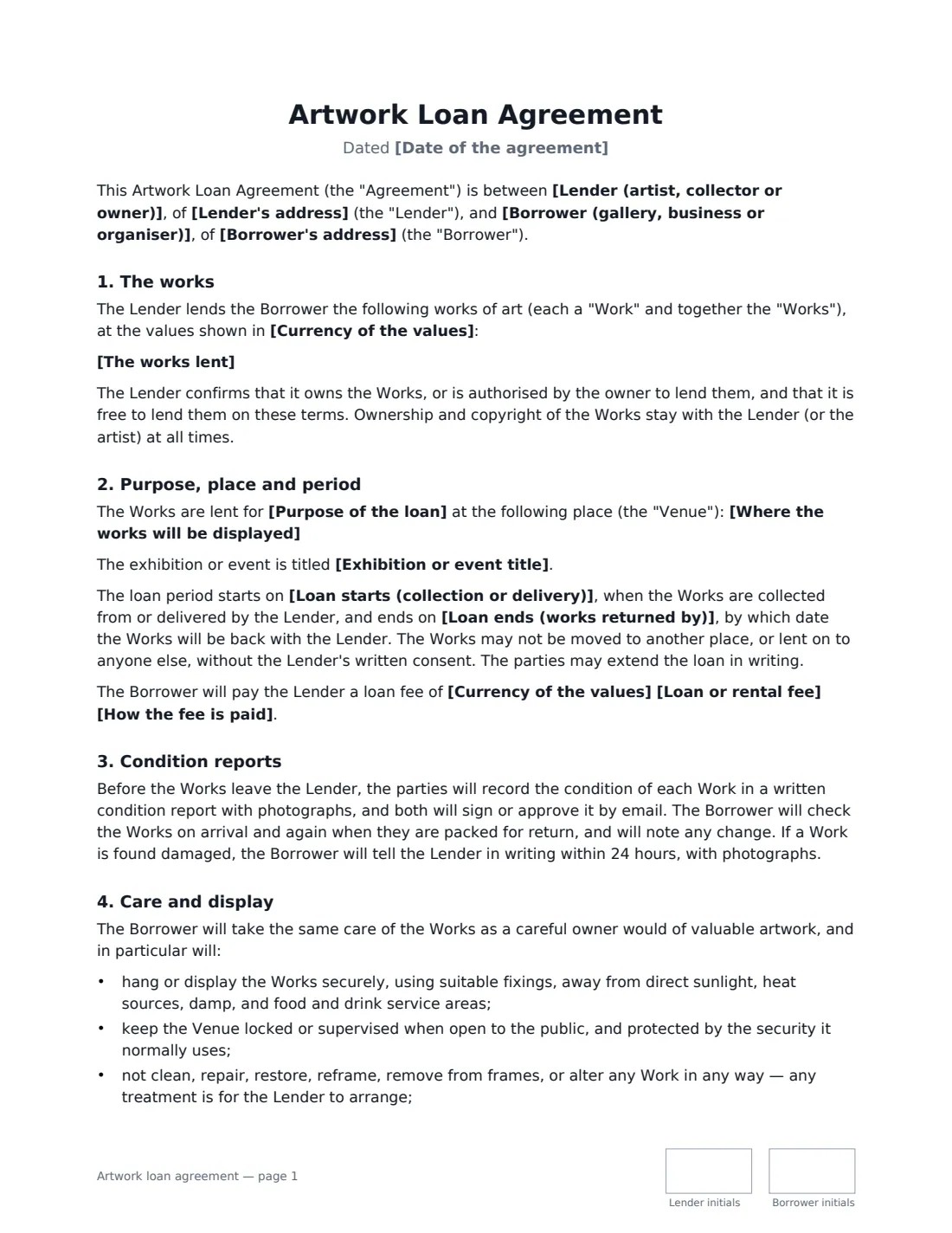
An artwork loan agreement is what an artist or collector signs with whoever is borrowing their work — a gallery for an exhibition, a company hanging art in its offices, a café or restaurant showing local artists, or a production borrowing pieces for a shoot. It records exactly which works are lent and what each is worth, and puts the borrower on the hook for looking after them, insuring them and giving them back.
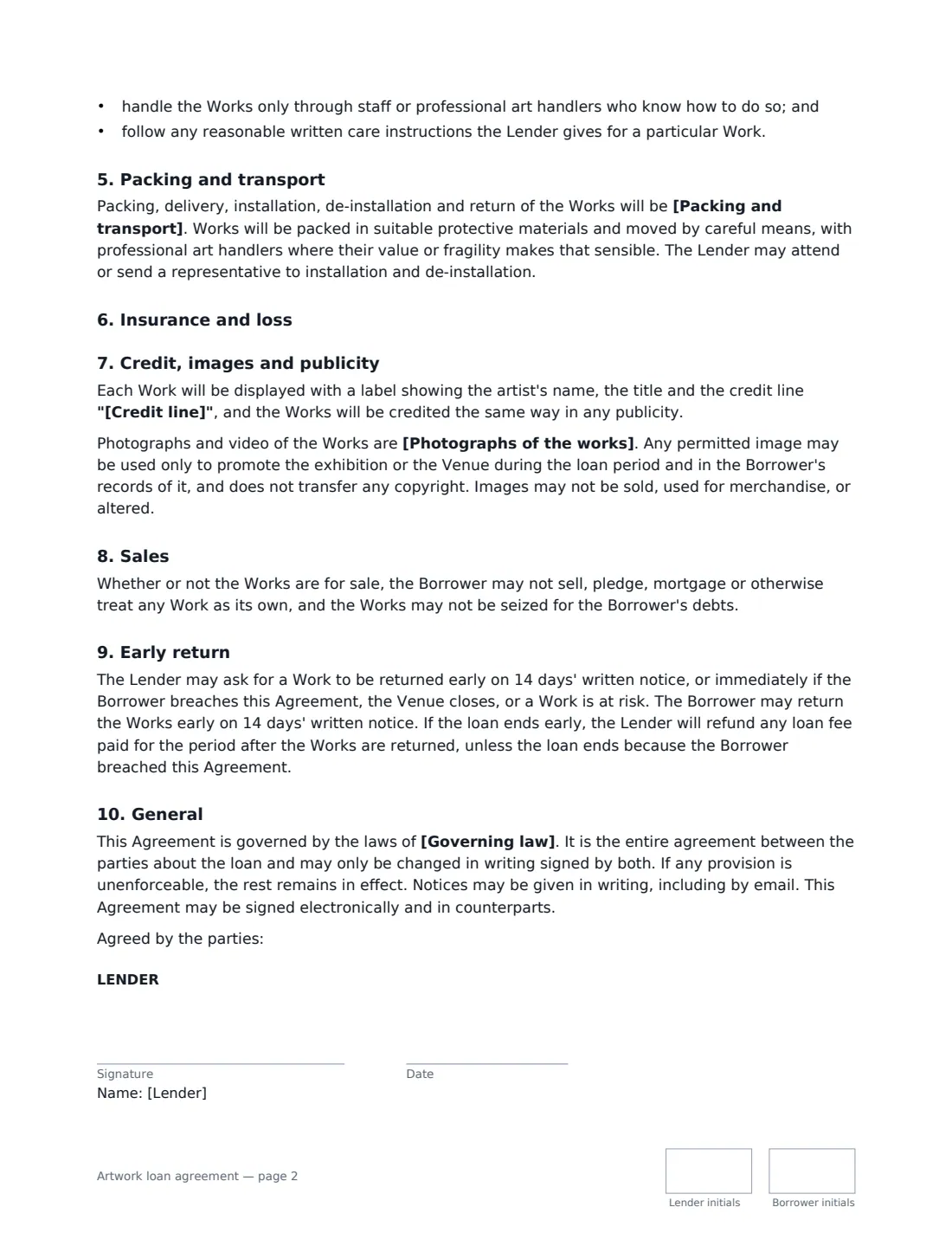
This template covers the list of works with their values, the purpose, venue and loan period, signed condition reports at the start and end, rules for care and display, packing and transport (who arranges and pays), insurance — either the borrower insures "nail to nail" or the lender keeps its own cover — responsibility for loss or damage, the credit line and photography rules, whether the works can be sold (with the borrower's commission), and early return.
- Best for
- Exhibitions, office and corporate art, cafés and restaurants, shoots and film sets
- Signed by
- The lender (artist or owner) and the borrower
- Insurance
- Borrower insures nail to nail, or the lender keeps its own policy
- Length
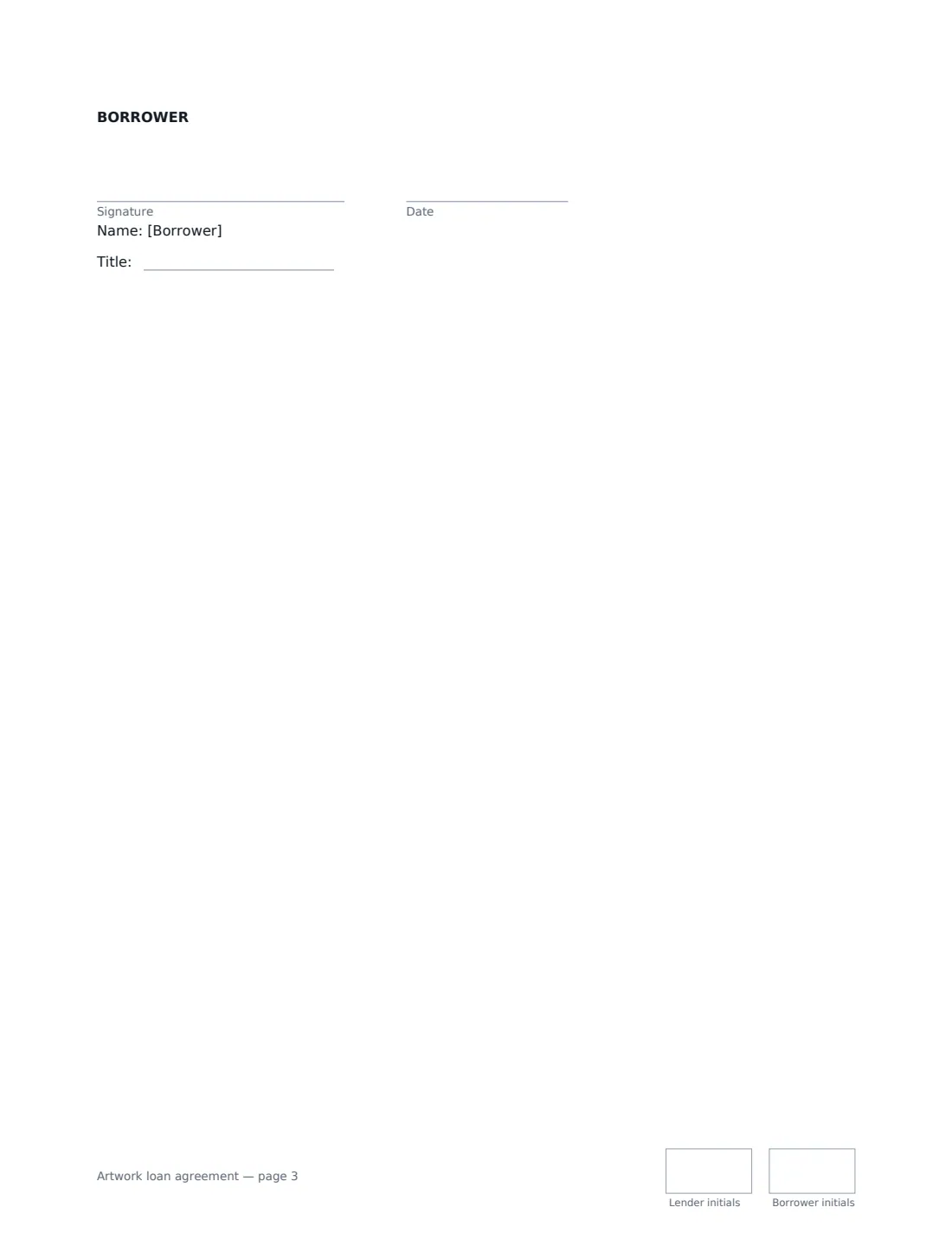
- 3 pages, initialled on every page
When to Use a artwork loan agreement
- An artist lending work to a gallery or group exhibition
- A collector lending pieces to a museum or charity show
- A company borrowing art to hang in its offices or reception
- A café, restaurant or hotel showing a local artist's work, with sales on commission
- A production borrowing artwork to dress a set or photo shoot
What You Fill In
21 blanks, then the name and email of each person who signs: lender, borrower.
1 The parties
- Date of the agreement*
- Lender (artist, collector or owner)*
- Lender's address
- Borrower (gallery, business or organiser)*
- Borrower's address
2 The works
- The works lent*
- Currency of the values*
3 The loan
- Purpose of the loan* an exhibition · display in the Borrower's offices or premises · display in a café, restaurant or shop · a photo shoot or film set
- Exhibition or event title
- Where the works will be displayed*
- Loan starts (collection or delivery)*
- Loan ends (works returned by)*
- Loan or rental fee
- How the fee is paid
4 Care and insurance
- Packing and transport* arranged and paid for by the Borrower · arranged and paid for by the Lender · arranged by the Borrower, with the cost shared equally
- Insurance* the Borrower insures the works "nail to nail" · the Lender keeps the works on its own insurance
5 Credit and sales
- Photographs of the works* allowed for promotion, with credit · allowed for press only, with the Lender's approval · not allowed
- Credit line*
- Can visitors buy the works?* No — the works are not for sale · Yes — the Borrower may take enquiries and earn commission
- Borrower's commission on a sale (%)
6 Other terms
- Governing law*
7 Who signs
- Lender signature and date, initials on every page · The artist, collector or owner lending the works.
- Borrower signature and date, job title, initials on every page · The gallery, business or organiser displaying the works.
What the artwork loan agreement Covers
- The works
- Purpose, place and period
- Condition reports
- Care and display
- Packing and transport
- Insurance and loss
- Credit, images and publicity
- Sales
- Early return
- General
Using the artwork loan agreement, step by step
1 List the works and their values
Put each work on its own line with artist, title, year, medium, size and value. The value is what the borrower insures and what it pays if the work is lost, so agree it realistically.
2 Set the purpose, venue and dates
Choose the purpose, add the venue address and, for an exhibition, its title. The loan runs from collection or delivery to the date the works must be back with the lender. Add a loan fee if there is one.
3 Decide transport and insurance
Choose who arranges and pays for packing and transport, and whether the borrower insures the works nail to nail (from the lender's wall and back again) or the lender keeps them on its own policy.
4 Credit, photos and sales
Write the credit line for labels and publicity, choose what photography is allowed, and say whether the works are for sale. If they are, set the borrower's commission — the lender sets the prices and the sale is between the lender and the buyer.
5 Send and do the condition report
Send the agreement for signature, then photograph and record the condition of each work before it leaves. Both parties approve the condition report.
Tips Before You Send It
- Take dated photos of every work, front and back, before it leaves — the condition report is your best evidence if something is damaged.
- If the borrower insures, get the certificate of insurance before the works are collected, not after.
- Agree values with any sale prices in mind — insuring for less than the price you'd sell for leaves you out of pocket if a work is lost.
- For work shown in public spaces like cafés, check the venue's security and keep works away from kitchens, heaters and direct sunlight.
Sign It Online In Minutes
- Fill in the blanks. Names, dates and amounts go straight into the agreement — the preview shows exactly where.
- Name who signs. Tick “This is me” for your own part. VergeHR builds the PDF with every signature, date and initials box on the right line, and you can check or move anything before sending.
- Send it. Each signer gets a secure link and signs from any device — no account needed. The signed PDF, with an audit trail and a Certificate of Completion, is filed in Files and emailed to everyone.
Artwork loan agreement: frequently asked questions
What does "nail to nail" insurance mean?
Cover that starts when a work comes off the lender's wall (or out of storage), continues through packing, transport and display, and ends only when it is back in place. It avoids gaps while works are in transit.
Who pays if a work is damaged?
It depends on the insurance option you choose. If the borrower insures nail to nail, the borrower is responsible for loss or damage during the loan, up to the work's listed value, unless it was caused by the lender, an inherent defect, or events outside the borrower's control that insurance wouldn't cover. If the lender keeps its own insurance, the lender claims on its policy first, and the borrower pays only for loss or damage caused by its own fault or breach that the insurance doesn't cover, including the excess. Damage is measured as the cost of restoration by the lender's chosen conservator plus any loss in value.
Can the borrower sell the artwork?
Only if you choose that the works are for sale. The borrower can then show prices and take enquiries, but can't change the price, and earns the commission you set once the buyer has paid in full.
Is an artwork loan agreement signed online valid?
In most countries, including the US (ESIGN Act and UETA), the UK, the EU (eIDAS) and Canada, an electronic signature is generally valid for an ordinary commercial contract like this one. VergeHR keeps an audit trail and a Certificate of Completion with the signed PDF as evidence of who signed and when.
Is this template free?
Yes. The template is free to use with the eSignature app in VergeHR, and the people you send it to don't need a VergeHR login to sign.