


What is a event code of conduct?
A code of conduct tells everyone at your event what behaviour is expected and what will not be tolerated, and — crucially — how to get help if something goes wrong. Publishing one is good practice; asking speakers, exhibitors, volunteers and attendees to sign it means nobody can later say they didn't know the rules, and gives your team a clear basis for acting quickly.
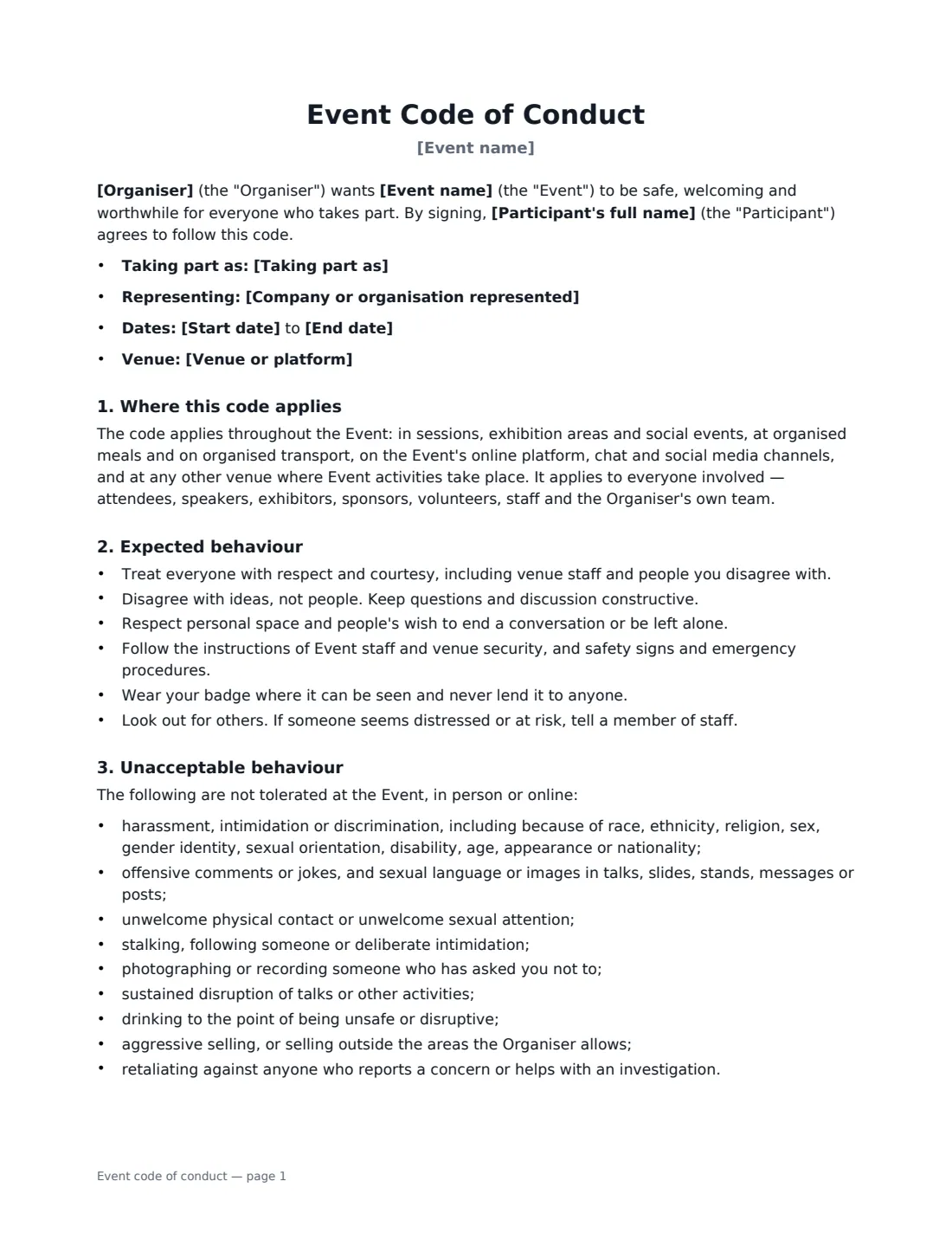
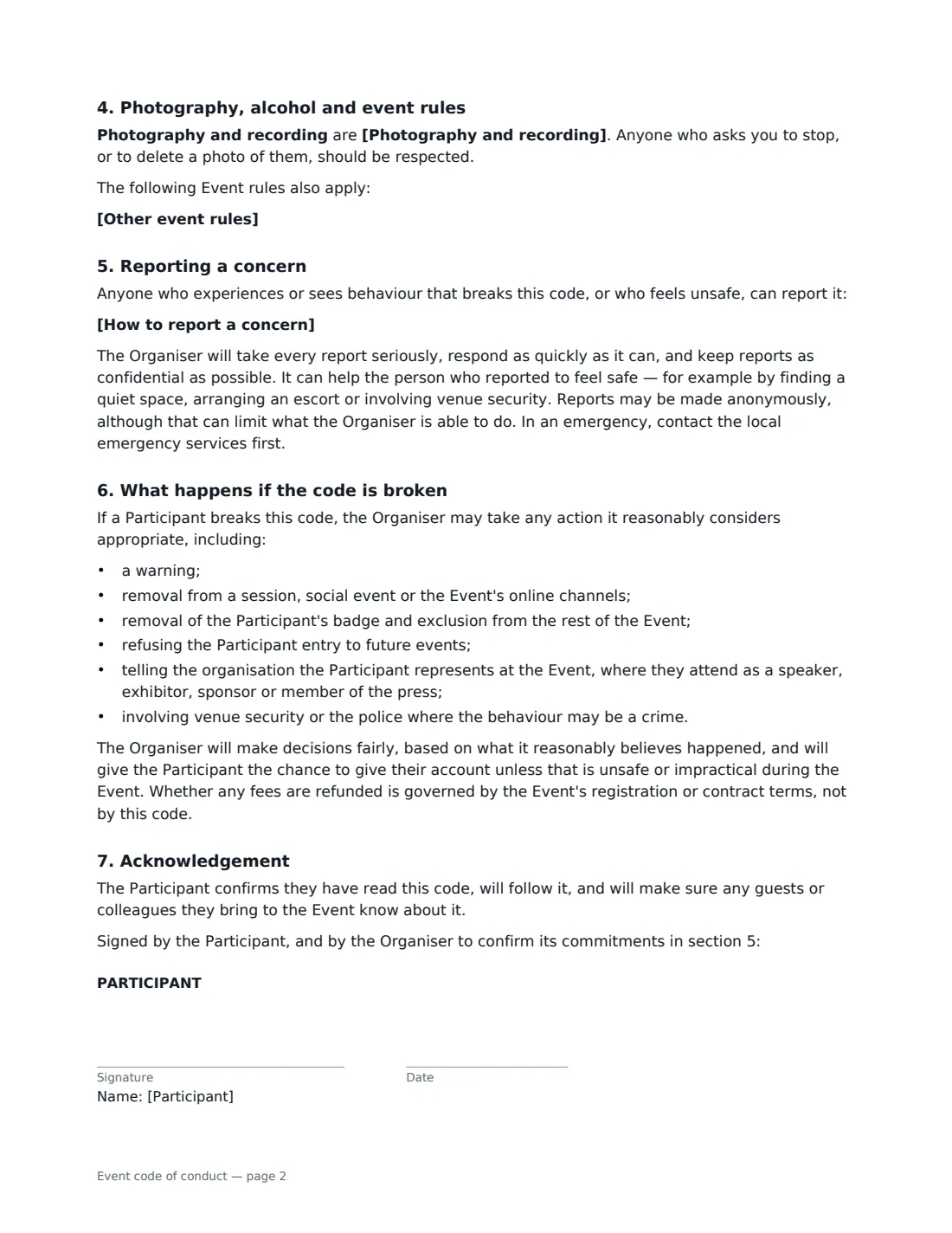
This template covers where the code applies (sessions, exhibition areas, socials, organised travel and online channels), expected behaviour, a list of unacceptable behaviour including harassment, unwelcome contact, recording people who have said no, and retaliation against reporters, and your rules on photography and alcohol. It adds role-specific commitments for speakers, exhibitors, sponsor representatives, volunteers and members of the press, depending on who is signing. You fill in how to report a concern; the organiser commits to taking reports seriously and keeping them confidential, and the code sets out the actions you may take — from a warning to removal from the event or involving the police — with a fair-process promise.
- Best for
- Conferences, meetups, trade shows, festivals, hackathons and online events
- Signed by
- The participant and someone from the event team
- Participant types
- Attendee, speaker, exhibitor, sponsor representative, volunteer or press
- Length
- 2–3 pages
When to Use a event code of conduct
- Speakers confirming their talks and slides will follow the code
- Exhibitors agreeing on behalf of everyone who works on their stand
- Volunteers and crew who will be the first point of contact for reports
- Community meetups and hackathons with a mix of in-person and online spaces
- Invite-only events, retreats or trips where attendees sign before they arrive
What You Fill In
12 blanks, then the name and email of each person who signs: participant, organiser.
1 The event
- Organiser*
- Event name*
- Start date*
- End date
- Venue or platform
2 The participant
- Participant's full name*
- Taking part as* Attendee · Speaker · Exhibitor · Sponsor representative · Volunteer · Member of the press
- Company or organisation represented
3 Reporting
- How to report a concern*
4 Event rules
- Photography and recording* allowed in public areas, but never of anyone who asks you not to · not allowed in sessions without the speaker's permission, and never of anyone who asks you not to · not allowed anywhere at the Event without the Organiser's permission
- Alcohol* Served at some parts of the event · The event is alcohol-free
- Other event rules
5 Who signs
- Participant signature and date · The attendee, speaker, exhibitor, sponsor representative or volunteer agreeing to the code.
- Organiser signature and date, job title · Someone from the event team.
What the event code of conduct Covers
- Where this code applies
- Expected behaviour
- Unacceptable behaviour
- Photography, alcohol and event rules
- Reporting a concern
- What happens if the code is broken
- Acknowledgement
Using the event code of conduct, step by step
1 Describe the event
Enter the event name, dates and venue or platform. Leave the end date empty for a one-day event.
2 Say how to report a concern
This is the most important blank. Give a person to find ("anyone in a red Staff lanyard"), a phone number that is answered throughout the event, and an email. It prints in its own section so it is easy to find.
3 Set photography and alcohol rules
Choose whether photography is allowed in public areas, restricted in sessions, or not allowed without permission, and whether alcohol is served or the event is alcohol-free. Add any other rules, one per line.
4 Choose the participant type and send
Pick attendee, speaker, exhibitor, sponsor representative, volunteer or press — the matching commitments appear automatically. Send it to each participant; you countersign for the organiser.
Tips Before You Send It
- Publish the same code on your website and in the event app, so attendees who don't sign it still see it.
- Brief your staff and volunteers on how to take a report and who to escalate to before doors open.
- Ask exhibitors to sign before the event so they can brief their own stand staff.
- Refunds for removed participants are governed by your registration terms, not this code — make sure those terms cover it.
Sign It Online In Minutes
- Fill in the blanks. Names, dates and amounts go straight into the agreement — the preview shows exactly where.
- Name who signs. Tick “This is me” for your own part. VergeHR builds the PDF with every signature, date box on the right line, and you can check or move anything before sending.
- Send it. Each signer gets a secure link and signs from any device — no account needed. The signed PDF, with an audit trail and a Certificate of Completion, is filed in Files and emailed to everyone.
Event code of conduct: frequently asked questions
Do attendees have to sign a code of conduct?
Many events simply publish the code and make agreeing to it a condition of registration. Getting a signature is most useful for speakers, exhibitors, sponsors, volunteers and small or higher-risk events, where you want a clear record.
Can someone report anonymously?
Yes. The code says reports may be made anonymously, while explaining that this can limit what the organiser is able to do.
What can the organiser do if the code is broken?
The code lists actions from a warning, through removal from a session or the event, to refusing entry to future events and involving venue security or the police where the behaviour may be a crime. The organiser commits to acting fairly and hearing the participant's account where it is safe and practical.
Is an electronic signature valid?
Electronic signatures are generally valid for agreements like this in the US (ESIGN Act and UETA), the UK, the EU (eIDAS) and Canada. VergeHR keeps an audit trail and a Certificate of Completion with the signed PDF.