

What is a flexible working agreement?
Once a manager and employee agree a new working pattern, it should be written down: exactly which days and hours, whether pay changes, whether it's a trial, and whether it's permanent or temporary. That avoids the slow drift where nobody remembers what was agreed, and it gives both sides a clear way to review or end the arrangement.
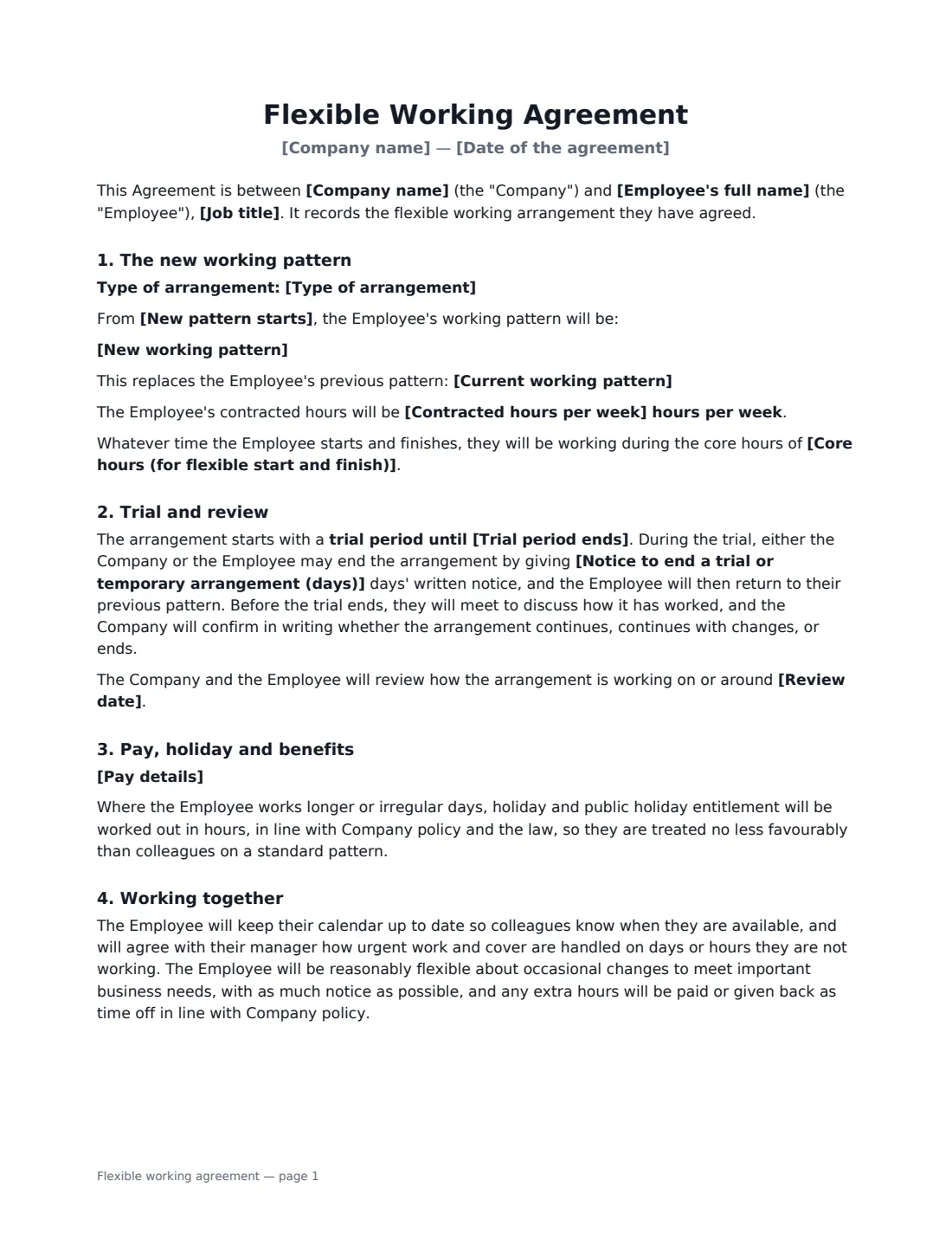
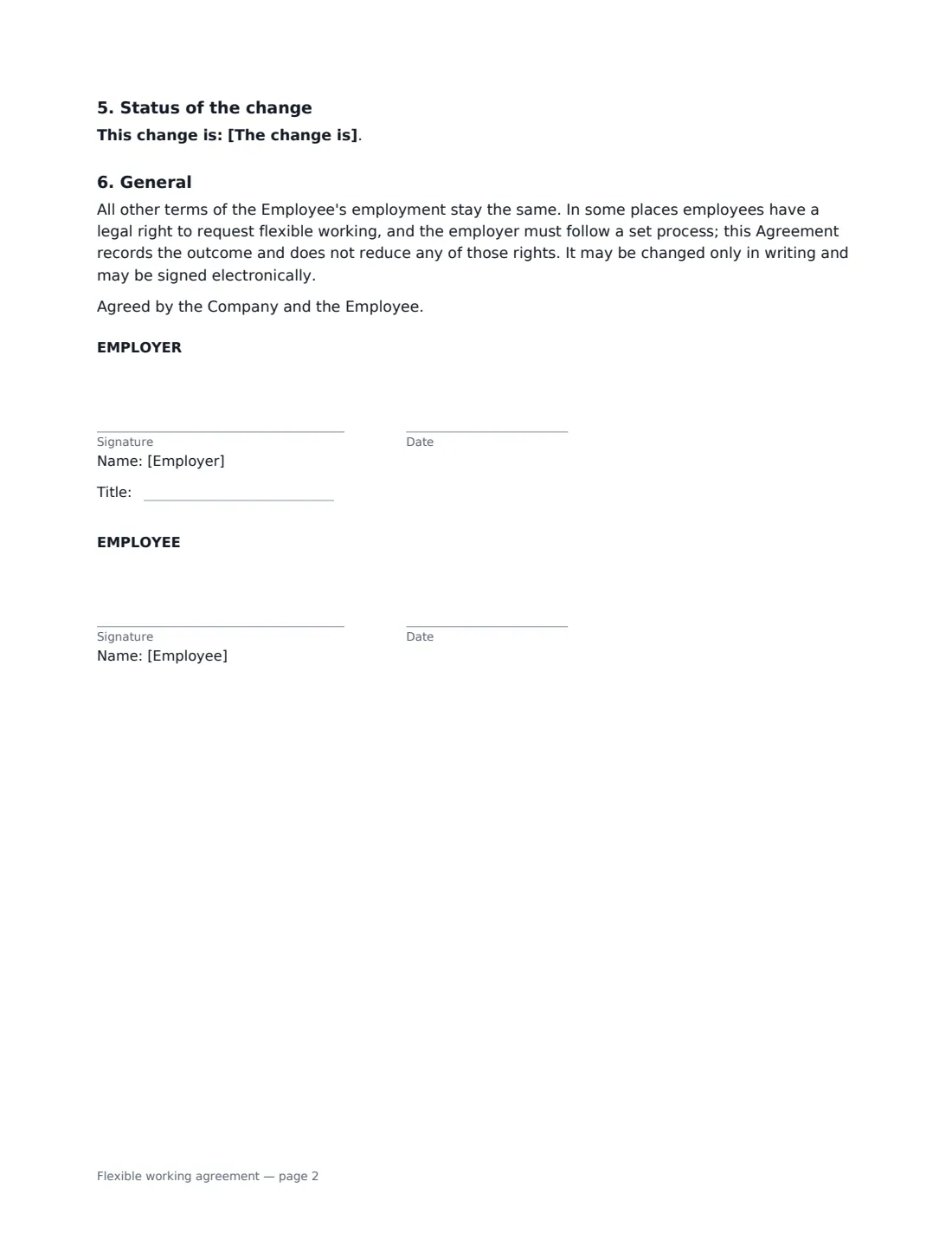
This agreement records the type of arrangement, the start date, the new pattern (and the one it replaces), weekly contracted hours and any core hours. For a compressed week it adds rest-break and working-time wording. You can add a trial period that either side can end with notice, a review date, and choose whether pay and benefits stay the same or adjust in proportion to the new hours, with holiday worked out in hours. Finally, you choose a permanent change to the contract or a temporary arrangement with an end date. It notes that in some places employees have a legal right to request flexible working, and that the agreement doesn't reduce it.
- Best for
- Compressed weeks, flexitime, different working days or reduced hours
- Signed by
- The employer and the employee
- Trial and duration
- Optional trial; permanent or temporary with an end date
- Length
- About 2 pages
When to Use a flexible working agreement
- A four-day compressed week of longer days
- Starting and finishing earlier to fit school pick-ups, within core hours
- Moving from Monday-Friday to Tuesday-Saturday
- Dropping to four days a week with pay adjusted pro rata
- A temporary flexible pattern during a course of study or caring period
What You Fill In
17 blanks, then the name and email of each person who signs: employer, employee.
1 The parties
- Company name*
- Date of the agreement*
- Employee's full name*
- Job title
2 The new pattern
- Type of arrangement* Compressed working week · Flexible start and finish times · Different working days · Reduced hours · Other flexible pattern
- New pattern starts*
- New working pattern*
- Current working pattern
- Contracted hours per week
- Core hours (for flexible start and finish)
3 Pay
- Effect on pay and benefits* No change · Adjusted in proportion to the new hours
- Pay details
4 Trial and duration
- Trial period ends
- The change is* Permanent · Temporary
- Temporary arrangement ends
- Notice to end a trial or temporary arrangement (days)*
- Review date
5 Who signs
- Employer signature and date, job title · The manager or HR person agreeing the change
- Employee signature and date · The employee whose schedule changes
What the flexible working agreement Covers
- The new working pattern
- Trial and review
- Pay, holiday and benefits
- Working together
- Status of the change
- General
Using the flexible working agreement, step by step
1 Describe the new pattern
Pick the type of arrangement and the start date, then write the days and times — including breaks. Add the current pattern, weekly hours and core hours if they help.
2 Decide the pay effect
Choose no change, or pay and benefits adjusted in proportion to the new hours, and add the figures if you like (for example, salary from 52,000 to 41,600 for 32 of 40 hours).
3 Set a trial and review
Add a trial end date if you want to test the arrangement first; either side can end it during the trial with the notice you set. Add a review date for later.
4 Choose permanent or temporary, and send
A permanent change updates the employment contract after any trial. A temporary one ends on the date you enter. Send it to the employee to sign.
Tips Before You Send It
- Where employees have a legal right to request flexible working, follow the required process and deadlines; this agreement records the outcome.
- For compressed weeks, check that the longer days stay within working-time and rest-break rules where you are.
- Work out holiday and public holidays in hours for irregular patterns, so the employee isn't short-changed.
- Agree how urgent work and cover are handled on days off before the arrangement starts.
Sign It Online In Minutes
- Fill in the blanks. Names, dates and amounts go straight into the agreement — the preview shows exactly where.
- Name who signs. Tick “This is me” for your own part. VergeHR builds the PDF with every signature, date box on the right line, and you can check or move anything before sending.
- Send it. Each signer gets a secure link and signs from any device — no account needed. The signed PDF, with an audit trail and a Certificate of Completion, is filed in Files and emailed to everyone.
Flexible working agreement: frequently asked questions
Is a flexible working agreement a change to the employment contract?
If you choose a permanent change, yes — after any trial period it becomes the employee's new terms. If you choose temporary, the employee returns to their previous pattern on the end date unless you both agree otherwise.
How does a trial period work?
During the trial either party can end the arrangement with the written notice you set, and the employee returns to their previous pattern. Before the trial ends you meet, and the company confirms in writing whether it continues, continues with changes, or ends.
Does pay change with flexible working?
Usually only if the total hours change. For a compressed week or flexible start times, pay usually stays the same. For reduced hours, pay, holiday and pay-related benefits are usually adjusted in proportion. You choose which applies.
Can I sign a flexible working agreement electronically?
Generally, yes. Electronic signatures are widely accepted for employment agreements in the US (ESIGN Act and UETA), the UK, the EU (eIDAS) and Canada.