

What is a joint purchase agreement?
A joint purchase agreement, or co-ownership agreement, is for two people who buy something together and share it: a boat, a camper van or caravan, a trailer, a ride-on mower, a hot tub, or expensive tools. Sharing makes the purchase affordable. It also raises questions nobody asks on the day you buy. Who gets the bank-holiday weekend? Who pays for the new engine? What happens when one of you wants out? This agreement answers them up front.
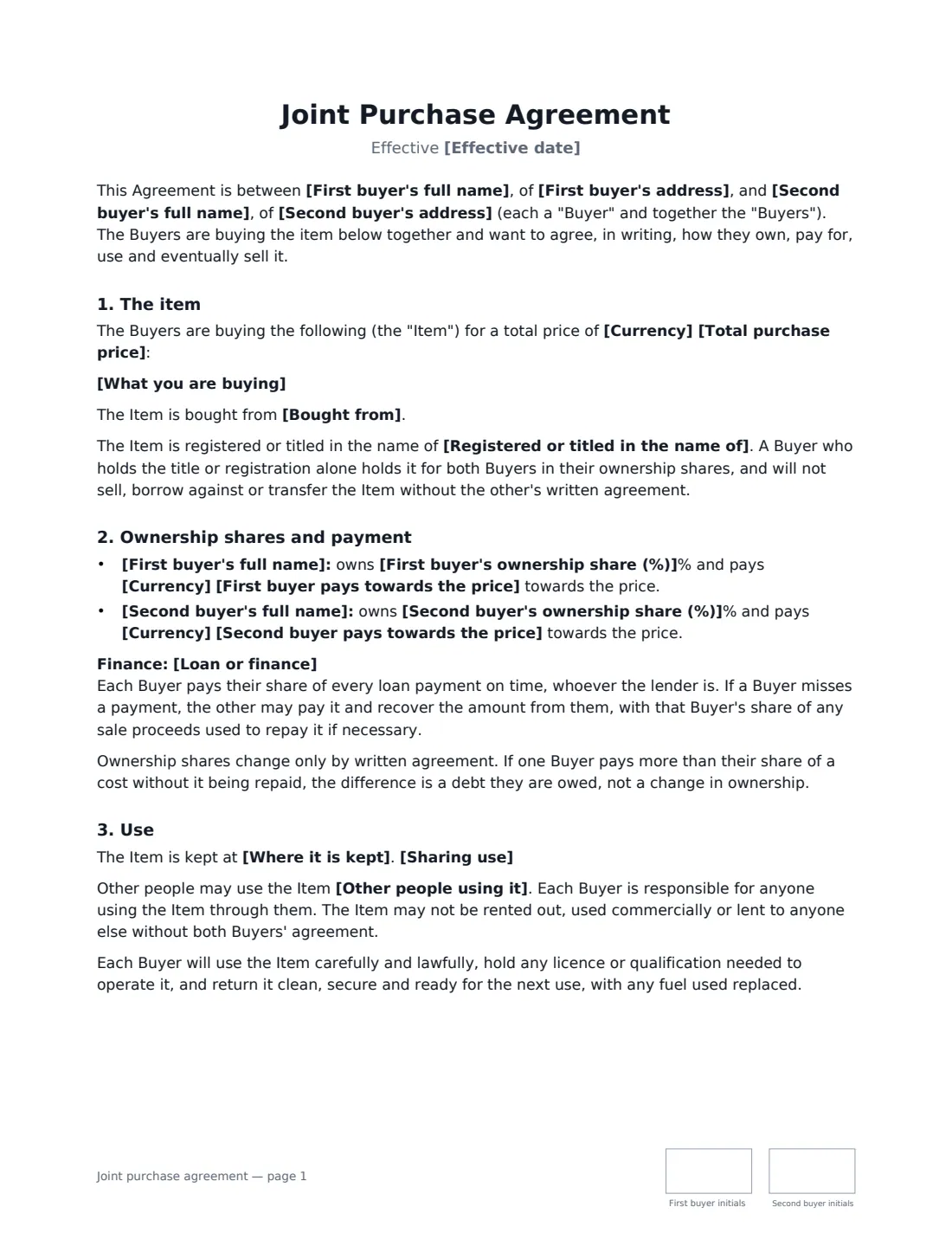
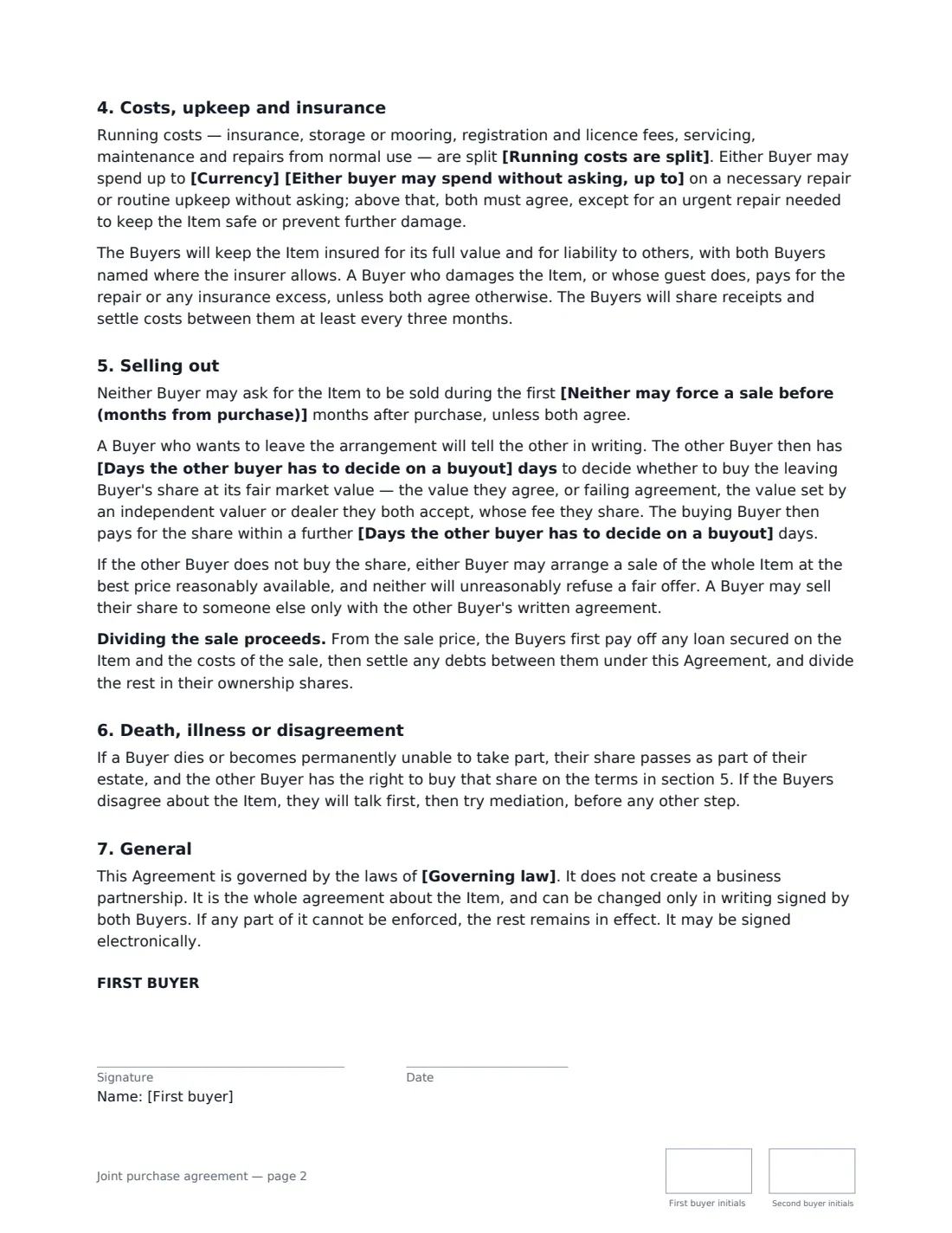
This template covers the item and price, whose name is on the title or registration (held for both if only one), ownership shares and what each pays, any loan and missed payments, where the item is kept, a booking pattern, guests and no commercial use, running costs and a repair spending limit, insurance and damage, an optional lock-in period, a buyout right at fair market value with an independent valuer, selling the whole item and dividing proceeds, death or incapacity, and mediation. Both buyers initial each page and sign.
- Best for
- Boats, caravans and camper vans, trailers, vehicles, garden machinery, tools and hobby equipment bought by two people
- Signed by
- Both buyers
- Exit
- Buyout at fair market value, or sale of the whole item with proceeds split by ownership share
- Length
- 2-3 pages, initialled on every page
When to Use a joint purchase agreement
- Two friends buying a small boat and sharing weekends
- Siblings buying a caravan or camper van for family holidays
- Neighbours sharing a trailer, log splitter or ride-on mower
- A parent and adult child buying a car together, with one name on the registration
- Hobby partners buying expensive equipment such as a kiln, telescope or 3D printer
What You Fill In
23 blanks, then the name and email of each person who signs: first buyer, second buyer.
1 The buyers
- First buyer's full name*
- First buyer's address
- Second buyer's full name*
- Second buyer's address
- Effective date*
2 The item
- What you are buying*
- Bought from
- Currency*
- Total purchase price*
- Registered or titled in the name of*
3 Shares and payment
- First buyer's ownership share (%)*
- Second buyer's ownership share (%)*
- First buyer pays towards the price*
- Second buyer pays towards the price*
- Loan or finance
4 Use and upkeep
- Where it is kept*
- Sharing use*
- Other people using it* only with a Buyer present · with a Buyer's permission, if they are insured to use it · not allowed
- Running costs are split* in proportion to the ownership shares · equally · by use for fuel and consumables, and by ownership share for everything else
- Either buyer may spend without asking, up to*
5 Selling out
- Days the other buyer has to decide on a buyout*
- Neither may force a sale before (months from purchase)
- Governing law*
6 Who signs
- First buyer signature and date, initials on every page
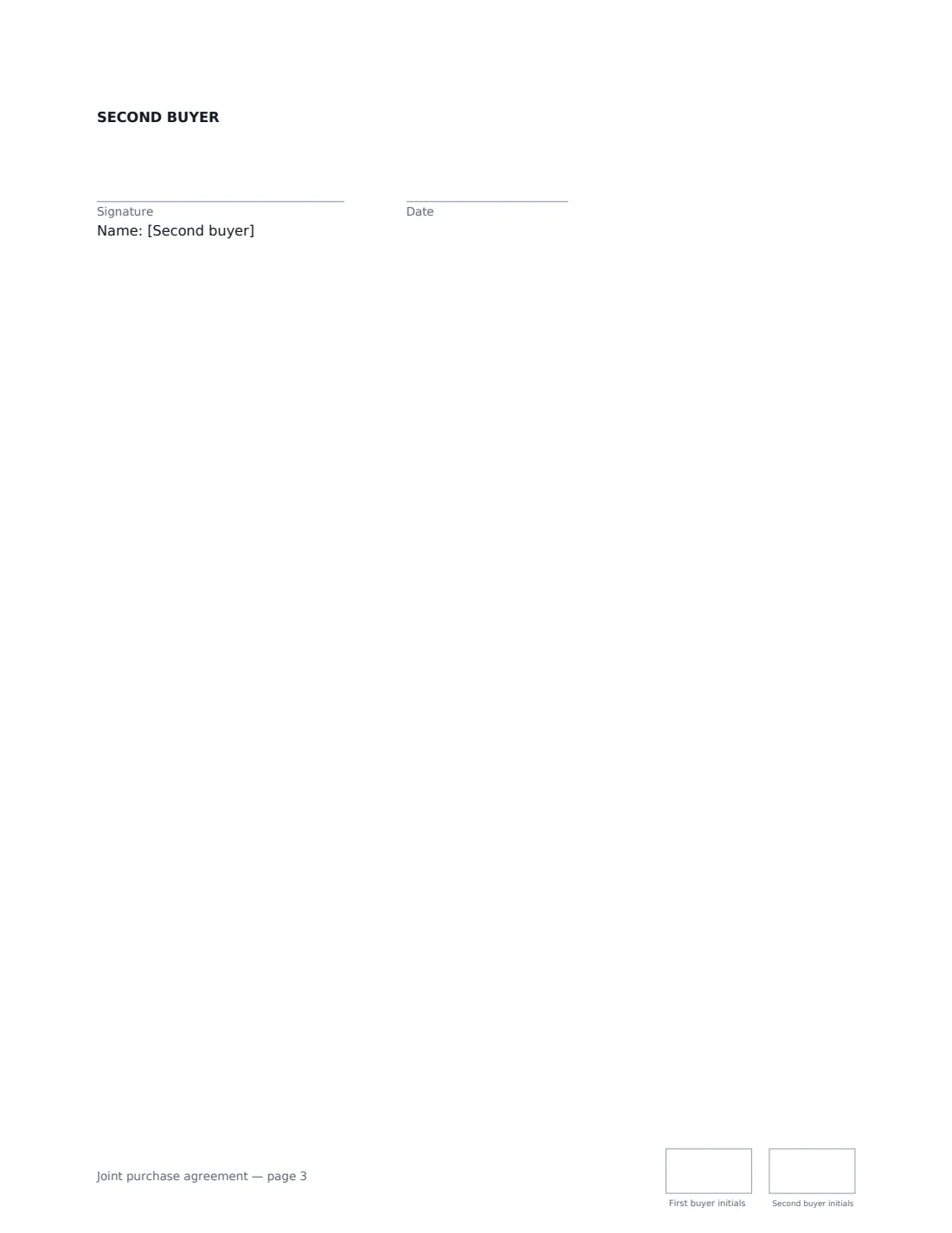
- Second buyer signature and date, initials on every page
What the joint purchase agreement Covers
- The item
- Ownership shares and payment
- Use
- Costs, upkeep and insurance
- Selling out
- Death, illness or disagreement
- General
Using the joint purchase agreement, step by step
1 Describe the item and the price
Describe exactly what you're buying, with make, model, year and any serial, hull, VIN or registration numbers, and list included accessories. Enter the seller and the total price. Say whose name the title or registration will be in. If only one name is allowed, the agreement says that person holds it for both.
2 Set shares and payments
Enter each buyer's ownership percentage and how much each pays towards the price. They don't have to match 50/50. If you're borrowing, describe the loan. Each buyer must pay their share of every loan payment, whoever the lender is.
3 Agree use and costs
Say where the item is kept and how you share its use, for example a shared calendar with a monthly limit each. Choose whether others may use it, how running costs are split, and how much either of you can spend on a repair without asking.
4 Plan the exit and sign
Set how many days the other buyer has to decide on a buyout and, if you like, a lock-in period before either can force a sale. Enter the governing law, add the other buyer as a signer and send. You both initial each page and sign.
Tips Before You Send It
- Put both names on the title or registration where the rules allow. If only one name is possible, this agreement records that it is held for both.
- Insure the item for its full value, with both of you named where the insurer allows.
- Keep a shared log of bookings, costs and repairs. It makes settling up every three months, as the agreement asks, quick.
- Agree how you'll value the item before you need to. A dealer's valuation or a recent sale listing is usually enough.
- The template is for two buyers. For a home or land bought together, use the property co-ownership agreement instead.
Sign It Online In Minutes
- Fill in the blanks. Names, dates and amounts go straight into the agreement — the preview shows exactly where.
- Name who signs. Tick “This is me” for your own part. VergeHR builds the PDF with every signature, date and initials box on the right line, and you can check or move anything before sending.
- Send it. Each signer gets a secure link and signs from any device — no account needed. The signed PDF, with an audit trail and a Certificate of Completion, is filed in Files and emailed to everyone.
Joint purchase agreement: frequently asked questions
What happens if one of us wants to sell?
The leaving buyer tells the other in writing. The other has the number of days you set to buy their share at fair market value, agreed or set by an independent valuer. If they don't, the whole item is sold. Any loan and sale costs are paid first, then debts between you are settled, and the rest is split by ownership share.
What if one of us doesn't pay their share of the costs?
The other can pay and recover the money. It counts as a debt owed to them, not a change in ownership, and it is settled from the defaulting buyer's share of the proceeds when the item is sold.
Does this make us business partners?
No. The agreement says it does not create a business partnership. It also rules out renting the item out or using it commercially unless you both agree. If you plan to earn money from it, look at a partnership agreement instead.
Is a co-ownership agreement signed online valid?
Electronic signatures are generally valid for ordinary agreements like this in the US (ESIGN Act and UETA), the UK, the EU (eIDAS) and Canada. VergeHR keeps an audit trail and a Certificate of Completion with the signed PDF as a record of who signed and when.
Is this template free?
Yes. The template is free to use with the eSignature app in VergeHR, and the people you send it to don't need a VergeHR login to sign.