

What is a property co-ownership agreement?
When two people buy property together, the deed usually says only that they both own it. It rarely says who put in more of the deposit, how the mortgage is split, who can live there, or what happens if one wants to sell and the other doesn't. A co-ownership agreement fills that gap before it becomes a dispute.
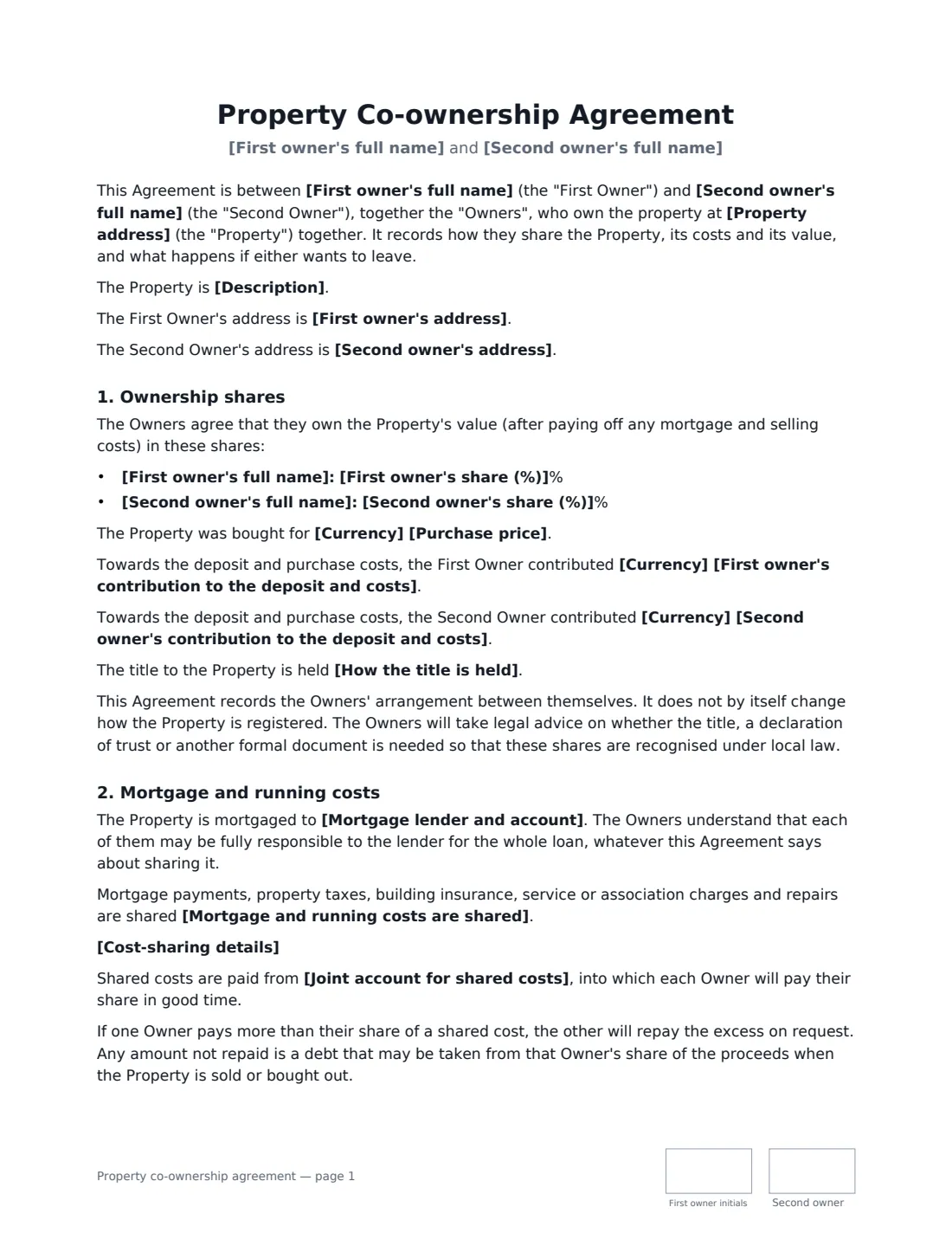
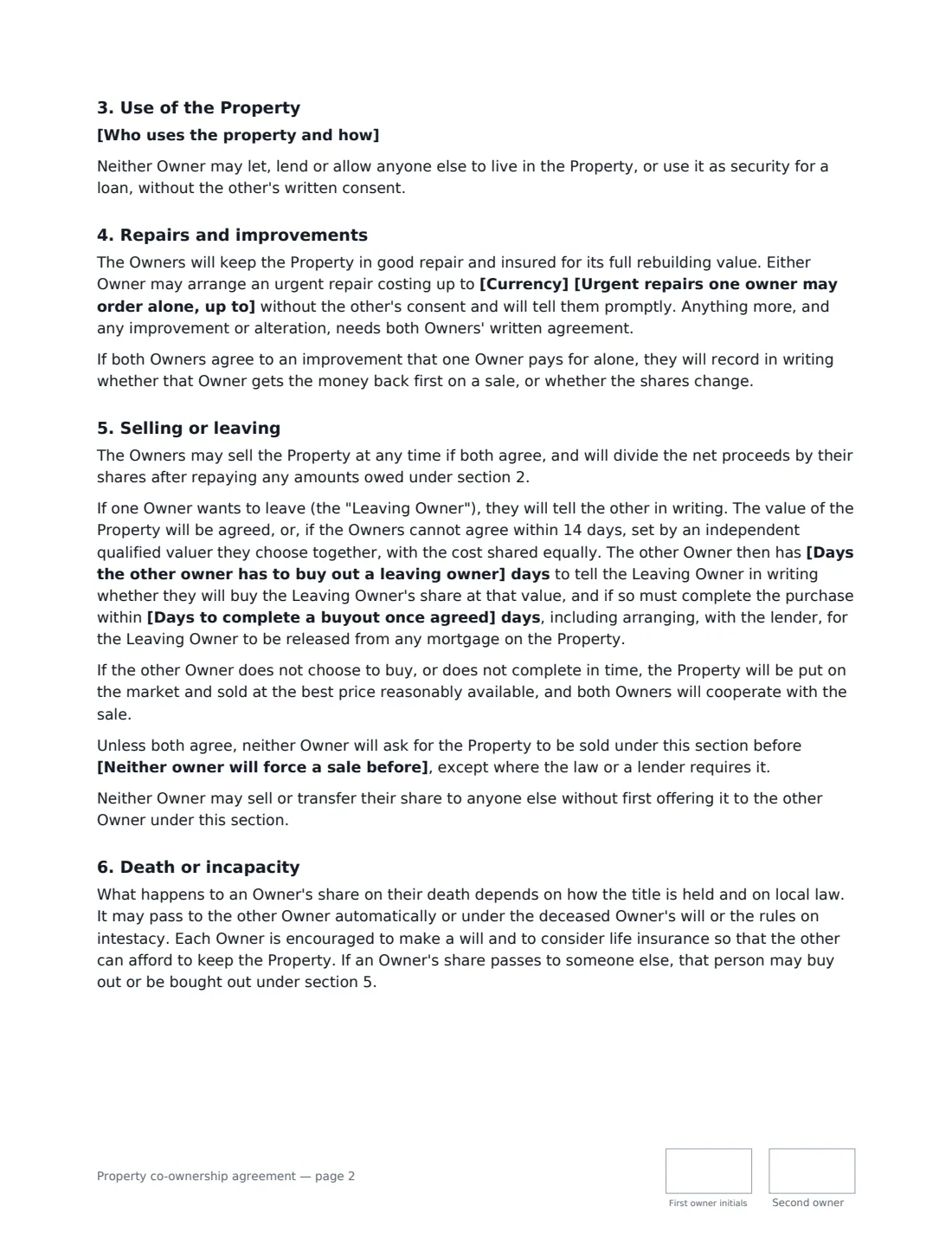
This template records each owner's percentage share and contributions, how mortgage payments and running costs are shared (by share, equally or your own split), how overpayments are settled, who uses the property and on what terms, urgent repairs one owner may order alone, a buy-out process with an independent valuation and deadlines, a sale if no buyout happens, an optional lock-in date, what happens on death, and mediation before court. It is explicit that it does not change how the title is registered — so you can pair it with the formal documents your local law needs.
- Best for
- Friends, siblings, parents and children, and unmarried couples who co-own property
- Signed by
- Both owners
- Key clause
- Buy-out at an independent valuation, then sale if no buyout completes
- Length
- About 3 pages, initialled on every page
When to Use a property co-ownership agreement
- Two friends buying a first home together with different deposits
- A parent helping an adult child buy, in return for a share of the value
- Siblings who inherited a family house and want to agree its use and sale
- An unmarried couple recording unequal contributions
- Co-owners of a holiday home sharing use and running costs
What You Fill In
23 blanks, then the name and email of each person who signs: first owner, second owner.
1 The owners
- First owner's full name*
- First owner's address
- Second owner's full name*
- Second owner's address
2 The property
- Property address*
- Description
- How the title is held
3 Shares
- Currency*
- Purchase price
- First owner's contribution to the deposit and costs
- Second owner's contribution to the deposit and costs
- First owner's share (%)*
- Second owner's share (%)*
4 Costs
- Mortgage lender and account
- Mortgage and running costs are shared* in proportion to the ownership shares · equally · as set out below
- Cost-sharing details
- Joint account for shared costs
5 Use
- Who uses the property and how*
- Urgent repairs one owner may order alone, up to*
6 Selling
- Days the other owner has to buy out a leaving owner*
- Days to complete a buyout once agreed*
- Neither owner will force a sale before
7 Other terms
- Governing law*
8 Who signs
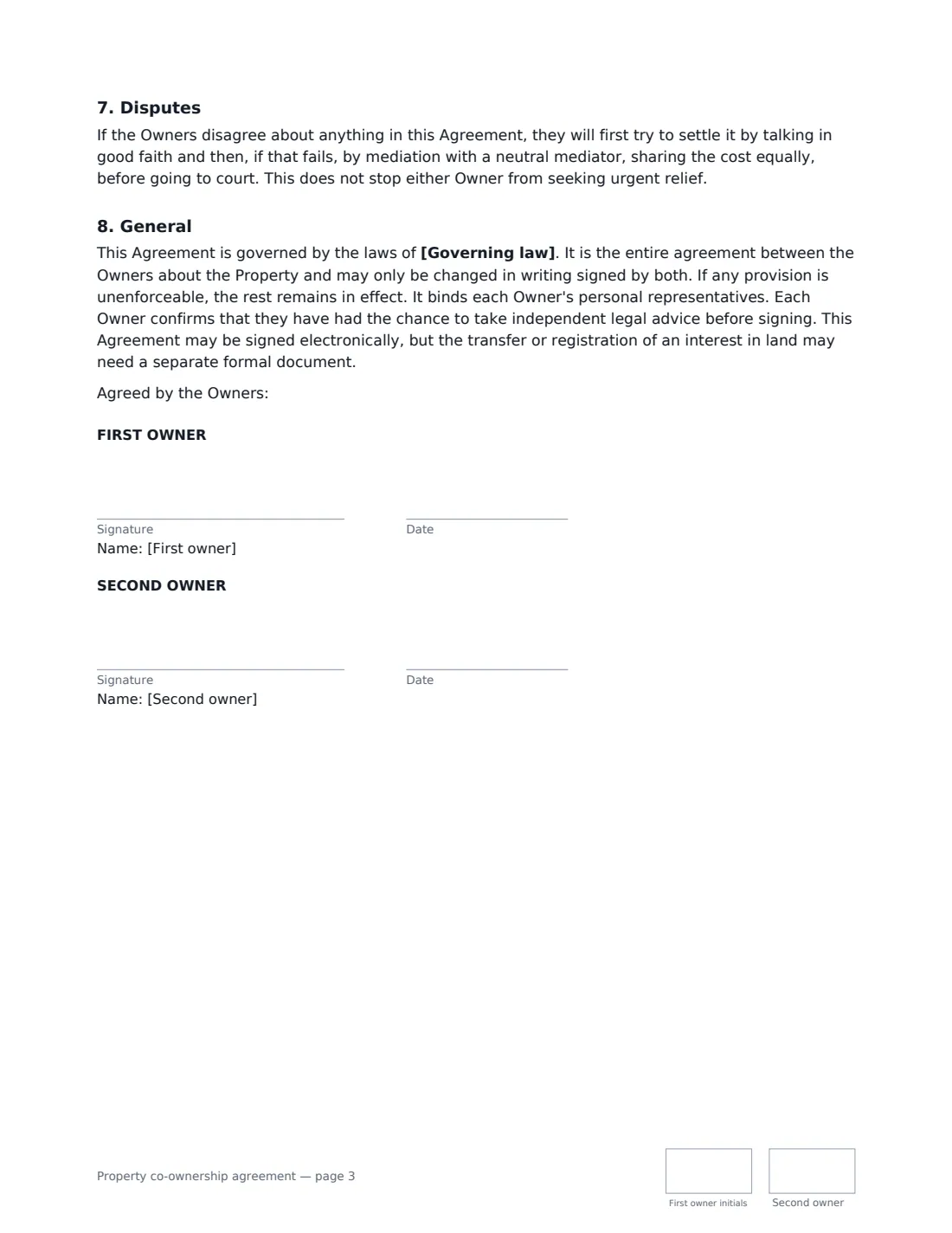
- First owner signature and date, initials on every page
- Second owner signature and date, initials on every page
What the property co-ownership agreement Covers
- Ownership shares
- Mortgage and running costs
- Use of the Property
- Repairs and improvements
- Selling or leaving
- Death or incapacity
- Disputes
- General
Using the property co-ownership agreement, step by step
1 Record the shares and contributions
Enter the purchase price, what each owner put towards the deposit and costs, and each owner's percentage share. The shares should add up to 100. Add how the title is held (for example as tenants in common) if you know.
2 Agree costs and use
Choose whether the mortgage and running costs are split by share, equally, or in a way you describe. Add the joint account you'll pay from, and describe who lives at the property — including any rent an occupying owner pays the other.
3 Set the exit rules
Choose how long the other owner has to decide on a buyout of a leaving owner, and how long to complete it. Add an optional date before which neither of you will force a sale, and the urgent-repair limit either owner can spend alone.
4 Take advice and sign
Both owners should read it carefully and ideally take independent legal advice, then sign online. VergeHR places both signatures and initials on every page and files the signed copy in Files.
Tips Before You Send It
- Your lender can usually pursue either of you for the whole mortgage, whatever your agreement says about sharing it.
- How the title is held (for example joint tenancy versus tenancy in common) can decide what happens to a share on death. Check it and make wills that match.
- In some places a declaration of trust or a registered document is needed for unequal shares to be recognised. This agreement doesn't replace it.
- Keep receipts for major improvements and record in writing whether the payer gets that money back first on a sale.
Sign It Online In Minutes
- Fill in the blanks. Names, dates and amounts go straight into the agreement — the preview shows exactly where.
- Name who signs. Tick “This is me” for your own part. VergeHR builds the PDF with every signature, date and initials box on the right line, and you can check or move anything before sending.
- Send it. Each signer gets a secure link and signs from any device — no account needed. The signed PDF, with an audit trail and a Certificate of Completion, is filed in Files and emailed to everyone.
Property co-ownership agreement: frequently asked questions
Does this agreement change who owns the property?
No. It records how the owners have agreed to share the property between themselves. It does not change the registered title, and transferring or registering an interest in land usually needs a separate formal document under local law.
What happens if one owner wants to sell and the other doesn't?
The owner who wants to leave gives written notice. The value is agreed or set by an independent valuer, and the other owner can buy them out within the time you set. If they don't, the property is sold and the proceeds split by share.
What if one owner stops paying their share?
The other can pay it and ask for it back. Anything not repaid is a debt that can be taken from the non-paying owner's share when the property is sold or bought out.
Can this be signed electronically?
Yes, for the agreement itself — electronic signatures are generally valid for ordinary contracts in the US (ESIGN Act and UETA), the UK, the EU (eIDAS) and Canada. Deeds, transfers of land and documents that must be witnessed or notarised often still need wet ink or a specific process, so check before using an e-signature for those.
Is this template free?
Yes. The template is free to use with the eSignature app in VergeHR. The other party doesn't need a VergeHR login to sign.