

What is a living together agreement?
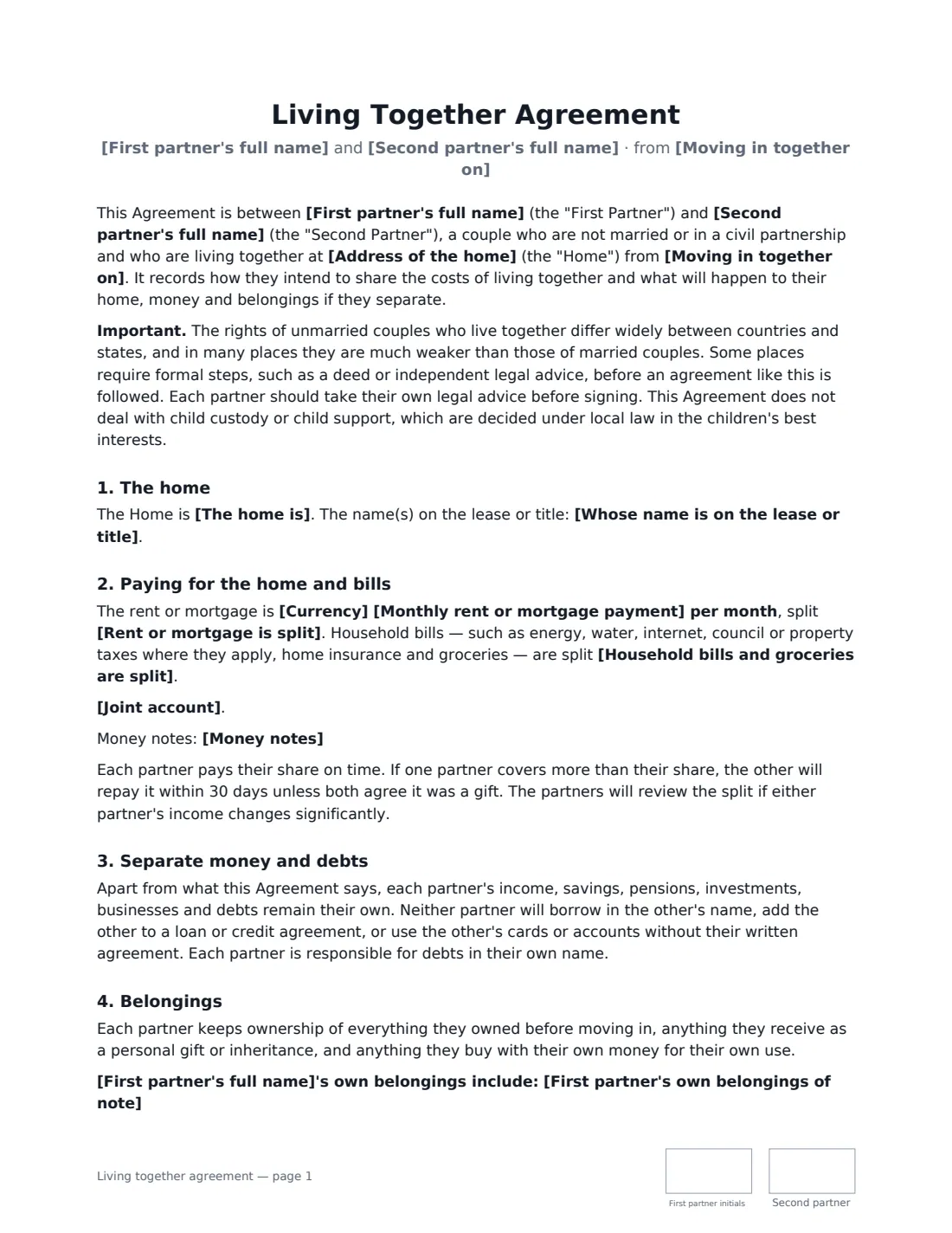
A cohabitation agreement, also called a living together agreement, is a written record of how an unmarried couple will handle money and property while they share a home, and what will happen if they split up. In many countries and states unmarried partners have far fewer automatic rights than married couples. Deciding now, while you get on well, can avoid a costly dispute later.
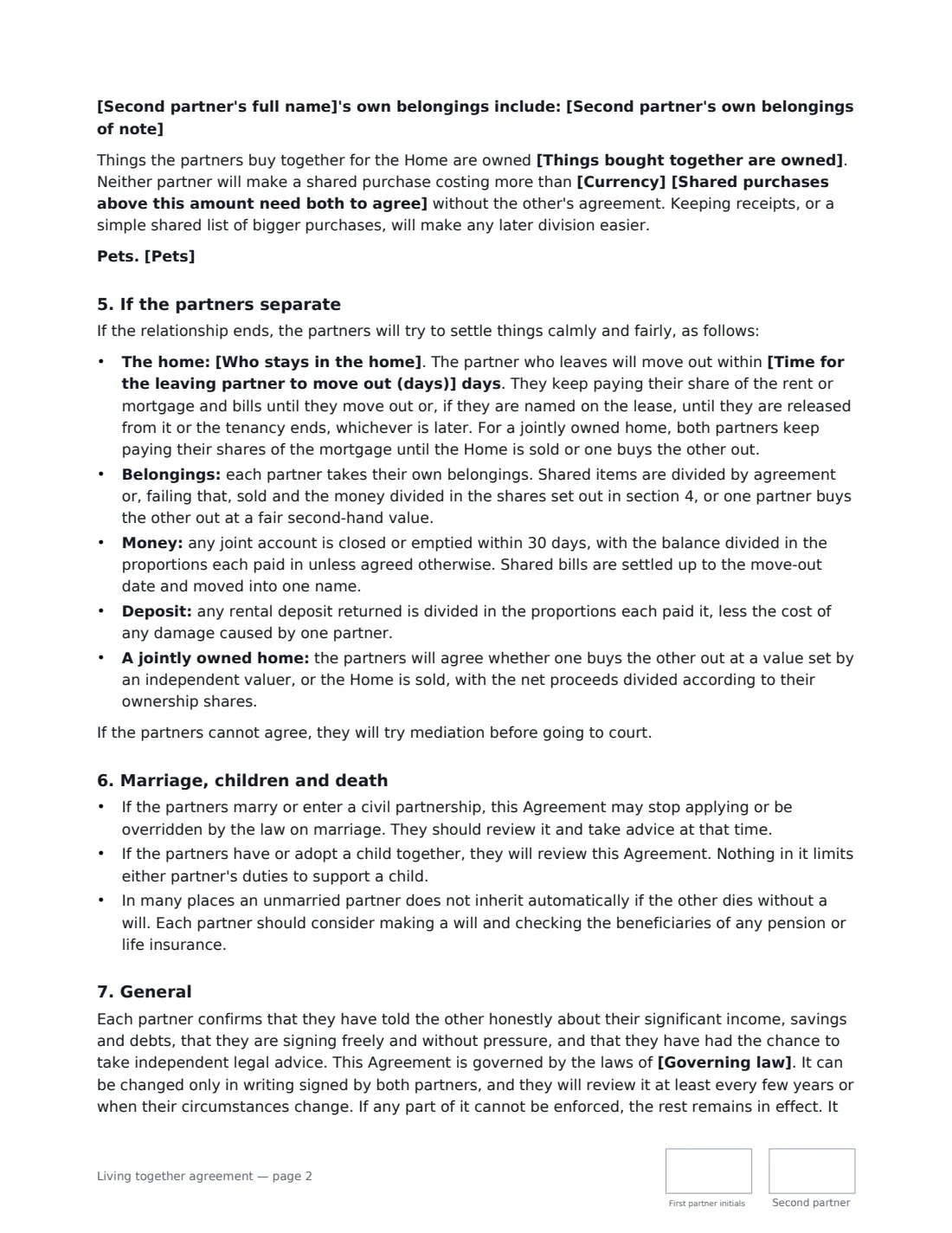
This template covers whether the home is rented, owned by one partner or owned jointly, whose name is on the lease or title, how the rent or mortgage and bills are split, a joint account, keeping your own money and debts separate, each partner's own belongings, shared purchases and a spending limit, pets, and a separation plan: who stays, time to move out, and how belongings, the joint account, the deposit and a jointly owned home are divided. It also covers what to review if you marry, have children or make wills. Both partners initial every page and sign. Because the law on cohabiting couples varies so much, each partner should take their own legal advice before relying on it.
- Best for
- Unmarried couples moving in together, into a rented home, one partner's home, or a home bought jointly
- Signed by
- Both partners, ideally after each has taken independent legal advice
- Covers
- Housing costs, bills, joint account, belongings, shared purchases, pets and separation
- Length
- About 3 pages, initialled on every page
When to Use a living together agreement
- Moving into a partner's home when they own it and you'll help with the mortgage
- Renting together and splitting rent and bills unequally because your incomes differ
- Buying a home together in unequal shares and recording who put in what
- Bringing valuable furniture, a car or a pet into a shared home
- Updating arrangements after years together, before a big shared purchase
What You Fill In
21 blanks, then the name and email of each person who signs: first partner, second partner.
1 The couple
- First partner's full name*
- Second partner's full name*
2 The home
- Address of the home*
- Moving in together on*
- The home is* rented · owned by the First partner · owned by the Second partner · owned jointly by both partners
- Whose name is on the lease or title*
- Ownership shares (jointly owned home)
3 Money
- Currency*
- Monthly rent or mortgage payment*
- Rent or mortgage is split* equally · in proportion to our incomes · as set out in the money notes
- Household bills and groceries are split* equally · in proportion to our incomes · in the same way as the rent or mortgage · as set out in the money notes
- Joint account* We will not have a joint account; each partner pays their share directly · We will open a joint account for shared household costs and each pay in our share every month
- Money notes
4 Belongings
- First partner's own belongings of note
- Second partner's own belongings of note
- Things bought together are owned* equally, whoever paid · in proportion to what each partner paid
- Shared purchases above this amount need both to agree*
- Pets
5 If we separate
- Time for the leaving partner to move out (days)*
- Who stays in the home* the partner who owns the Home, or whose name alone is on the lease, stays; if both are named, the partners will try to agree and, failing that, will both give notice or sell · the partners will decide together at the time and, if they cannot agree within 30 days, will both give notice or sell
- Governing law*
6 Who signs
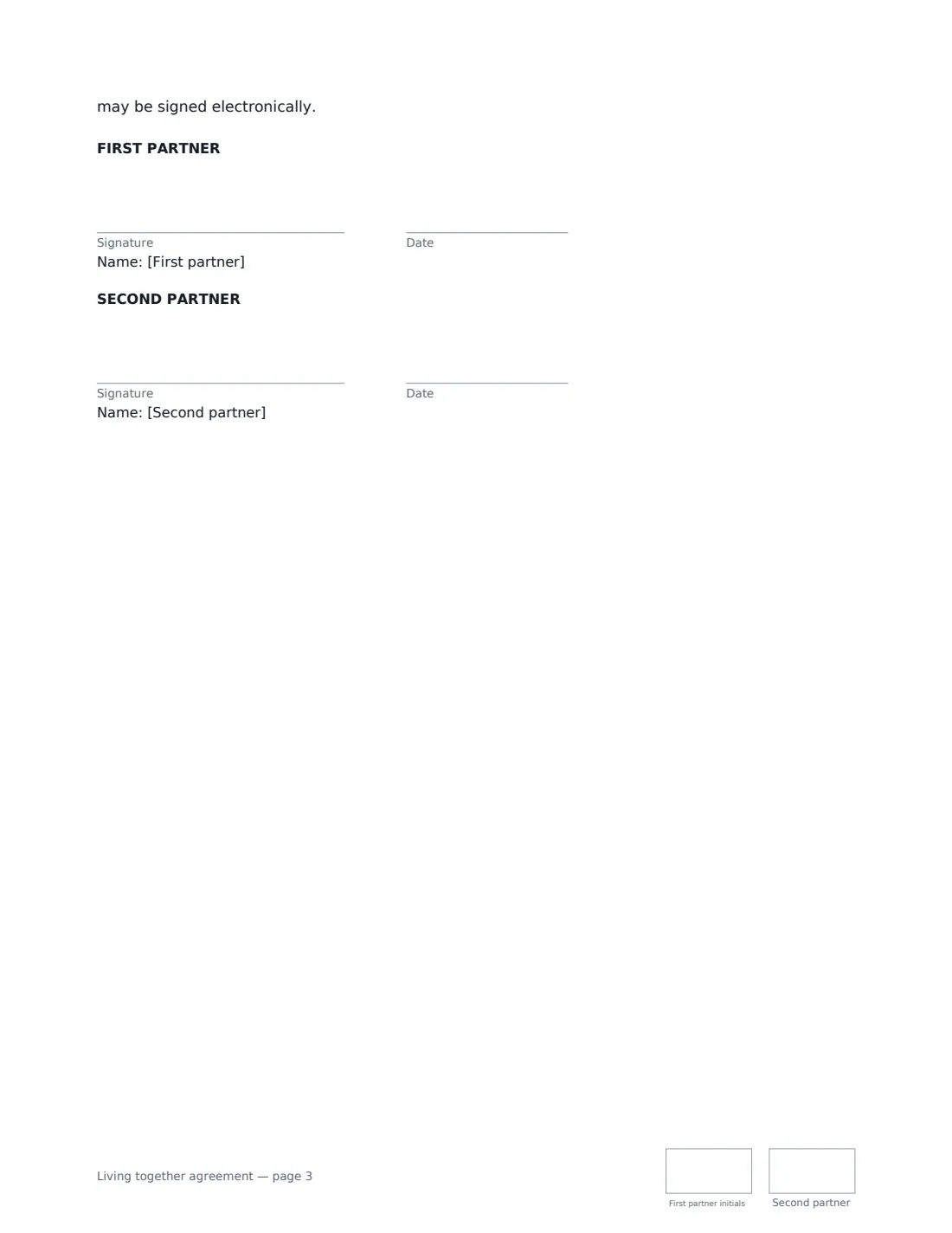
- First partner signature and date, initials on every page
- Second partner signature and date, initials on every page · Each partner should read the agreement carefully and ideally take their own legal advice before signing.
What the living together agreement Covers
- The home
- Paying for the home and bills
- Separate money and debts
- Belongings
- If the partners separate
- Marriage, children and death
- General
Using the living together agreement, step by step
1 Describe the home
Enter the address and move-in date. Choose whether the home is rented, owned by the first or second partner, or owned jointly, and write exactly whose name is on the lease or title. The agreement then adds the right clause. If one partner owns the home, it says the other's payments are contributions to living costs, not an ownership share. If it is jointly owned, it records your ownership shares.
2 Agree the money
Enter the monthly rent or mortgage and choose how it is split: equally, in proportion to your incomes, or as set out in your notes. Do the same for bills and groceries, and choose whether you'll have a joint account. Use the money notes for exact figures, such as who pays which bill.
3 List what belongs to whom
Note the important things each of you owns, like furniture, a car or family heirlooms. Choose whether things you buy together are owned equally or in proportion to what each paid, and set a limit above which shared purchases need both partners to agree. Add who keeps any pets.
4 Plan for a separation, then take advice
Choose who stays in the home if you split up and how many days the other has to move out, and enter the governing law. Before sending, each partner should have the draft checked by their own lawyer. Then add your partner as the second signer and send. You both initial each page and sign.
Tips Before You Send It
- Take independent legal advice, separately. In some places an agreement is more likely to be followed if each partner had their own advice and full information about the other's finances.
- If you are buying a home together, record your ownership shares on the title or in a formal deed as your local law requires. This agreement doesn't replace that.
- Keep receipts and a simple list of big shared purchases. It makes dividing things much easier if you separate.
- Make wills and check who is named on your pensions and life insurance. In many places an unmarried partner doesn't inherit automatically.
- Review the agreement if you marry, have a child, buy property or your incomes change a lot.
Sign It Online In Minutes
- Fill in the blanks. Names, dates and amounts go straight into the agreement — the preview shows exactly where.
- Name who signs. Tick “This is me” for your own part. VergeHR builds the PDF with every signature, date and initials box on the right line, and you can check or move anything before sending.
- Send it. Each signer gets a secure link and signs from any device — no account needed. The signed PDF, with an audit trail and a Certificate of Completion, is filed in Files and emailed to everyone.
Living together agreement: frequently asked questions
Is a cohabitation agreement legally binding?
It depends heavily on where you live. Some countries and states treat these agreements as ordinary contracts. Others follow them only when formal steps were taken, such as independent legal advice for each partner, full financial disclosure or a deed. Some give courts wide discretion regardless. That's why the template recommends local legal advice before you rely on it.
Does it cover children?
No. Custody, contact and child support are decided under local law in the children's best interests, and couples can't agree them away in advance. The agreement says you'll review it if you have or adopt a child.
What happens to this agreement if we get married?
Marriage usually brings in different rules on property and money, which may override it. The agreement says you'll review it and take advice at that point. Many couples then make a prenuptial or postnuptial agreement.
Is a cohabitation agreement signed online valid?
Electronic signatures are generally valid for ordinary agreements like this in the US (ESIGN Act and UETA), the UK, the EU (eIDAS) and Canada. VergeHR keeps an audit trail and a Certificate of Completion with the signed PDF as a record of who signed and when. If your local law requires a deed, witnesses or a notary for property arrangements, sign those documents in the form required.
Is this template free?
Yes. The template is free to use with the eSignature app in VergeHR, and the people you send it to don't need a VergeHR login to sign.