


What is a pet custody agreement?
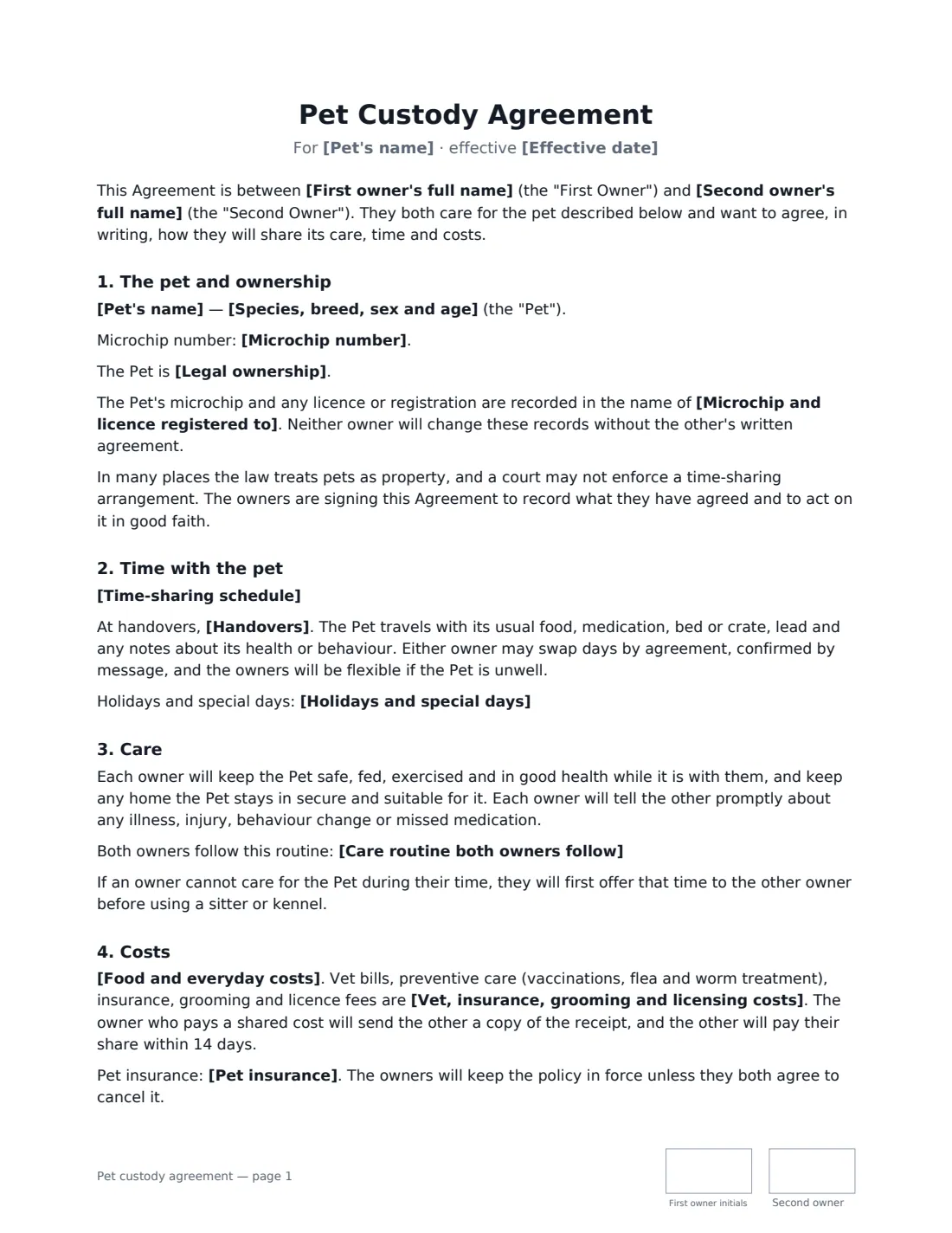
A pet custody agreement sets out how two people share a pet they both love. Couples often use one when they separate, but it also suits friends, relatives or housemates who co-own a dog or cat. Many legal systems treat a pet as property, so without an agreement the question is often just "whose name is on the paperwork". Writing down a fair arrangement protects the pet's routine as well as both relationships with it.
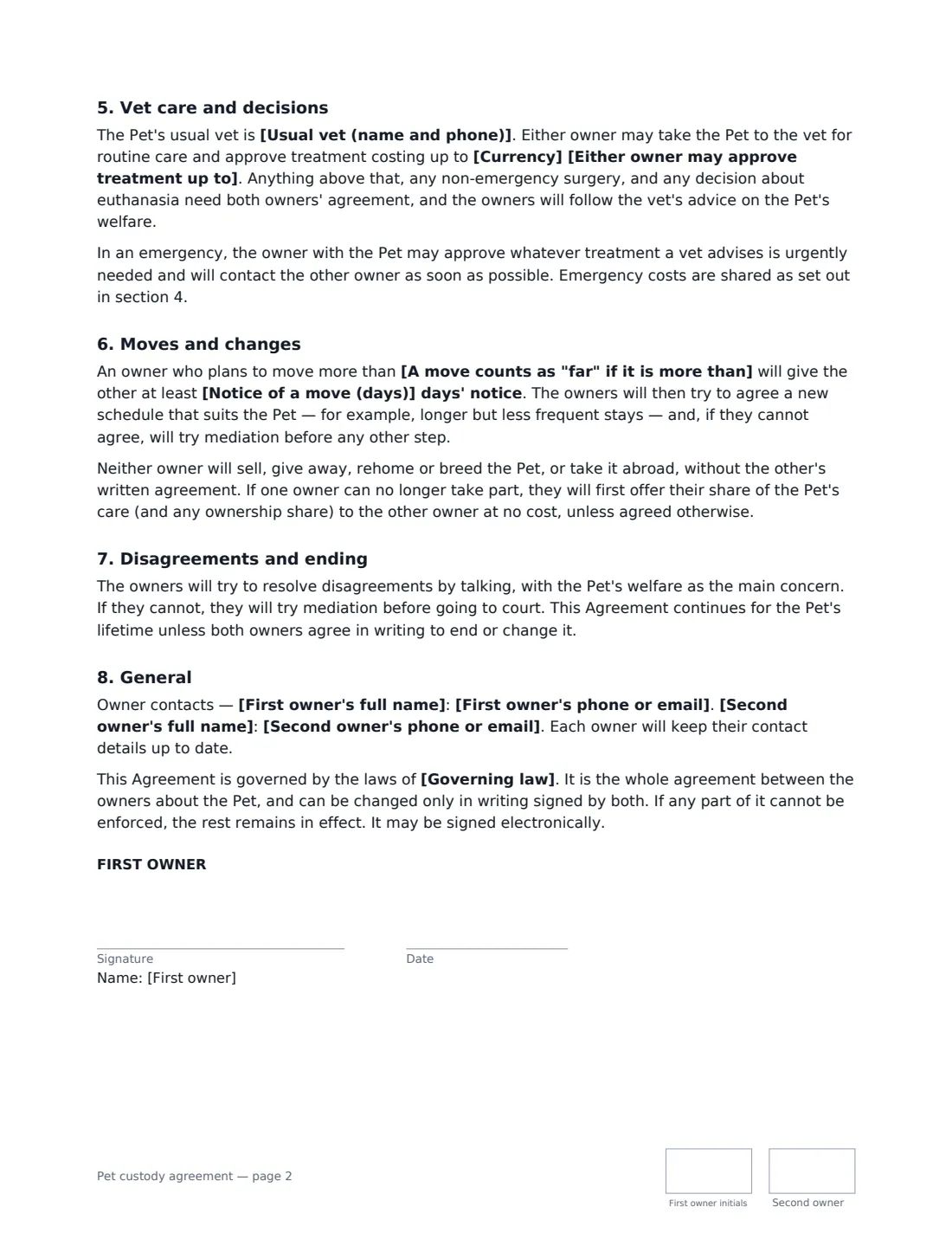
This template covers legal ownership (joint, or one owner sharing time), microchip and licence records, the time-sharing schedule, handovers and holidays, a shared care routine, food and everyday costs, how vet, insurance and grooming bills are split, a vet spending limit either owner can approve alone, emergencies and end-of-life decisions, notice of a move, no selling or rehoming without consent, and mediation for disagreements. Both owners initial each page and sign.
- Best for
- Separating couples, co-owners and families sharing a dog, cat or other pet between two homes
- Signed by
- Both owners
- Costs
- Everyday costs by whoever has the pet, or shared. Vet and insurance costs equally, 60/40, or by one owner
- Length
- About 2 pages, initialled on every page
When to Use a pet custody agreement
- A couple splitting up who both want to keep seeing their dog
- Two friends or housemates who bought a puppy together
- A parent and an adult child sharing a family pet between their homes
- Recording that one person owns the pet while the other keeps regular time with it
- Agreeing in advance what happens if one owner moves away
What You Fill In
23 blanks, then the name and email of each person who signs: first owner, second owner.
1 The owners
- First owner's full name*
- First owner's phone or email
- Second owner's full name*
- Second owner's phone or email
- Effective date*
2 The pet
- Pet's name*
- Species, breed, sex and age*
- Microchip number
- Legal ownership* owned jointly by both owners, in equal shares · owned by the First owner, who agrees to share time with the Second owner · owned by the Second owner, who agrees to share time with the First owner
- Microchip and licence registered to
3 Time with the pet
- Time-sharing schedule*
- Handovers*
- Holidays and special days
- Care routine both owners follow
4 Costs
- Currency*
- Food and everyday costs* Each owner pays for food, treats and everyday supplies while the pet is with them · Food and everyday supplies are shared equally
- Vet, insurance, grooming and licensing costs* shared equally · shared 60% by the First owner and 40% by the Second owner · shared 40% by the First owner and 60% by the Second owner · paid by the First owner · paid by the Second owner
- Pet insurance
5 Vet decisions
- Usual vet (name and phone)*
- Either owner may approve treatment up to*
6 Moves and changes
- Notice of a move (days)*
- A move counts as "far" if it is more than*
- Governing law*
7 Who signs
- First owner signature and date, initials on every page
- Second owner signature and date, initials on every page
What the pet custody agreement Covers
- The pet and ownership
- Time with the pet
- Care
- Costs
- Vet care and decisions
- Moves and changes
- Disagreements and ending
- General
Using the pet custody agreement, step by step
1 Describe the pet and who owns it
Enter the pet's name, species, breed, sex and age, and its microchip number if it has one. Choose whether the pet is owned jointly in equal shares, or by one owner who agrees to share time. Note whose name the microchip and licence are registered in. Neither owner may change those records alone.
2 Set the schedule
Write the time-sharing pattern plainly, for example alternate weeks changing over on Sunday at 6 pm, or weekdays with one owner and weekends with the other. Say who collects the pet at handover, add any holiday arrangements, and list the care routine you both follow, like the same food and walks.
3 Agree costs and vet decisions
Choose how food and everyday costs work and how vet, insurance, grooming and licence costs are split. Add the usual vet and a spending limit either of you can approve alone. Above it, both must agree, except in an emergency. The agreement already requires both owners to agree on euthanasia.
4 Plan for moves, then sign
Set what counts as a far move and how much notice an owner must give. Enter the governing law, add the other owner as a signer and send. You both initial each page and sign.
Tips Before You Send It
- Keep the pet's routine the same in both homes: food, feeding times, walks and house rules.
- Send each other receipts for shared costs straight away. The agreement asks for payment within 14 days.
- Put both owners' numbers on the microchip record and with the vet, so either can be reached in an emergency.
- Watch how the pet copes with the changeovers. If it is stressed, agree a different pattern, such as longer but fewer stays.
- If the pet is part of a wider separation or divorce, mention this agreement to whoever handles the rest of the settlement.
Sign It Online In Minutes
- Fill in the blanks. Names, dates and amounts go straight into the agreement — the preview shows exactly where.
- Name who signs. Tick “This is me” for your own part. VergeHR builds the PDF with every signature, date and initials box on the right line, and you can check or move anything before sending.
- Send it. Each signer gets a secure link and signs from any device — no account needed. The signed PDF, with an audit trail and a Certificate of Completion, is filed in Files and emailed to everyone.
Pet custody agreement: frequently asked questions
Will a court enforce a pet custody agreement?
It varies. In many places the law treats pets as property, and courts may decide ownership but not enforce a visiting schedule. Some places now consider a pet's welfare. The agreement is still valuable as clear evidence of ownership and of what you both agreed, and it says so plainly.
What if one of us moves far away?
The moving owner gives the notice you set, and you try to agree a new schedule, such as longer, less frequent stays. If you can't agree, the agreement says you try mediation before any other step.
Who decides on major vet treatment?
Either owner can approve routine care and treatment up to the limit you set. Anything above that, non-emergency surgery and end-of-life decisions need both owners' agreement. In an emergency, the owner with the pet can approve urgent treatment and must tell the other as soon as possible.
Is a pet custody agreement signed online valid?
Electronic signatures are generally valid for ordinary agreements like this in the US (ESIGN Act and UETA), the UK, the EU (eIDAS) and Canada. VergeHR keeps an audit trail and a Certificate of Completion with the signed PDF as a record of who signed and when.
Is this template free?
Yes. The template is free to use with the eSignature app in VergeHR, and the people you send it to don't need a VergeHR login to sign.