

What is a barter agreement?
A barter agreement, sometimes called a trade or swap agreement, records an exchange of goods or services instead of money. Freelancers and small businesses swap skills, neighbours trade labour for goods, and makers trade products. Barter deals often go wrong for the same reasons as paid ones: the scope was vague, one side delivered and the other didn't, or the quality wasn't what was expected. Without an invoice there's often no written record at all.
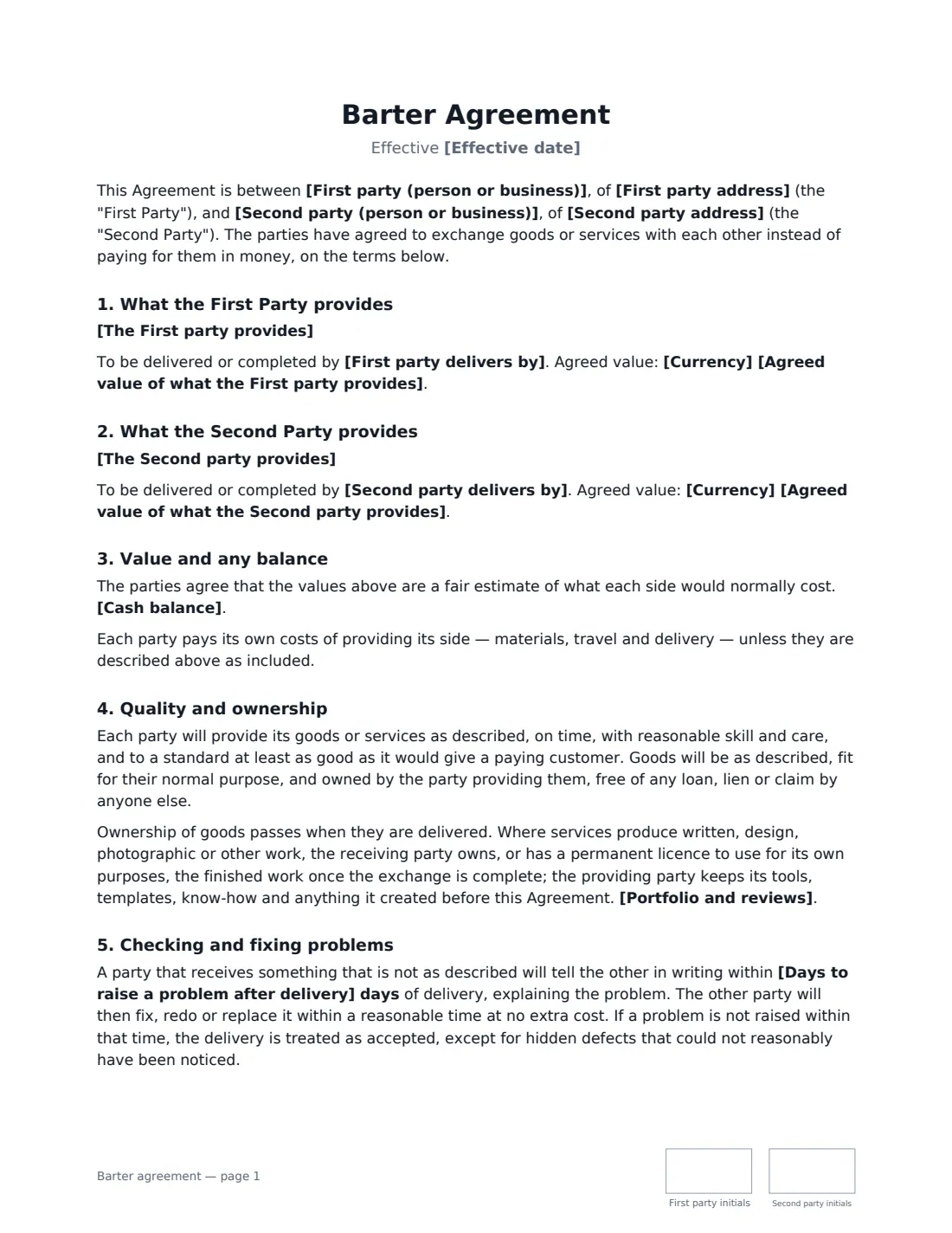
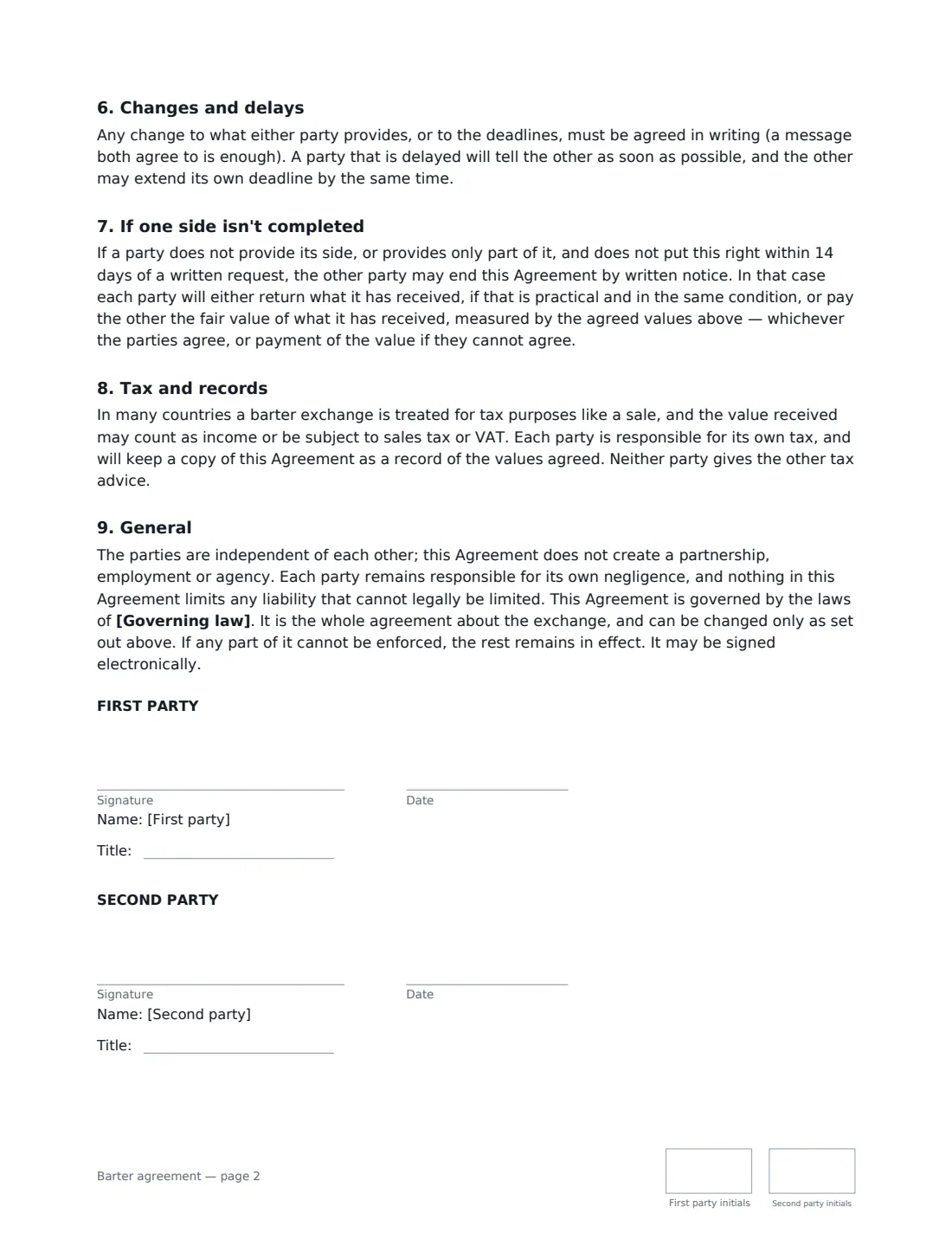
This template covers what each party provides and by when, the agreed market value of each side, whether the exchange is even or one party pays a cash balance, costs, quality and good title to goods, ownership of goods and of work created by services, portfolio use, checking deliveries and fixing problems, changes and delays, what happens if one side isn't completed (return or pay the agreed value), tax and records, and the governing law. Both parties initial each page and sign.
- Best for
- Freelancers, sole traders, small businesses and individuals swapping goods or services
- Signed by
- Both parties, with a job title when signing for a business
- Value
- An agreed value for each side, with an optional cash balance either way
- Length
- About 2 pages, initialled on every page
When to Use a barter agreement
- A web designer building a site for a photographer in exchange for a shoot
- A tradesperson doing repairs in exchange for furniture or equipment
- Two small businesses swapping products for their shops
- A coach or tutor swapping sessions for bookkeeping or marketing help
- Neighbours trading labour, like building a fence, for goods or other work
What You Fill In
18 blanks, then the name and email of each person who signs: first party, second party.
1 The parties
- First party (person or business)*
- First party address
- Second party (person or business)*
- Second party address
- Effective date*
2 The exchange
- The First party provides*
- First party delivers by*
- The Second party provides*
- Second party delivers by*
3 Value
- Currency*
- Agreed value of what the First party provides*
- Agreed value of what the Second party provides*
- Cash balance* No money changes hands — the parties accept the exchange as even · The First party pays the Second party the balance below · The Second party pays the First party the balance below
- Balance amount
- Balance paid
4 Terms
- Days to raise a problem after delivery*
- Portfolio and reviews* Either party may mention the exchange and show the work in its portfolio · Neither party will publicise the exchange without the other's permission
- Governing law*
5 Who signs
- First party signature and date, job title, initials on every page · Add a job title only if signing for a business.
- Second party signature and date, job title, initials on every page · Add a job title only if signing for a business.
What the barter agreement Covers
- What the First Party provides
- What the Second Party provides
- Value and any balance
- Quality and ownership
- Checking and fixing problems
- Changes and delays
- If one side isn't completed
- Tax and records
- General
Using the barter agreement, step by step
1 Describe each side of the swap
Write exactly what each party provides and the deadline for each. Be as specific as you would for a paid job: pages, hours, quantities, number of revisions, delivery method. Vague scope is the most common reason barter deals go wrong.
2 Agree the values
Enter a fair market value for each side, meaning what it would normally cost a paying customer. These values matter for tax records and decide what is owed if the swap isn't completed. If the values differ, choose whether the exchange is accepted as even or one party pays a cash balance, and when.
3 Set the terms
Set how many days each party has to raise a problem after delivery. The other must then fix it at no extra cost. Choose whether either party may show the work in its portfolio or mention the exchange publicly, and enter the governing law.
4 Sign before anyone starts
Add the other party as a signer (with a job title if signing for a business) and send. You both initial each page and sign before either side starts work, so the deal is fixed before anyone has delivered.
Tips Before You Send It
- Treat a barter job like a paid one: same scope, same deadlines, same quality.
- Use realistic market values. They're your evidence if the swap falls through, and your record for tax.
- If one side's work is much bigger, stage it, for example half the photos after the homepage is live.
- Keep a copy of the signed agreement with your accounts. VergeHR files it in Files.
- Ask an accountant how barter income is treated where you are, especially if you're registered for sales tax or VAT.
Sign It Online In Minutes
- Fill in the blanks. Names, dates and amounts go straight into the agreement — the preview shows exactly where.
- Name who signs. Tick “This is me” for your own part. VergeHR builds the PDF with every signature, date and initials box on the right line, and you can check or move anything before sending.
- Send it. Each signer gets a secure link and signs from any device — no account needed. The signed PDF, with an audit trail and a Certificate of Completion, is filed in Files and emailed to everyone.
Barter agreement: frequently asked questions
Do I have to pay tax on a barter exchange?
Often, yes. In many countries a barter is treated like a sale, so the value you receive may count as income and may be subject to sales tax or VAT. The agreement makes each party responsible for its own tax and records the agreed values. Ask an accountant how it applies to you.
What if the other side doesn't deliver?
Ask them in writing to put it right. If they haven't within 14 days, you can end the agreement. Each party then returns what it received, if practical, or pays its agreed value. If you can't agree which, payment of the value applies.
Who owns work created in a service swap?
The receiving party owns the finished deliverables, or has a permanent licence to use them for its own purposes, once the exchange is complete. The provider keeps its tools, templates and know-how. You choose whether either side may show the work in a portfolio.
Is a barter agreement signed online valid?
Electronic signatures are generally valid for ordinary agreements like this in the US (ESIGN Act and UETA), the UK, the EU (eIDAS) and Canada. VergeHR keeps an audit trail and a Certificate of Completion with the signed PDF as a record of who signed and when.
Is this template free?
Yes. The template is free to use with the eSignature app in VergeHR, and the people you send it to don't need a VergeHR login to sign.