

What is a letter of authorization?
A letter of authorization (or authority letter) tells an office, business or other organisation that someone else may act for you on a particular task. People use one to have a relative collect a passport, parcel or certificate, to let a colleague deal with a supplier or landlord, or to allow a friend to pick up a car from a garage while they are away. Unlike a power of attorney, it covers one clearly described job, for a short time, and nothing more.
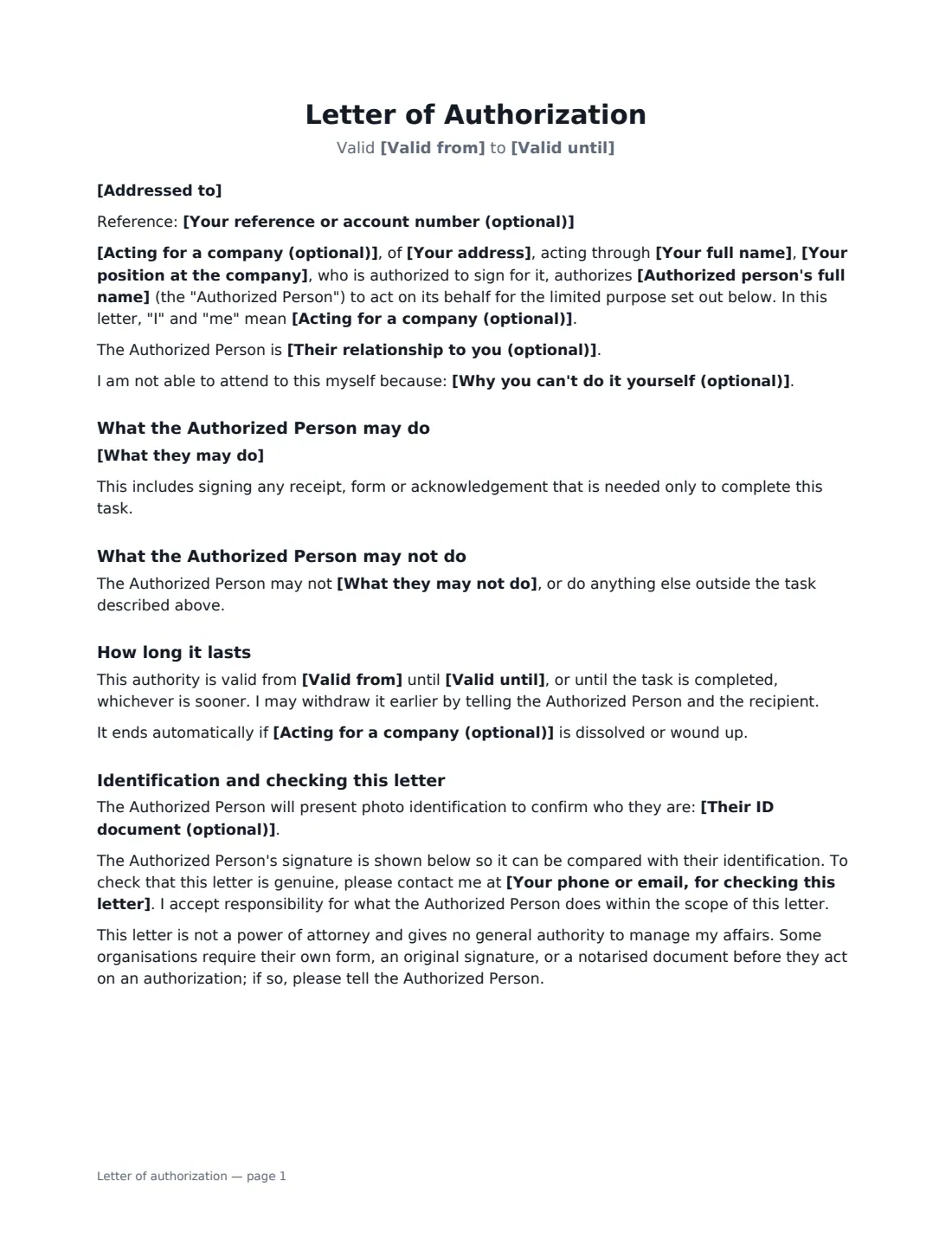
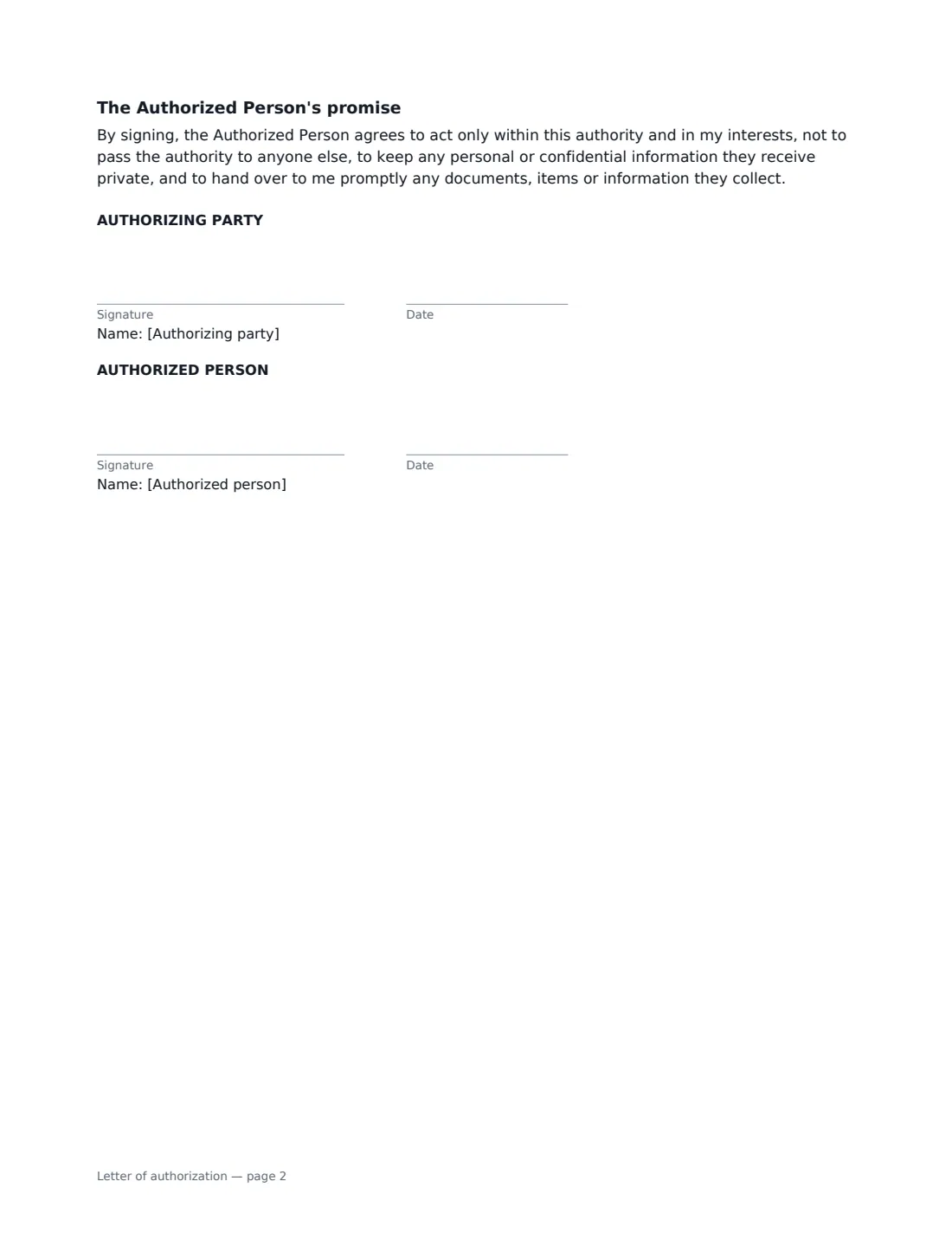
This template is addressed to the organisation (or "To whom it may concern") and can quote your reference or account number. You describe the task in your own words, list what the authorized person may not do — by default signing contracts, making payments, opening or closing accounts or changing details — and set the dates it is valid. It records the ID the authorized person will show, gives your contact details so the recipient can check the letter, and says plainly that it is not a power of attorney. The authorized person signs too, promising to stay within the authority and hand everything over, and their signature serves as a specimen the recipient can compare with their ID. It also works for a company authorizing an employee or courier.
- Best for
- Collecting documents or items, dealing with a supplier, landlord, garage or office on someone's behalf
- Signed by
- The person or company giving authority, and the authorized person
- Validity
- Between the dates you choose, or until the task is done
- Length
- 1-2 pages
When to Use a letter of authorization
- A parent authorizing an adult child to collect documents from a government office
- Letting a friend pick up your car, parcel or dry cleaning while you are away
- A company authorizing an employee or courier to collect goods or sign for a delivery
- Allowing a relative to talk to your landlord, school or utility provider about one matter
- An owner authorizing a manager to deal with a specific supplier or contractor
What You Fill In
15 blanks, then the name and email of each person who signs: authorizing party, authorized person.
1 Who is giving authority
- Your full name*
- Your address*
- Your phone or email, for checking this letter*
- Acting for a company (optional)
- Your position at the company
- Your reference or account number (optional)
2 Who is authorized
- Authorized person's full name*
- Their relationship to you (optional)
- Their ID document (optional)
3 The task
- Addressed to*
- What they may do*
- What they may not do
- Why you can't do it yourself (optional)
- Valid from*
- Valid until*
4 Who signs
- Authorizing party signature and date · The person giving the authority, or someone who can sign for the company giving it.
- Authorized person signature and date · The person who will act. Their signature on the letter doubles as a specimen the recipient can compare.
What the letter of authorization Covers
- What the Authorized Person may do
- What the Authorized Person may not do
- How long it lasts
- Identification and checking this letter
- The Authorized Person's promise
Using the letter of authorization, step by step
1 Add your details
Enter your name, address and a phone number or email the recipient can use to check the letter. If you're authorizing on behalf of a company, add the company name and your position. Include a reference or account number if the organisation will need it to find your file.
2 Name the authorized person
Enter their full name exactly as it appears on their ID, and optionally the ID they will show — the last few digits of a passport or licence number are usually enough.
3 Describe the task and the limits
Write the task as specifically as you can: what, where and for which matter. Edit the list of things they may not do, which finishes the sentence "The Authorized Person may not…". Add a short reason if the organisation is likely to ask why you can't attend.
4 Set the dates and send
Choose the first and last day the letter is valid — keep the window short. Add the authorized person as a signer and send; they sign after you, and can show the signed PDF or a printout.
Tips Before You Send It
- Check first whether the organisation accepts authorization letters. Banks, government agencies and courts often have their own forms or require a notarised document.
- Give the authorized person a copy of your ID if the organisation asks for it, but never write full bank or card numbers in the letter.
- One task per letter. A letter that tries to cover everything is less likely to be accepted and more likely to be misused.
- If you need someone to manage your money or property generally, or to act if you lose capacity, you need a power of attorney made under your local law — not this letter.
- Tell the organisation if you withdraw the authority before the end date.
Sign It Online In Minutes
- Fill in the blanks. Names, dates and amounts go straight into the agreement — the preview shows exactly where.
- Name who signs. Tick “This is me” for your own part. VergeHR builds the PDF with every signature, date box on the right line, and you can check or move anything before sending.
- Send it. Each signer gets a secure link and signs from any device — no account needed. The signed PDF, with an audit trail and a Certificate of Completion, is filed in Files and emailed to everyone.
Letter of authorization: frequently asked questions
What is the difference between a letter of authorization and a power of attorney?
A letter of authorization lets someone do one limited task for a short time. A power of attorney is a formal legal document, usually with signing and witnessing rules set by local law, that can give much wider authority over your affairs. This letter says clearly that it is not a power of attorney.
Will every organisation accept this letter?
No — each organisation decides what it accepts. Some will act on a signed letter and ID, others require their own form, an original ink signature or a notarised document. Ask in advance, and the letter tells the recipient to let the authorized person know if they need something else.
Why does the authorized person sign too?
Their signature confirms they accept the limits and will hand over what they collect, and it gives the recipient a specimen signature to compare with their ID.
Is an electronically signed authorization letter valid?
Electronic signatures are generally valid for ordinary documents like this in the US (ESIGN Act and UETA), the UK, the EU (eIDAS) and Canada. Documents that must be notarised or witnessed, such as many powers of attorney, usually need to be signed in person instead.
Is this template free?
Yes. It is free to use with the eSignature app in VergeHR, and the authorized person doesn't need a VergeHR login to sign.