

What is a neighbour consent letter?
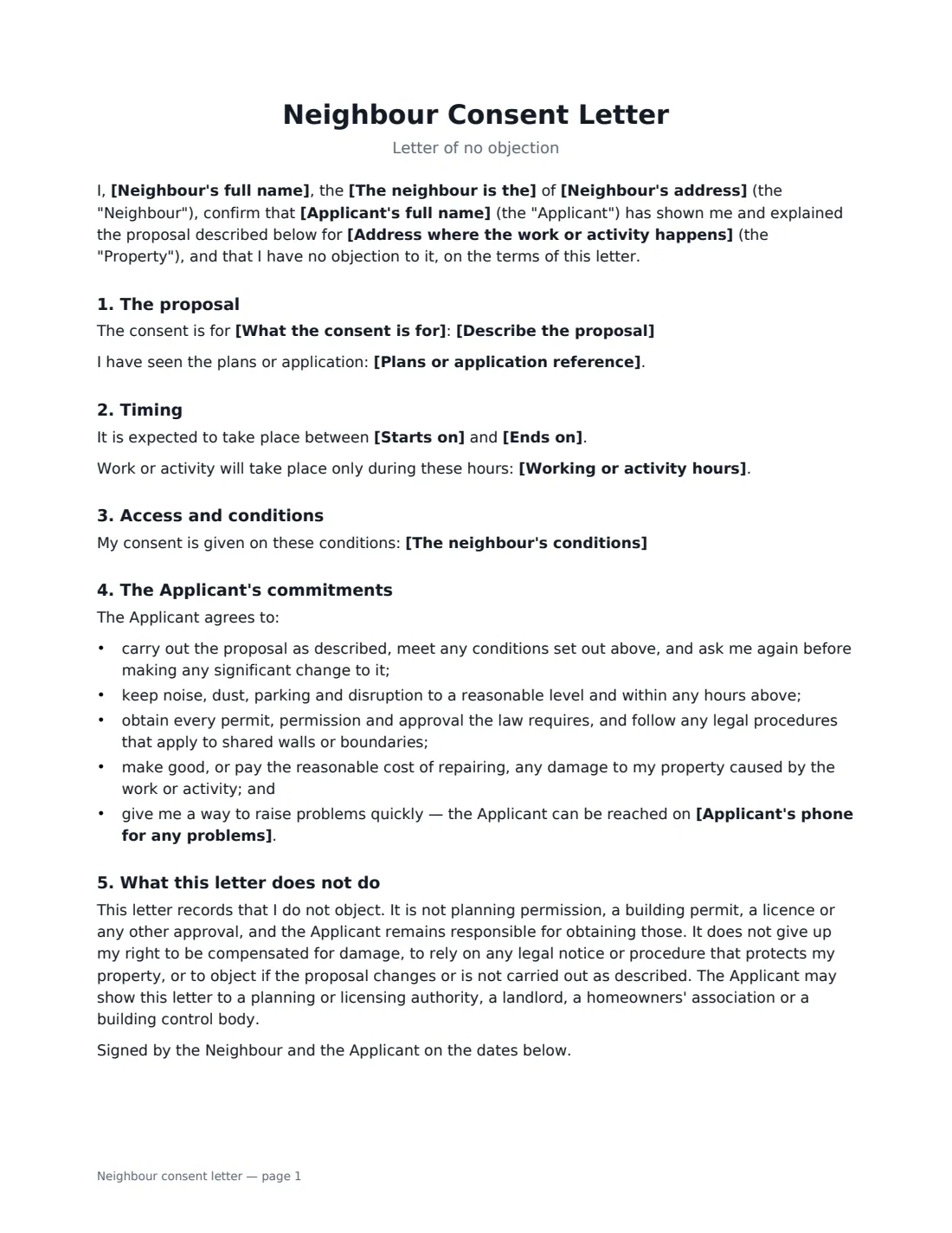
Planning officers, licensing authorities, landlords and homeowners' associations often ask whether the neighbours have been consulted. A signed neighbour consent letter shows they have: it records exactly what the neighbour was shown and agreed not to object to, and any conditions they asked for in return.
This template identifies the neighbour and whether they own or rent, and the property where the work or activity happens. You describe the proposal — building work, an extension, an event, a business activity, or work on a shared boundary, fence or tree — with any plan or application reference, dates and working hours. It records whether access to the neighbour's property is needed and on what terms, and the neighbour's conditions. The applicant commits to carry out the proposal as described, keep disruption reasonable, get every permit required, follow any procedures for shared walls or boundaries, and put right any damage. A final section makes clear the letter is not planning permission or any other approval, and that the neighbour keeps their rights if things change or damage is done.
- Best for
- Extensions, renovations, events, home businesses, fence and tree work
- Signed by
- The neighbour and the applicant
- Covers
- The proposal, timing, hours, access, the neighbour's conditions, damage
- Length
- 2 pages
When to Use a neighbour consent letter
- Supporting a planning or building permit application for a rear extension
- Getting a neighbour's agreement before erecting scaffolding on their side
- A garden party, wedding or street event with music into the evening
- Opening a home-based business such as childminding, a salon or a workshop
- Replacing a shared fence or cutting back a tree on the boundary
What You Fill In
15 blanks, then the name and email of each person who signs: neighbour, applicant.
1 The applicant
- Applicant's full name*
- Address where the work or activity happens*
- Applicant's phone for any problems*
2 The neighbour
- Neighbour's full name*
- Neighbour's address*
- The neighbour is the* owner · tenant · owner and occupier
3 The proposal
- What the consent is for* building work · an extension · an event · a business activity · work on a shared boundary, fence or tree
- Describe the proposal*
- Plans or application reference
4 Timing
- Starts on*
- Ends on
- Working or activity hours
5 Conditions
- Access to the neighbour's property* No access to the Neighbour's property is needed · Access to the Neighbour's property is needed, as described below
- Access needed
- The neighbour's conditions
6 Who signs
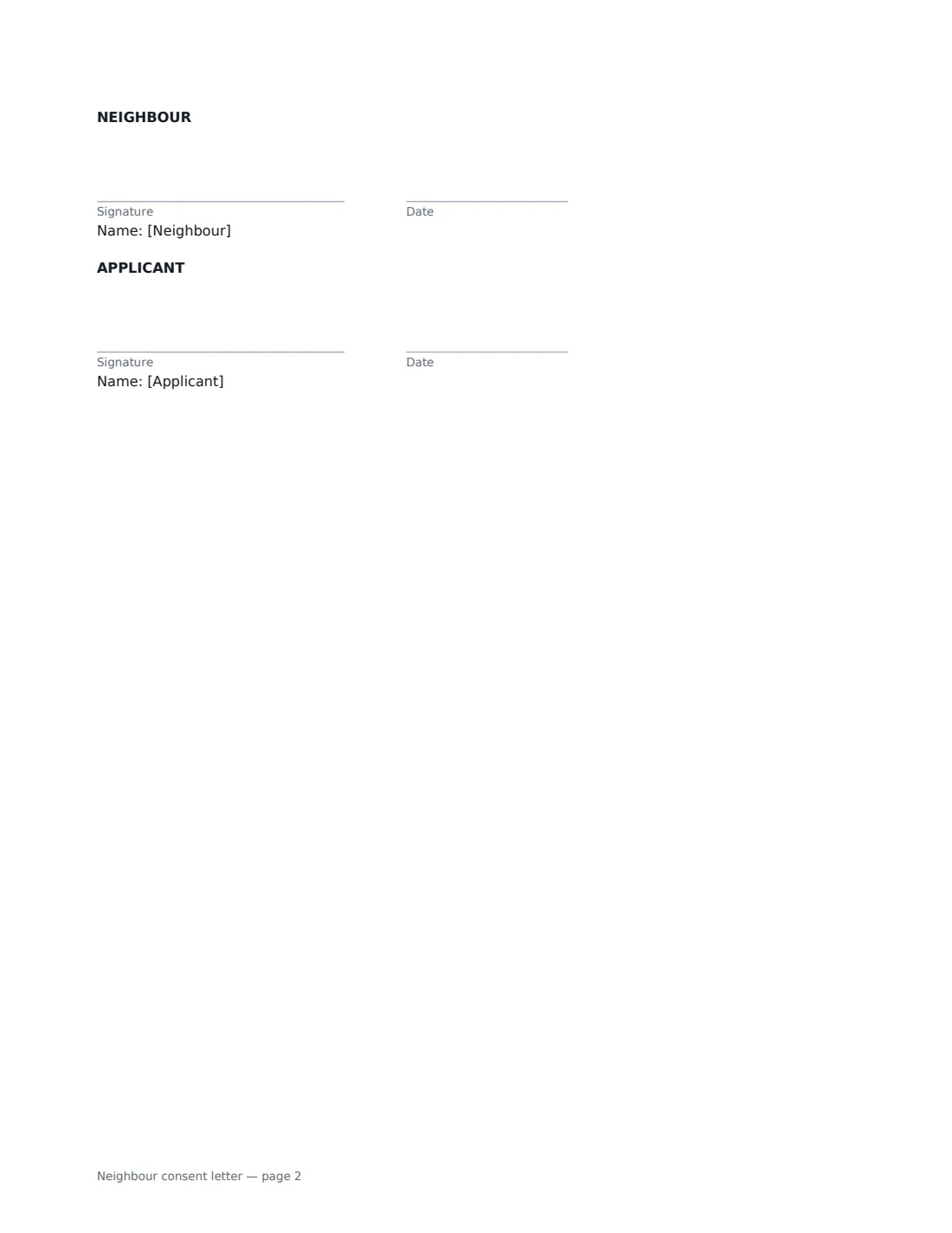
- Neighbour signature and date · The owner or occupier of the neighbouring property who is giving consent.
- Applicant signature and date · The person planning the work, event or activity.
What the neighbour consent letter Covers
- The proposal
- Timing
- Access and conditions
- The Applicant's commitments
- What this letter does not do
Using the neighbour consent letter, step by step
1 Describe the proposal specifically
Size, position, what happens and how often. "A single-storey rear extension, 4 m deep and 3.5 m high, 1 m from our shared boundary" is far more useful than "an extension" — and the neighbour is agreeing to exactly what you write.
2 Add plans and timing
Reference any drawings or application number the neighbour has seen, and give start and end dates and the working hours. For an ongoing business activity, leave the end date empty.
3 Agree access and conditions
If you need scaffolding, a ladder or workers on the neighbour's side, choose that access is needed and describe it. Record anything the neighbour asked for — skip placement, photos of their wall before work starts, music off by a set time.
4 Send for signature
You and the neighbour sign online. Attach the signed letter to your application, or keep it in Files in case questions come up later.
Tips Before You Send It
- Show the neighbour the actual plans before they sign. A consent to something they didn't see is worth little.
- Some authorities want the owner's consent, not a tenant's — the letter records which the neighbour is.
- Photograph shared walls, fences and paths before work starts, and share the photos with the neighbour.
- Where you are building on or near a shared wall, there may be formal notice procedures in your area. This letter does not replace them.
Sign It Online In Minutes
- Fill in the blanks. Names, dates and amounts go straight into the agreement — the preview shows exactly where.
- Name who signs. Tick “This is me” for your own part. VergeHR builds the PDF with every signature, date box on the right line, and you can check or move anything before sending.
- Send it. Each signer gets a secure link and signs from any device — no account needed. The signed PDF, with an audit trail and a Certificate of Completion, is filed in Files and emailed to everyone.
Neighbour consent letter: frequently asked questions
Is a neighbour consent letter the same as planning permission?
No. It only records that the neighbour does not object. You still need any planning permission, building permit, licence or other approval the law requires, and the letter says so.
Does the neighbour give up any rights by signing?
No. The letter keeps the neighbour's right to compensation for damage, to rely on any legal notice or procedure that protects their property, and to object if the proposal changes or isn't carried out as described.
Will a planning authority accept a letter signed electronically?
Electronic signatures are generally recognised in the US (ESIGN and UETA), the UK, the EU (eIDAS) and Canada, and many authorities accept supporting letters signed this way — but each sets its own requirements, so check with the authority first. If it has its own form, use that as well.
What if the neighbour only agrees with conditions?
Write them in the conditions box. They become part of the letter, the neighbour's consent is given on those conditions, and the applicant commits to meet them.