

What is a paid work trial agreement?
A work trial — also called a trial shift, working interview or paid skills test — lets a candidate do real work for a few hours or days so both sides can see whether the job is a good fit. It is common in hospitality, retail, trades, warehousing and creative roles. Trials go wrong when expectations are vague: the candidate doesn't know whether they will be paid, the trial quietly grows into a week of free labour, or nobody explains the safety rules.
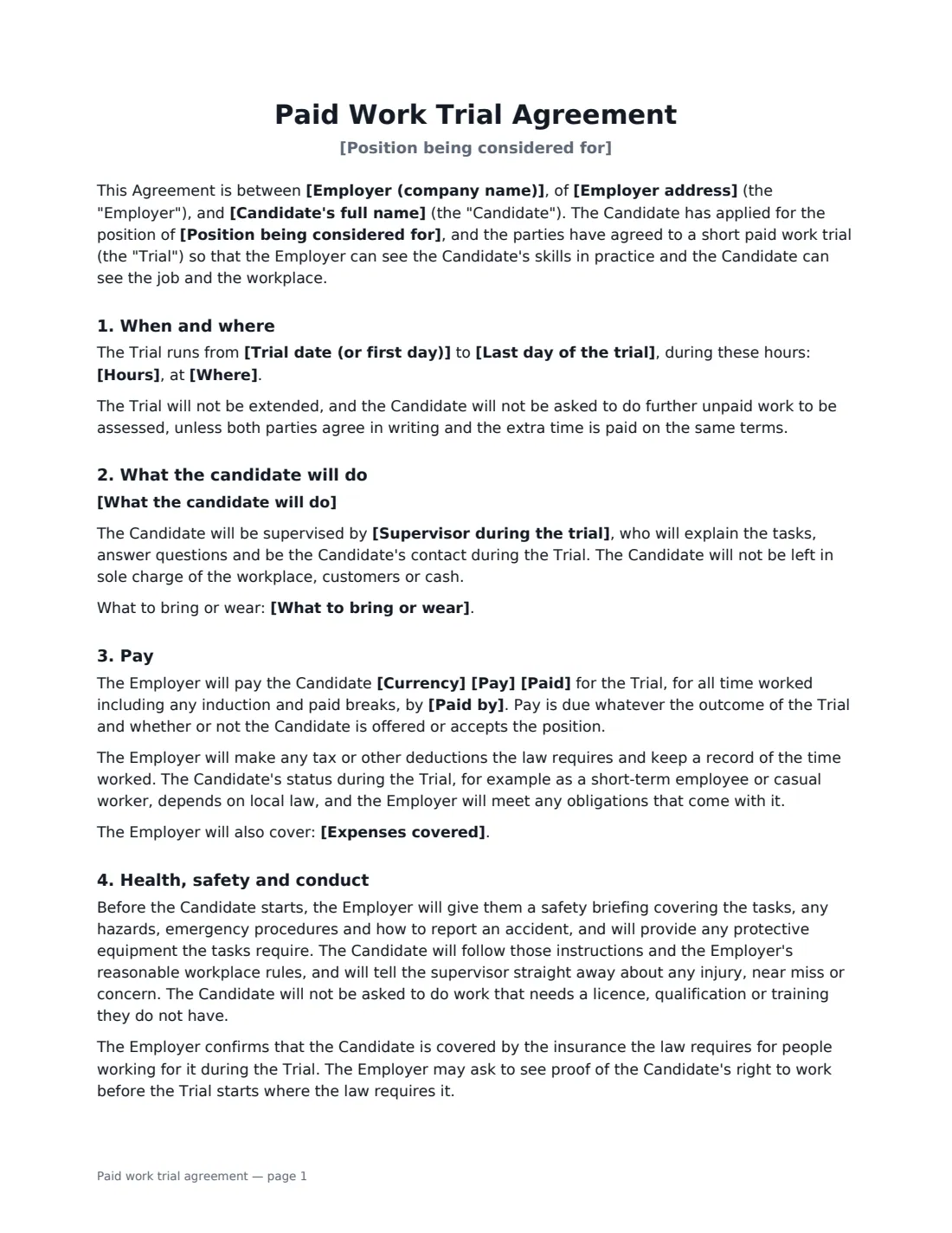
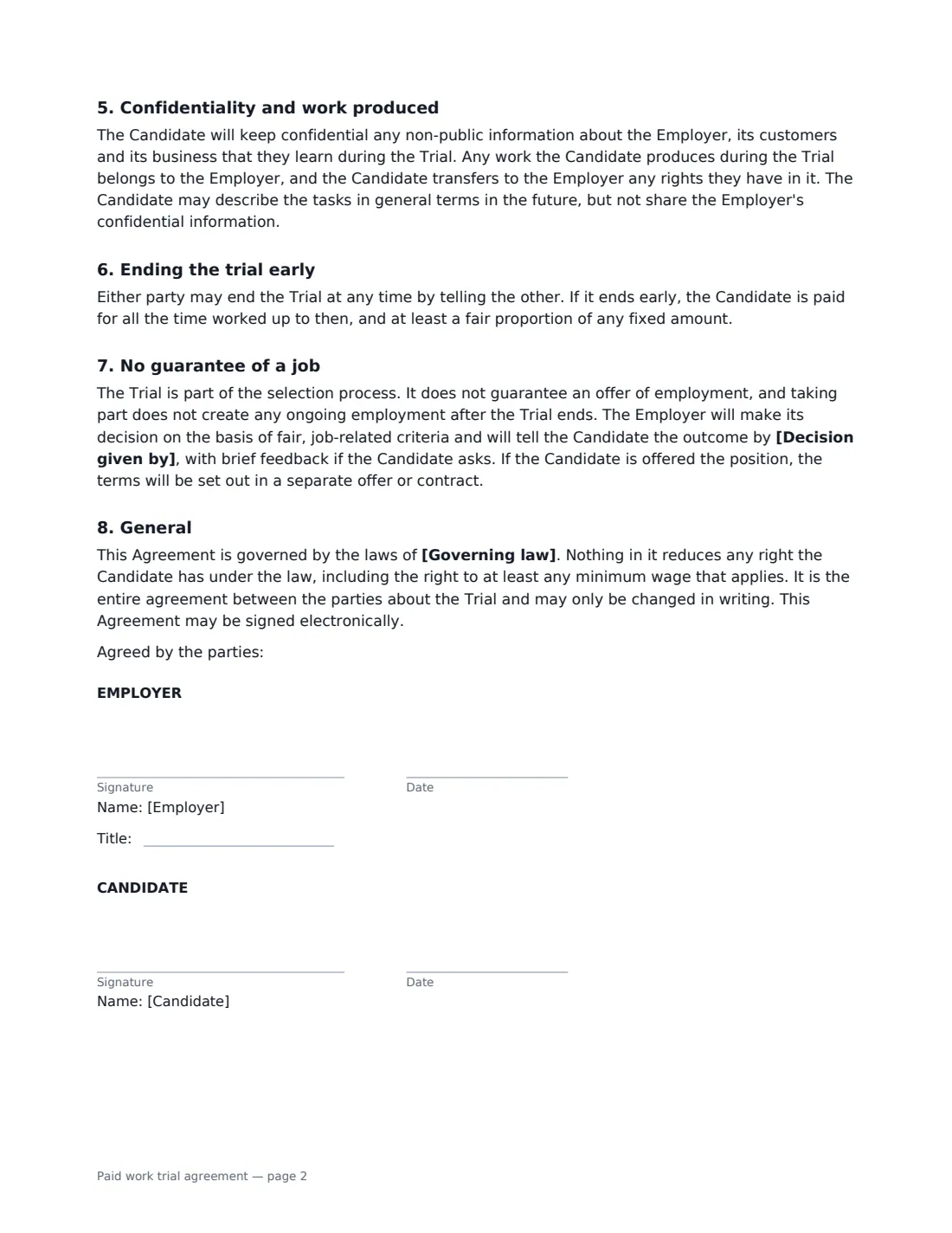
This template puts the essentials in writing before the trial starts. It sets the date or dates, hours and location, the tasks the candidate will do, and a named supervisor. Pay is per hour, per day or a fixed amount, due whatever the outcome, for all time worked including induction, with any legally required deductions. It covers a safety briefing and protective equipment, insurance and right-to-work checks, confidentiality, ownership of the work produced, ending the trial early (with pay for time worked), and a clear statement that the trial does not guarantee a job — with a date by which the employer will give its decision.
- Best for
- Trial shifts and short paid test projects before a hiring decision
- Signed by
- The employer and the candidate
- Pay
- Per hour, per day or a fixed amount — paid whatever the outcome
- Length
- About 2 pages
When to Use a paid work trial agreement
- A restaurant trialling a cook or server for a lunch service
- A retailer or café running a paid trial shift before hiring
- A trades or warehouse business checking practical skills on the job
- A design, writing or development team setting a short paid test project
- A salon or studio seeing a stylist or instructor work with real clients under supervision
What You Fill In
18 blanks, then the name and email of each person who signs: employer, candidate.
1 The parties
- Employer (company name)*
- Employer address
- Candidate's full name*
- Position being considered for*
2 The trial
- Trial date (or first day)*
- Last day of the trial
- Hours*
- Where*
- What the candidate will do*
- Supervisor during the trial*
- What to bring or wear
3 Pay
- Currency*
- Pay*
- Paid* per hour · per day · as a fixed amount
- Paid by*
- Expenses covered
4 After the trial
- Decision given by*
- Governing law*
5 Who signs
- Employer signature and date, job title
- Candidate signature and date · The person doing the trial.
What the paid work trial agreement Covers
- When and where
- What the candidate will do
- Pay
- Health, safety and conduct
- Confidentiality and work produced
- Ending the trial early
- No guarantee of a job
- General
Using the paid work trial agreement, step by step
1 Name the parties and the job
Enter your business name and address, the candidate's name and the position they are being considered for.
2 Plan the trial
Set the date (add a last day only for a multi-day trial), the hours, where it happens and the tasks. Choose real, representative tasks and keep the trial as short as it can be while still showing the skills you need. Name the supervisor and, if useful, what to bring or wear.
3 Set the pay
Enter the amount and whether it is per hour, per day or a fixed amount, plus how and when it will be paid. Make sure it is at least any minimum wage that applies for all the time worked. Add expenses you will cover, such as a meal or parking, if any.
4 Commit to a decision date and send
Choose the date by which you will tell the candidate the outcome and enter the governing law. Add the candidate as signer and send it before the trial day, so it is signed before they start.
Tips Before You Send It
- Get the agreement signed before the trial starts, not on the day.
- Keep the trial short. A few hours is often enough to see how someone works; longer trials cost more and are harder for candidates who have other jobs or commitments.
- Record the actual start and finish times on the day so pay is easy to calculate.
- Give every candidate for the same role a comparable trial and judge them on the same job-related criteria.
- If you hire the candidate, send a proper offer letter or contract — this agreement covers only the trial.
Sign It Online In Minutes
- Fill in the blanks. Names, dates and amounts go straight into the agreement — the preview shows exactly where.
- Name who signs. Tick “This is me” for your own part. VergeHR builds the PDF with every signature, date box on the right line, and you can check or move anything before sending.
- Send it. Each signer gets a secure link and signs from any device — no account needed. The signed PDF, with an audit trail and a Certificate of Completion, is filed in Files and emailed to everyone.
Paid work trial agreement: frequently asked questions
Do I have to pay for a work trial?
In many places, yes — unpaid trials that involve productive work can breach minimum wage rules. This template is for paid trials only, and says pay is due whatever the outcome.
Is the candidate an employee during the trial?
It depends on local law. The agreement doesn't decide it; it says the employer will meet whatever obligations come with the candidate's status, such as deductions, record-keeping and insurance.
Can we end the trial early?
Yes. Either side can stop at any time, and the candidate is paid for the time worked up to then, and at least a fair proportion of a fixed amount.
Can a candidate sign this on their phone?
Yes. The candidate gets a secure link and can sign on any device without a VergeHR account. Electronic signatures are generally valid for ordinary agreements like this in the US (ESIGN Act and UETA), the UK, the EU (eIDAS) and Canada.