

What is a partnership dissolution agreement?
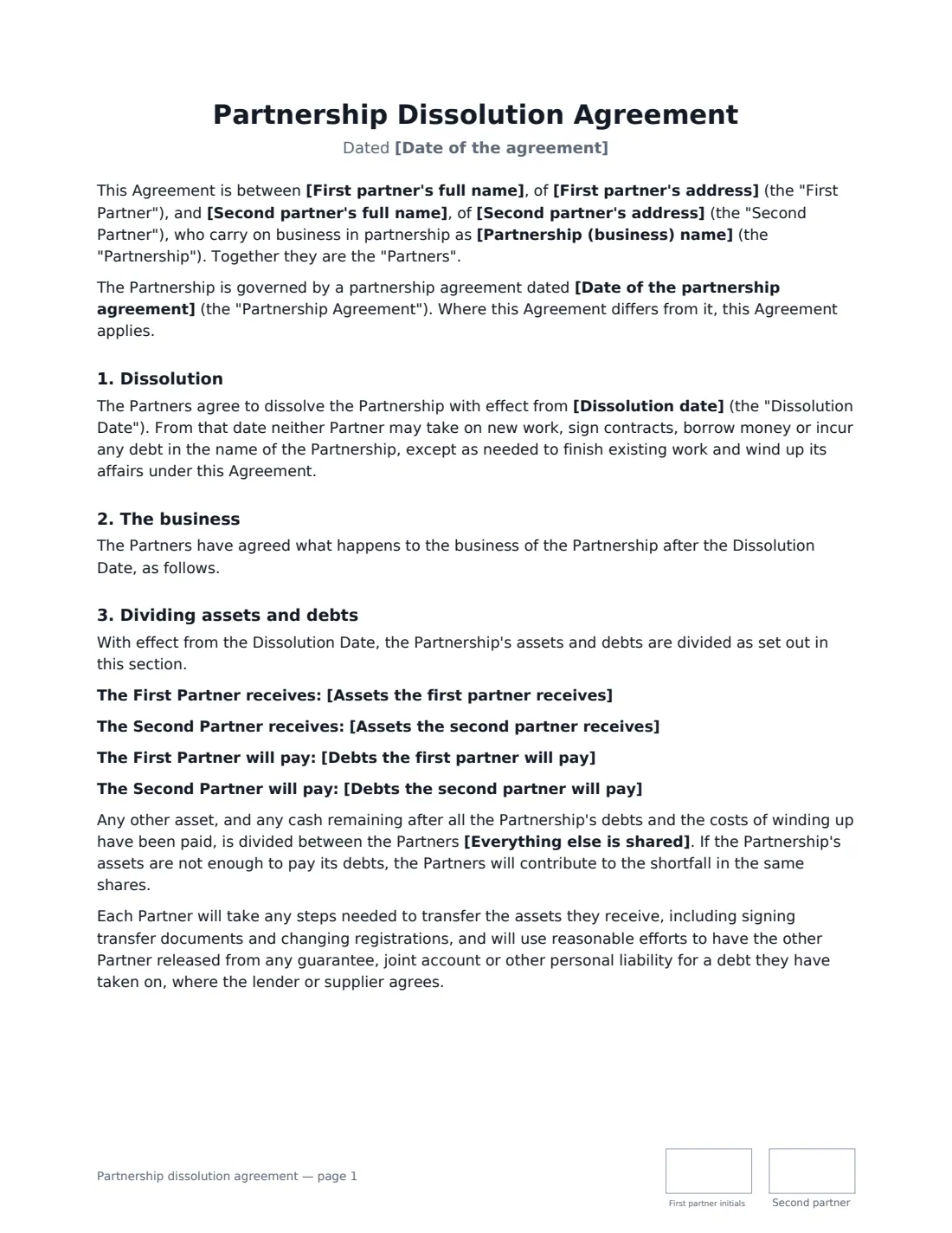
When partners go their separate ways, a written dissolution agreement stops the ending from turning into a dispute. It fixes the date the partnership stops trading, whether one partner carries the business on (and pays the other for their share) or it closes, and exactly who takes which assets and which debts. Without it, partners often discover months later that they disagree about a car, a loan, a client or a final tax bill.
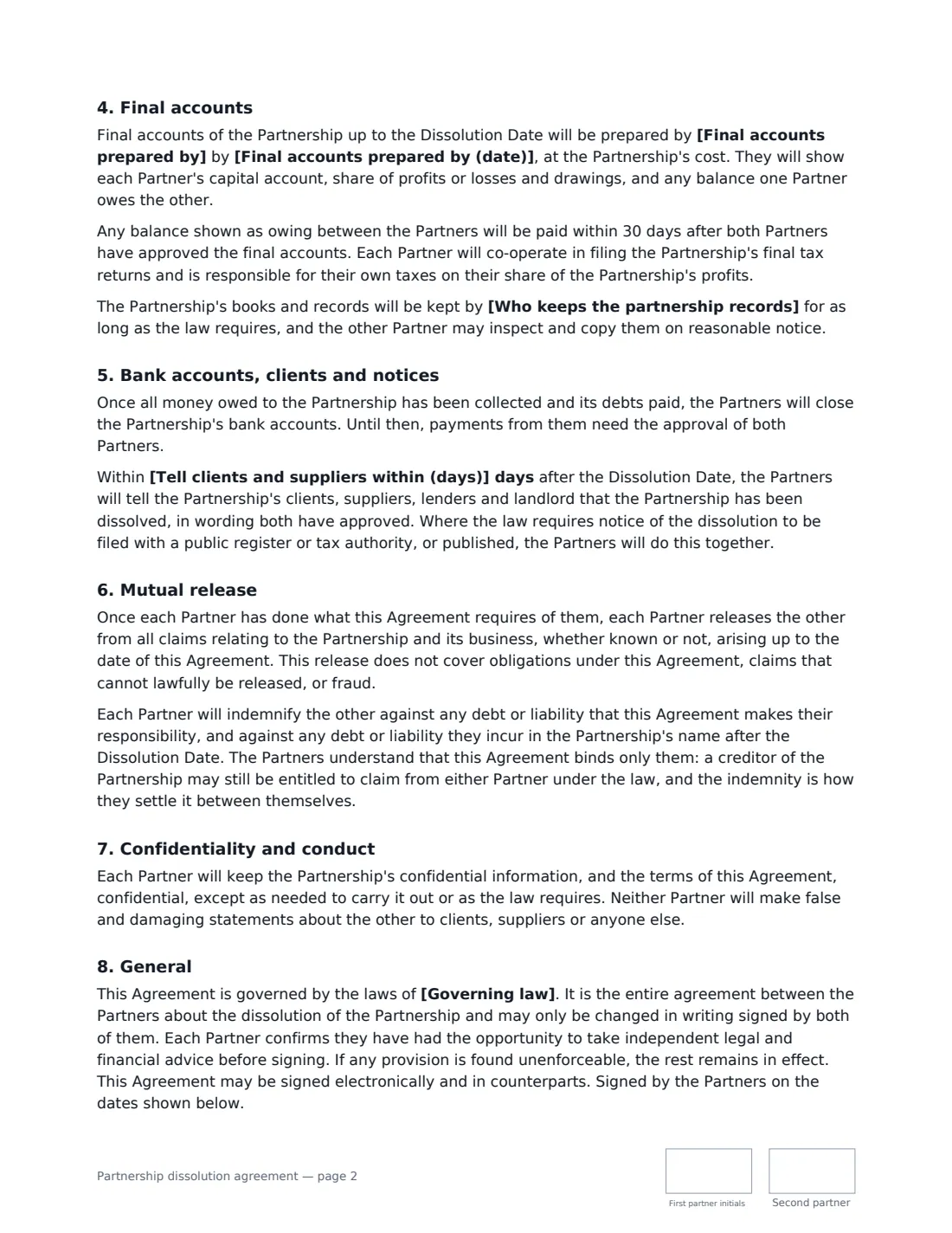
This template covers the dissolution date and the limits on new business after it, three outcomes for the business (it closes, or either partner carries it on and keeps the name), an optional buy-out payment, a division of named assets and debts with everything else shared in the proportions you set, final accounts, records, bank accounts, notifying clients and suppliers, a mutual release with indemnities, and confidentiality.
- Best for
- Two-partner general partnerships and informal business partnerships
- Signed by
- Both partners
- Business
- Closes, or the first or second partner carries it on
- Length
- About 3 pages, initialled on every page
When to Use a partnership dissolution agreement
- Two partners closing a shared design studio, consultancy or shop
- One partner continuing the business under its name while the partnership itself is wound up
- Splitting equipment, vehicles and loans at the end of a partnership
- Ending an informal partnership that never had a written agreement
- Recording a negotiated exit after a disagreement between partners
What You Fill In
22 blanks, then the name and email of each person who signs: first partner, second partner.
1 The partnership
- Date of the agreement*
- Partnership (business) name*
- Date of the partnership agreement
- First partner's full name*
- First partner's address
- Second partner's full name*
- Second partner's address
2 Ending the partnership
- Dissolution date*
- What happens to the business* The business closes · The first partner carries it on · The second partner carries it on
- Currency*
- Buy-out payment to the leaving partner
- Buy-out paid by
3 Dividing assets and debts
- Assets the first partner receives
- Assets the second partner receives
- Debts the first partner will pay
- Debts the second partner will pay
- Everything else is shared*
4 Final accounts
- Final accounts prepared by (date)*
- Final accounts prepared by
- Who keeps the partnership records* the First Partner · the Second Partner
5 Other terms
- Tell clients and suppliers within (days)*
- Governing law*
6 Who signs
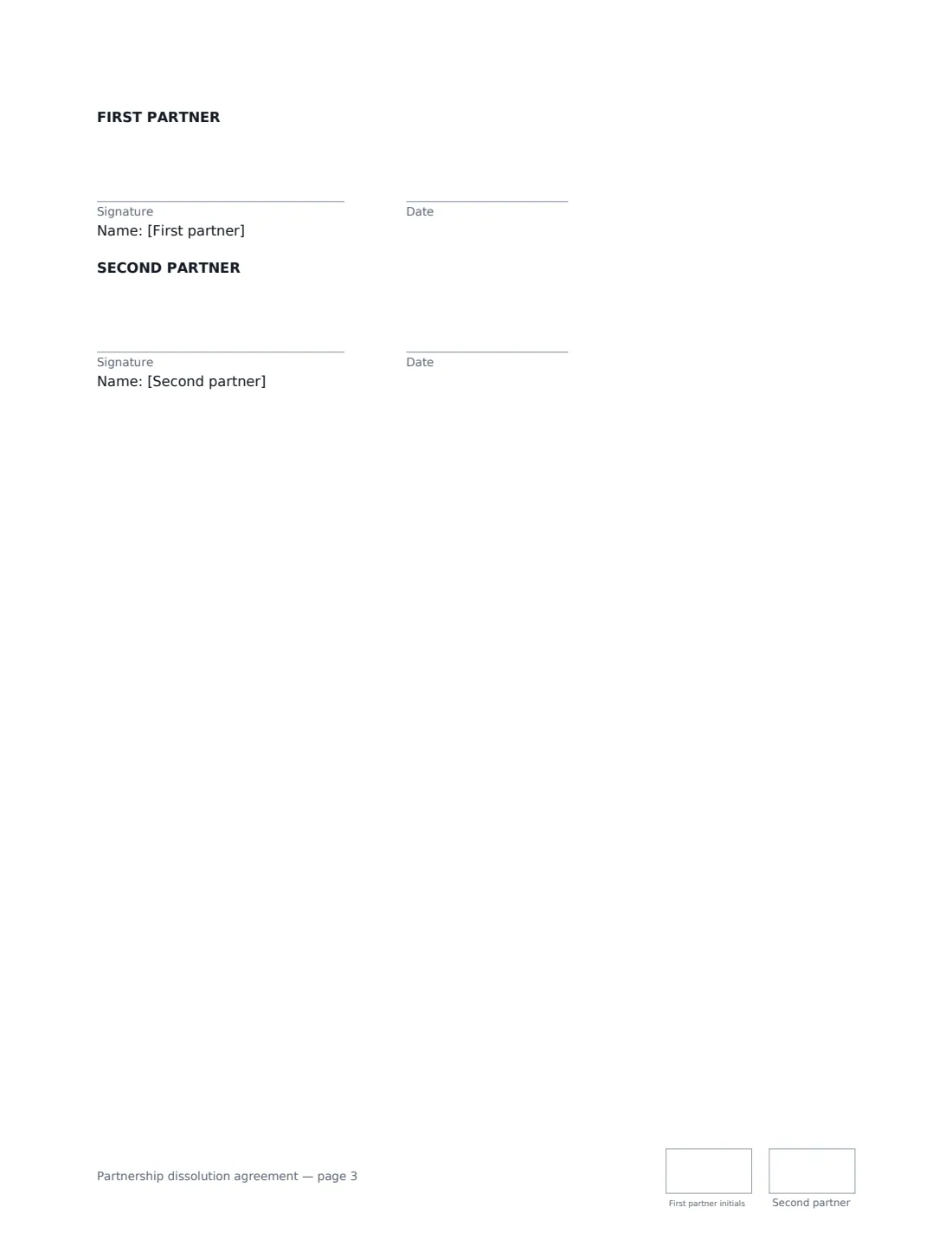
- First partner signature and date, initials on every page
- Second partner signature and date, initials on every page
What the partnership dissolution agreement Covers
- Dissolution
- The business
- Dividing assets and debts
- Final accounts
- Bank accounts, clients and notices
- Mutual release
- Confidentiality and conduct
- General
Using the partnership dissolution agreement, step by step
1 Set the date and what happens to the business
The dissolution date is when the partnership stops taking on new business. Choose whether the business closes or one partner carries it on — the continuing partner keeps the name, goodwill and work in progress. Add a buy-out amount and date if the continuing partner is paying for the other's share.
2 Divide the assets and debts
List what each partner takes and which debts each will pay. Only the lines you fill in appear in the agreement. Everything else, including cash left after paying debts, is shared in the proportions you enter — "equally" by default.
3 Agree the final accounts
Set the date the final accounts must be ready, and name the accountant if one will prepare them. Choose who keeps the partnership records. Balances between the partners are settled within 30 days of approving the accounts.
4 Tell clients and sign
Set how quickly clients, suppliers, lenders and the landlord will be told. Both partners sign online; the signed copy is filed in Files and emailed to both of you.
Tips Before You Send It
- This agreement binds the partners, not the partnership's creditors. Ask lenders and suppliers to release the leaving partner in writing where you can.
- If the partnership is registered, or files its own tax returns, check what must be filed to close it where you are.
- If you had a written partnership agreement, read its exit clauses first — this agreement says it takes priority where they differ.
- Each partner should consider independent legal and tax advice, especially where one is buying the other out.
Sign It Online In Minutes
- Fill in the blanks. Names, dates and amounts go straight into the agreement — the preview shows exactly where.
- Name who signs. Tick “This is me” for your own part. VergeHR builds the PDF with every signature, date and initials box on the right line, and you can check or move anything before sending.
- Send it. Each signer gets a secure link and signs from any device — no account needed. The signed PDF, with an audit trail and a Certificate of Completion, is filed in Files and emailed to everyone.
Partnership dissolution agreement: frequently asked questions
Does this agreement stop creditors from claiming against me?
No. It sets out how the partners share debts between themselves, with indemnities if one pays a debt the other agreed to take. A creditor of the partnership may still be entitled to claim from either partner, depending on the law, unless the creditor releases them.
Can one partner keep the business name?
Yes. If you choose that the first or second partner carries the business on, that partner keeps the name, goodwill and client relationships, and the other agrees not to use the name or anything confusingly similar.
What does the mutual release cover?
Once each partner has done what the agreement requires, each releases the other from claims about the partnership up to the signing date. It does not cover obligations under the agreement itself, claims that cannot lawfully be released, or fraud.
Can we sign a partnership dissolution agreement electronically?
Electronic signatures are generally valid for ordinary contracts like this in the US (ESIGN Act and UETA), the UK, the EU (eIDAS) and Canada. Transfers of land or buildings, or filings with a public register, may need their own forms.