

What is a student code of conduct acknowledgement?
A behaviour policy only works if students and families know it and the school applies it fairly. Collecting a signed acknowledgement at enrolment or the start of each year gives everyone the same summary and a record that it was read — useful when a difficult conversation comes later.
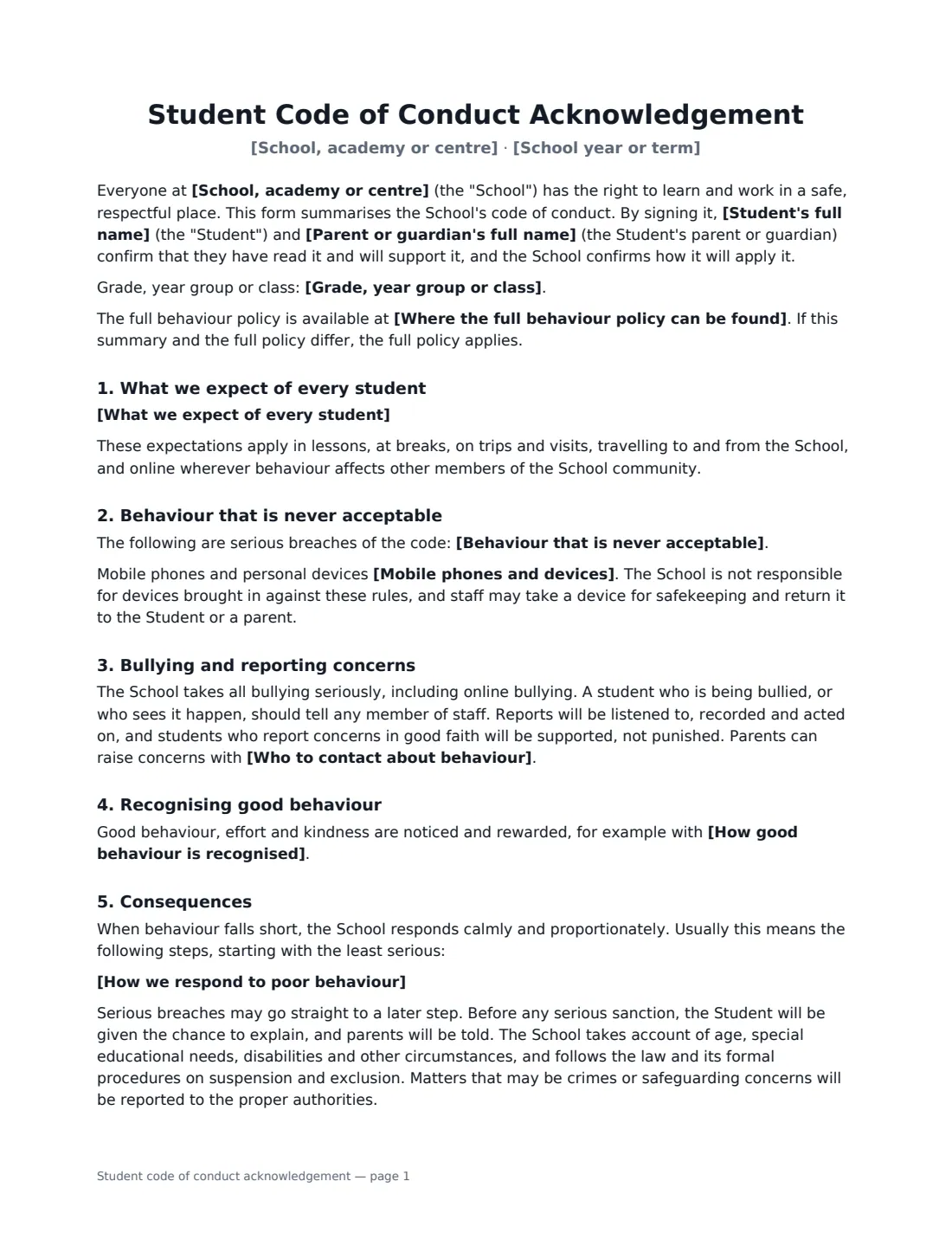
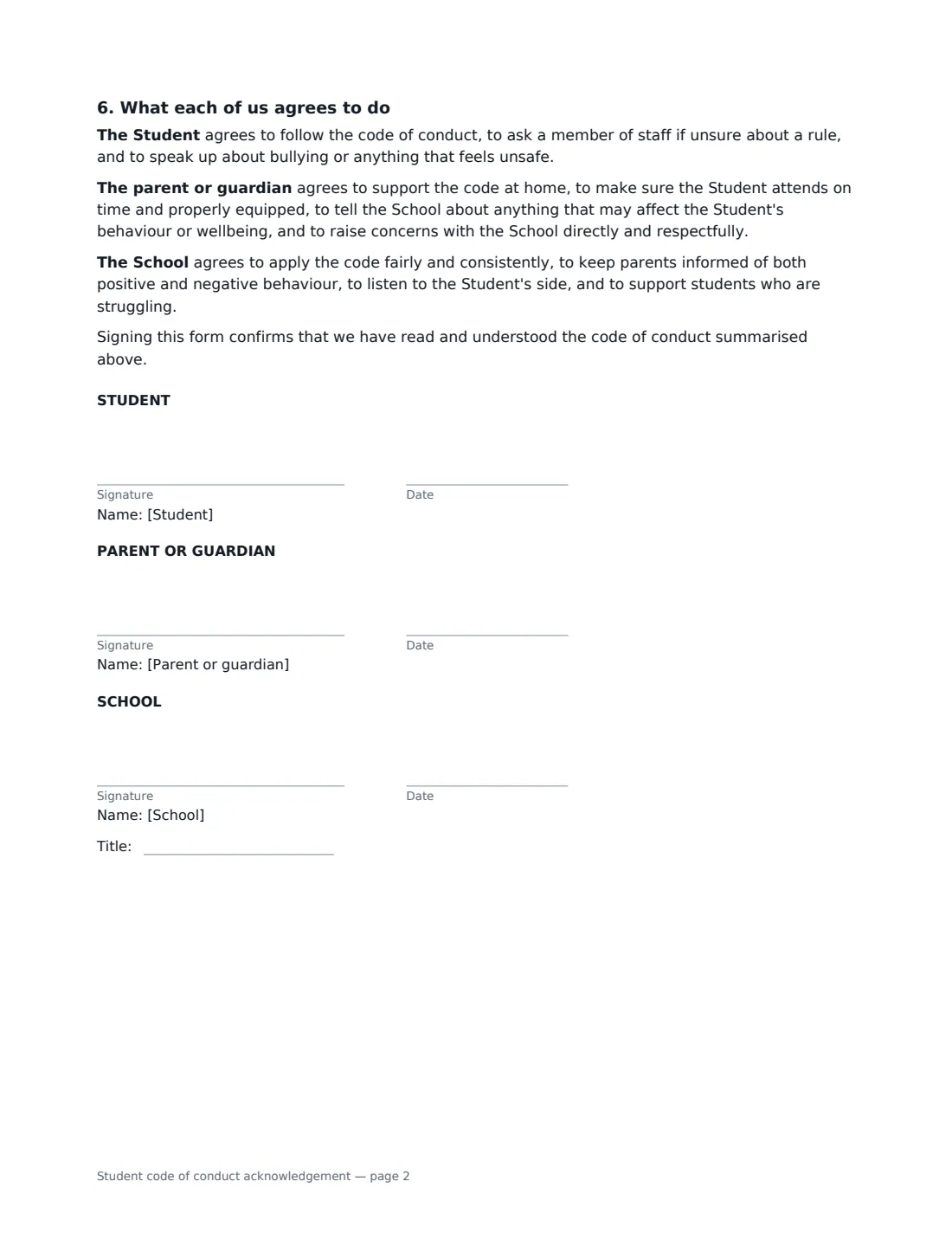
This template summarises your code in your own words: the expectations for every student, behaviour that is never acceptable (bullying, violence, weapons, drugs and vaping, theft, cheating, sharing images without consent), your mobile phone rule, how bullying can be reported, and how good behaviour is recognised. The consequences section sets out your steps from a reminder to suspension or exclusion, with the safeguards that matter: the student is heard first, parents are told, special educational needs and disabilities are taken into account, and legal procedures are followed. It ends with what the student, the parent or guardian and the school each commit to, and all three sign.
- Best for
- Private schools, academies, tutoring and learning centres, after-school programs, language schools
- Signed by
- The student, a parent or guardian, and the school
- You fill in
- Expectations, banned behaviour, phone rule, consequence steps, rewards, contact
- Length
- 2 pages
When to Use a student code of conduct acknowledgement
- Enrolment paperwork for a new school year
- A tutoring or learning centre introducing written behaviour rules
- A new mobile phone policy that families need to see and accept
- Re-confirming expectations after a behaviour incident
- Weekend, holiday or language schools with students from many schools
What You Fill In
12 blanks, then the name and email of each person who signs: student, parent or guardian, school.
1 The school
- School, academy or centre*
- School year or term*
- Where the full behaviour policy can be found
- Who to contact about behaviour*
2 The student
- Student's full name*
- Grade, year group or class
- Parent or guardian's full name*
3 Expectations
- What we expect of every student*
- Behaviour that is never acceptable*
- Mobile phones and devices* must be switched off and kept in bags during the school day unless a teacher allows their use · must be handed in at the start of the day and are returned at the end · may be used at breaks and lunch but not in lessons · must not be brought onto the premises
4 Consequences
- How we respond to poor behaviour*
- How good behaviour is recognised
5 Who signs
- Student signature and date
- Parent or guardian signature and date · A parent or legal guardian of the student.
- School signature and date, job title · The head, principal, director or a teacher signing for the school.
What the student code of conduct acknowledgement Covers
- What we expect of every student
- Behaviour that is never acceptable
- Bullying and reporting concerns
- Recognising good behaviour
- Consequences
- What each of us agrees to do
Using the student code of conduct acknowledgement, step by step
1 Add your school and a contact
Name the school and year, where the full behaviour policy lives, and who parents should contact about behaviour. If the summary and the full policy ever differ, the full policy applies.
2 Write expectations and red lines
The defaults are a sensible starting point — arrive ready to learn, treat everyone with respect, follow instructions, do honest work. Edit them into your own voice, one per line. Adjust the list of behaviour that is never acceptable.
3 Choose the phone rule and consequences
Pick one of four common mobile phone rules. Then list your consequence steps from least to most serious. Suspension and exclusion are often regulated by law or your governing body, so make sure your steps match the rules that apply to you.
4 Send to student and parent
Add the student, a parent or guardian, and yourself. Each signs from their own device, and the signed copy is filed in Files.
Tips Before You Send It
- Keep it to a summary. Families read a short page of clear rules; they rarely read a twenty-page policy. Point to the full policy for the detail.
- Include praise as well as sanctions — the template has a section for how good behaviour is recognised.
- Apply the code consistently. Inconsistent sanctions are what parents challenge most often.
- For very young children, the student's signature is symbolic; the parent's acknowledgement is what matters.
Sign It Online In Minutes
- Fill in the blanks. Names, dates and amounts go straight into the agreement — the preview shows exactly where.
- Name who signs. Tick “This is me” for your own part. VergeHR builds the PDF with every signature, date box on the right line, and you can check or move anything before sending.
- Send it. Each signer gets a secure link and signs from any device — no account needed. The signed PDF, with an audit trail and a Certificate of Completion, is filed in Files and emailed to everyone.
Student code of conduct acknowledgement: frequently asked questions
Does the student have to sign as well as the parent?
The template has signature blocks for the student, a parent or guardian, and the school. Having the student sign helps them take ownership of the rules, even when legally it is the parent's acknowledgement that counts.
Can I suspend or exclude a student based on this form?
The form describes your steps, but suspension and exclusion must follow the law and formal procedures that apply to your school, which vary widely by country, state and type of school. The form says so.
Does it cover online behaviour?
Yes. The expectations apply online wherever behaviour affects other members of the school community, and bullying includes online bullying.
Are electronic signatures acceptable?
Generally yes. Electronic signatures are widely recognised for acknowledgements like this in the US (ESIGN and UETA), the UK, the EU (eIDAS) and Canada. VergeHR records an audit trail for each signer.