

What is a artwork release?
When a recognisable piece of art, a design or a brand's logo appears in a film, photograph or printed piece, the production usually needs the rights owner's permission — something known as clearance. An artwork release is that permission in writing. Productions use it for paintings on a set wall, a mural behind a street scene, a designer's furniture, a poster or a product with a visible trademark; publishers and photographers use it for catalogues, books and campaigns.
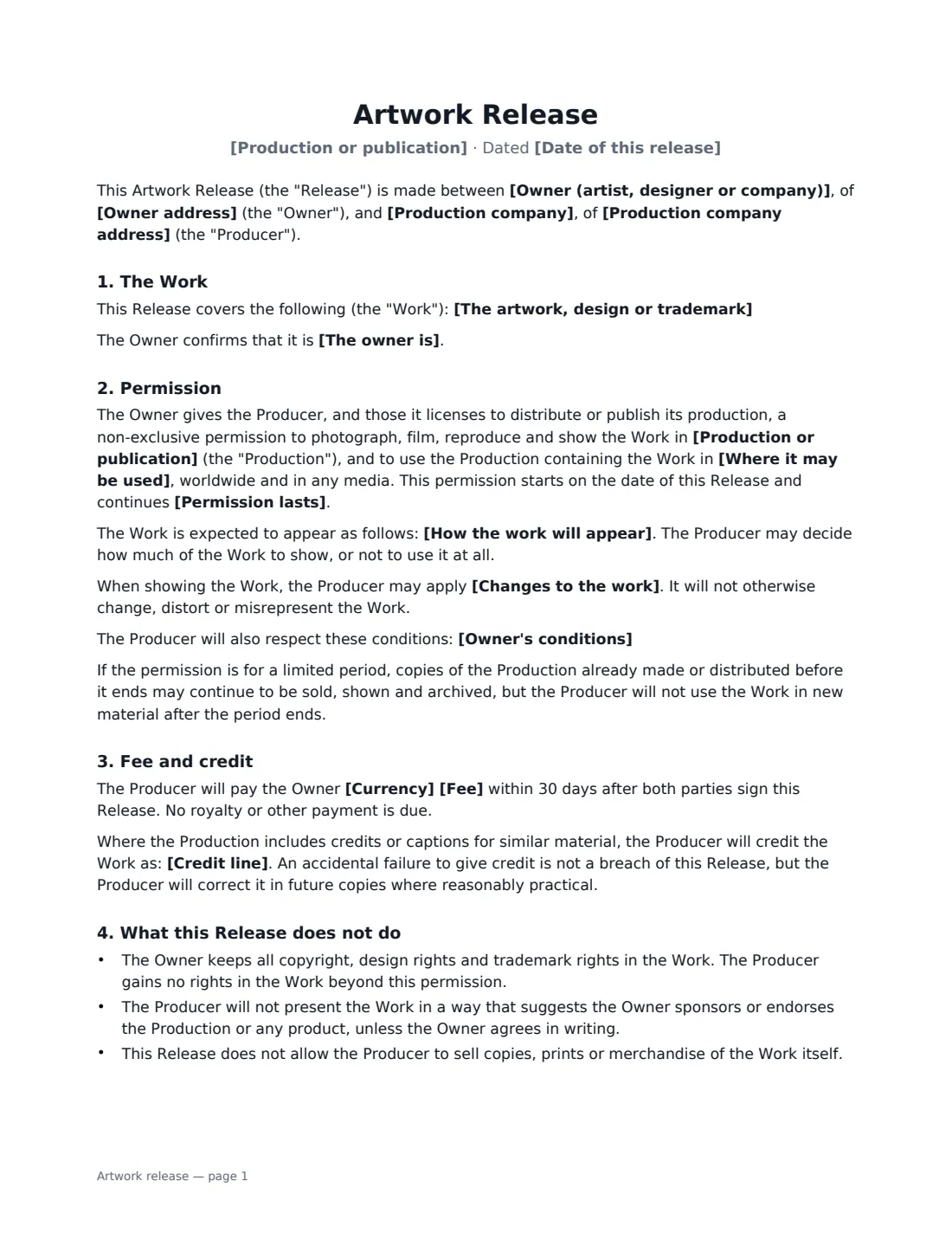
This template identifies the work precisely and records who is granting permission — the artist, the rights owner, the trademark owner or someone authorised for them. It grants a non-exclusive permission to show the work in the named production and, if you choose, its advertising and publicity, worldwide, permanently or for a set number of years. You can describe how the work will appear and add the owner's conditions. You choose whether only ordinary editing (cropping, framing, lighting, colour grading) is allowed or other changes such as blurring. It records any fee and credit line, and makes clear the owner keeps all its rights, the production will not suggest endorsement, and no merchandise may be made.
- Best for
- Film and TV set dressing, photo shoots, advertising, books and catalogues
- Signed by
- The owner of the work and the production company
- Permission
- Non-exclusive, worldwide; permanent or for 1, 3 or 5 years
- Length
- About 2 pages
When to Use a artwork release
- Showing a local artist's paintings on the walls of a film set
- Filming a street scene in front of a mural
- Featuring a designer's furniture or ceramics in a photo shoot
- Showing a brand's logo or product in a music video or advert
- Reproducing an artwork in a book, catalogue or magazine feature
What You Fill In
17 blanks, then the name and email of each person who signs: owner, production company.
1 The parties
- Date of this release*
- Production company*
- Production company address
- Owner (artist, designer or company)*
- Owner address
- The owner is* the artist or designer who created the Work · the owner of the copyright or design rights in the Work · the owner of the trademark shown in the Work · authorised to grant these rights for the rights owner
2 The work
- The artwork, design or trademark*
3 The use
- Production or publication*
- How the work will appear
- Where it may be used* the Production and its advertising, publicity and trailers · the Production only, not in advertising or publicity
- Permission lasts* permanently · for 1 year · for 3 years · for 5 years
- Changes to the work* ordinary editing only, such as cropping, framing, lighting and colour grading · ordinary editing, and any other change the Production reasonably needs, such as blurring or partly hiding the Work
- Owner's conditions
4 Fee and credit
- Currency
- Fee
- Credit line
- Governing law*
5 Who signs
- Owner signature and date, job title · The artist, designer or company that owns the rights in the work.
- Production company signature and date, job title · The production, publisher or photographer that wants to show the work.
What the artwork release Covers
- The Work
- Permission
- Fee and credit
- What this Release does not do
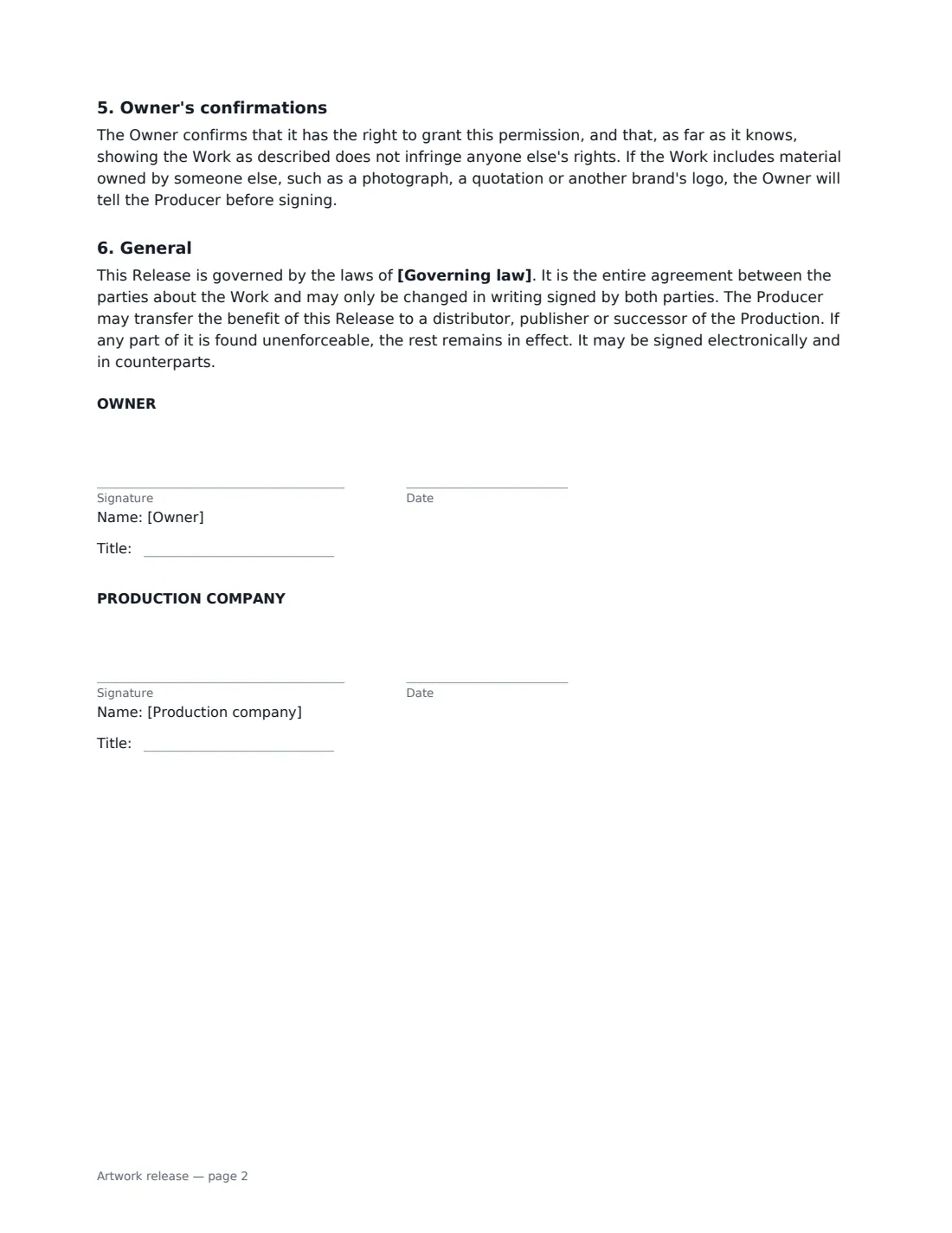
- Owner's confirmations
- General
Using the artwork release, step by step
1 Identify the owner and the work
Enter the owner and choose their role — the artist, the rights owner, the trademark owner or an authorised agent. Describe the work so it cannot be confused with anything else: title, artist or brand, medium and location.
2 Describe the use
Name the production or publication, say how the work will appear if you know, and choose whether it may also appear in advertising and publicity. Pick how long the permission lasts and what editing is allowed.
3 Add conditions, fee and credit
Add any conditions the owner asks for, such as not showing the work in a violent scene or next to a competitor. Enter a fee if there is one and the exact credit line, or leave them empty.
4 Send for signature
Send it to the owner. Both of you sign online and the signed PDF is filed in Files, ready to hand to a distributor, publisher or insurer.
Tips Before You Send It
- Clear artwork before the shoot, not after — replacing a piece on set is far cheaper than blurring it in the edit.
- Films and printed books usually need permanent permission because they cannot be changed after release.
- Check whether the work includes someone else's material, such as a photograph within a collage; the owner confirms it will tell you.
- Brief or incidental appearances may not always need clearance where you are, but a signed release removes doubt. Take advice for high-profile uses.
Sign It Online In Minutes
- Fill in the blanks. Names, dates and amounts go straight into the agreement — the preview shows exactly where.
- Name who signs. Tick “This is me” for your own part. VergeHR builds the PDF with every signature, date box on the right line, and you can check or move anything before sending.
- Send it. Each signer gets a secure link and signs from any device — no account needed. The signed PDF, with an audit trail and a Certificate of Completion, is filed in Files and emailed to everyone.
Artwork release: frequently asked questions
Does the production own the artwork after signing?
No. The owner keeps all copyright, design and trademark rights. The production gets a non-exclusive permission to show the work in the production described.
Can we use the work in posters and trailers?
Yes, if you choose the option that includes advertising, publicity and trailers. The other option limits use to the production itself.
What if the permission is for a limited time?
Copies of the production already made or distributed can continue to be sold and shown after it ends, but the work cannot be used in new material after that date.
Is an electronic signature valid for an artwork release?
Electronic signatures are generally valid for ordinary contracts like this in the US (ESIGN Act and UETA), the UK, the EU (eIDAS) and Canada. VergeHR keeps an audit trail and a Certificate of Completion with the signed PDF.