

What is a board member agreement?
A board member agreement, sometimes called a director appointment letter or trustee agreement, sets out what an organisation expects of a new board member and what the board member can expect in return. It does not replace the organisation's governing documents or the law. It puts the practical points in one signed document that both sides can refer back to: how often the board meets, what the role involves, how conflicts are handled and whether the role is paid.
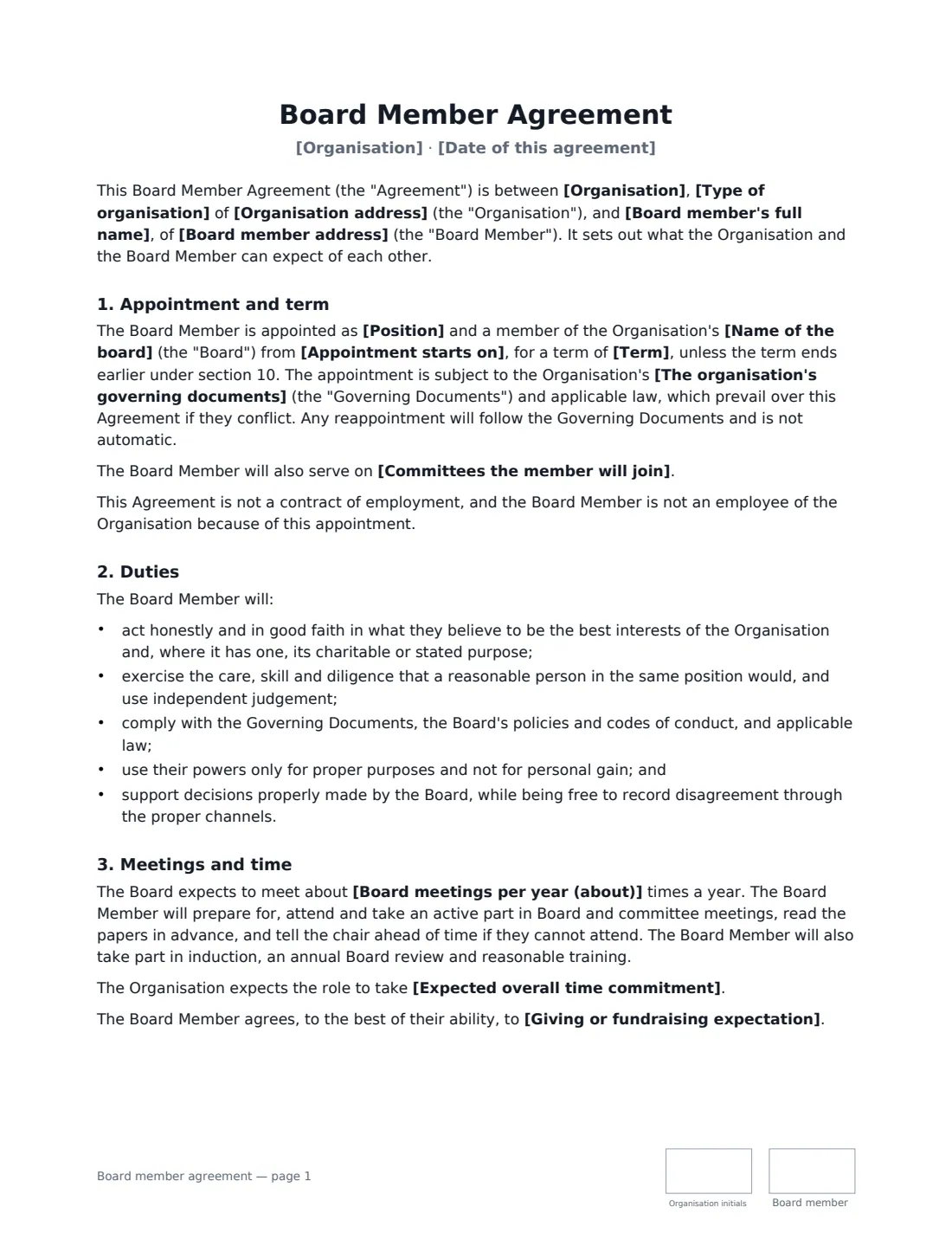
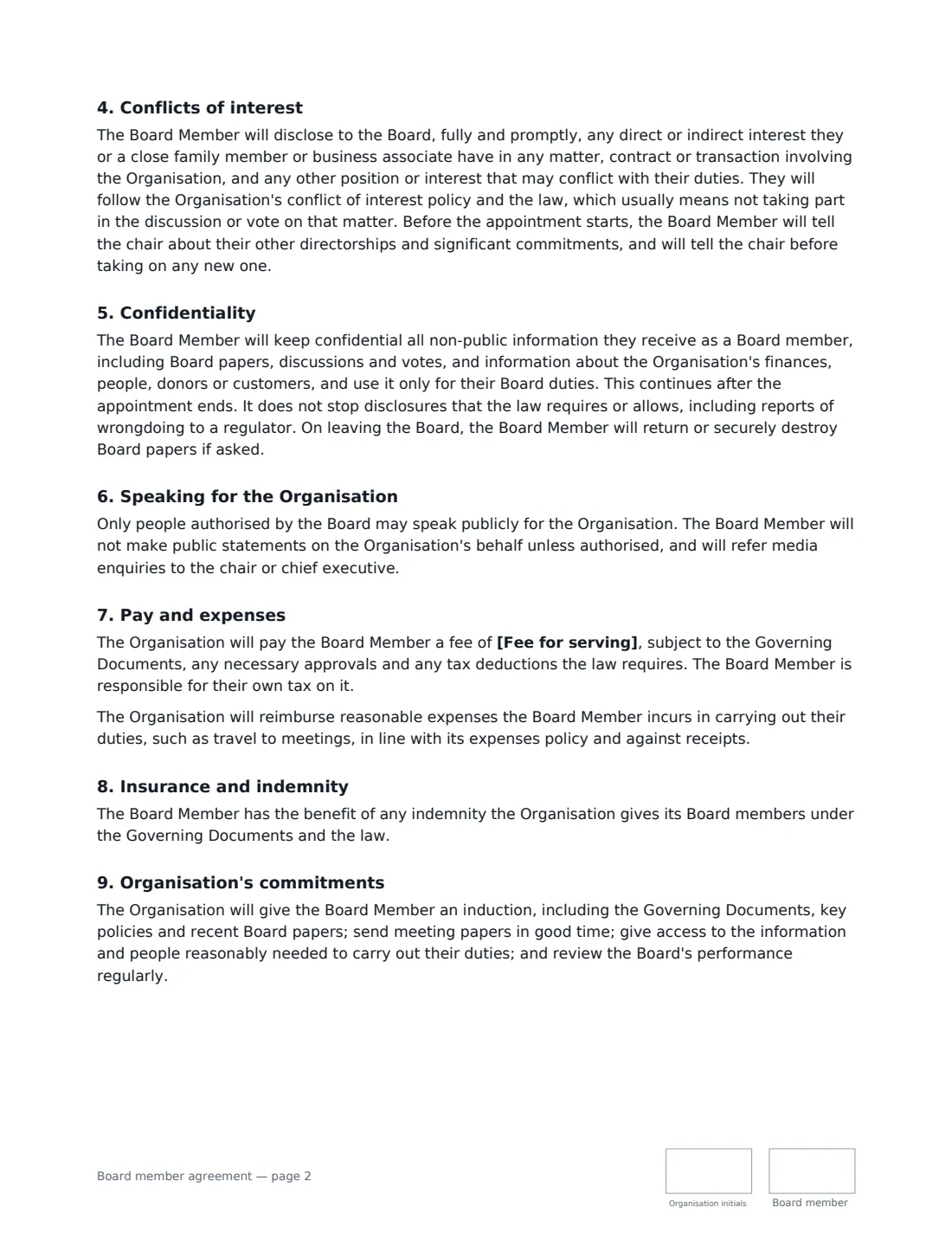
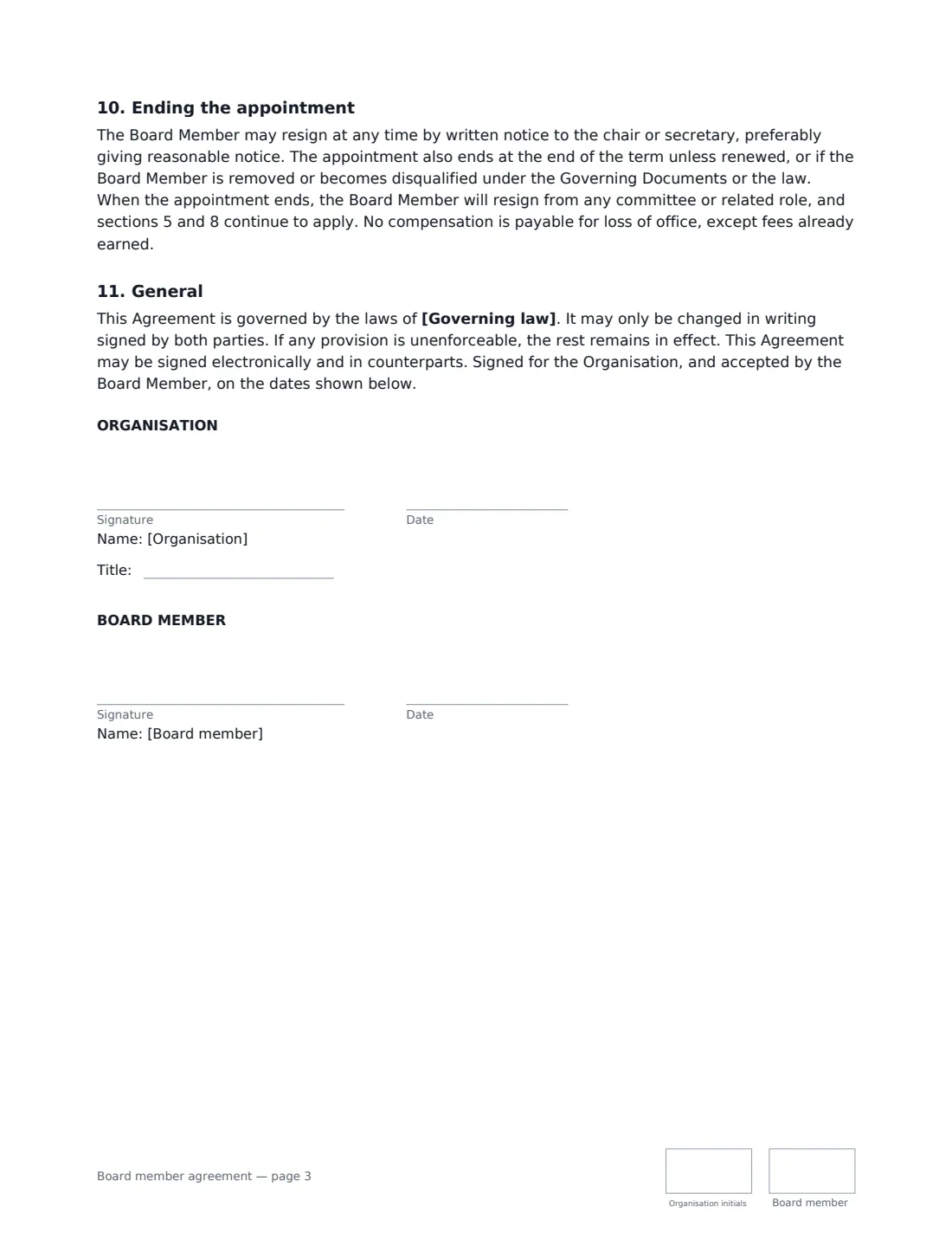
The template works for a company, a nonprofit organisation or a charity. You set the position, the start date and a term of 1 to 4 years, any committees, the expected number of meetings and time commitment, and an optional giving or fundraising expectation for nonprofits. It lists the core duties (good faith, care and skill, following the governing documents, proper purposes) and covers conflicts of interest and other directorships, confidentiality, and speaking for the organisation. It also covers any fee (or that the role is unpaid), expenses, directors' and officers' insurance, the organisation's own commitments such as induction and papers in good time, and resignation and removal. It says clearly that the role is not employment.
- Best for
- Companies, nonprofits and charities appointing a new director or trustee
- Signed by
- The organisation (usually the chair) and the new board member
- Term
- 1, 2, 3 or 4 years, subject to the governing documents
- Length
- About 3 pages, initialled on every page
When to Use a board member agreement
- A startup adding an independent or investor director to its board
- A nonprofit welcoming a new trustee and setting a giving expectation
- A family business appointing its first non-executive director
- A charity recording that trustees are unpaid but reimbursed for expenses
- Refreshing expectations when a board member is reappointed for a new term
What You Fill In
18 blanks, then the name and email of each person who signs: organisation, board member.
1 The organisation
- Date of this agreement*
- Organisation*
- Organisation address
- Type of organisation* a company · a nonprofit organisation · a charity
- Name of the board*
- The organisation's governing documents*
2 The appointment
- Board member's full name*
- Board member address
- Position*
- Appointment starts on*
- Term* 1 year · 2 years · 3 years · 4 years
- Committees the member will join
3 Commitment
- Board meetings per year (about)*
- Expected overall time commitment
- Giving or fundraising expectation
4 Pay and expenses
- Fee for serving
- Does the organisation hold directors' and officers' (D&O) insurance?* Yes · No
- Governing law*
5 Who signs
- Organisation signature and date, job title, initials on every page · Usually signed by the chair or another authorised officer.
- Board member signature and date, initials on every page · The new director or trustee.
What the board member agreement Covers
- Appointment and term
- Duties
- Meetings and time
- Conflicts of interest
- Confidentiality
- Speaking for the Organisation
- Pay and expenses
- Insurance and indemnity
- Organisation's commitments
- Ending the appointment
- General
Using the board member agreement, step by step
1 Describe the organisation
Enter its name and type, the name of the board (such as Board of Trustees) and its governing documents, such as bylaws or articles of association. The agreement says those documents and the law prevail if anything conflicts.
2 Set the appointment
Enter the board member's name, their position, start date and term, and any committees they will join.
3 Agree the commitment
Enter the expected number of meetings a year and, optionally, an overall time commitment and a giving or fundraising expectation.
4 Pay, insurance and signing
Enter a fee or leave it empty for an unpaid role, say whether you hold D&O insurance, and choose the governing law. The chair or another authorised person signs for the organisation.
Tips Before You Send It
- Make sure the appointment itself is made properly under your governing documents, for example by a board or member resolution. This agreement records the terms but does not appoint anyone.
- Many charities and nonprofits can only pay trustees or directors in limited circumstances. Check your rules and local law before entering a fee.
- Give new members the conflict of interest policy with this agreement, and ask them to list their other directorships before they start.
- If you do not have D&O insurance, the template says so. Experienced directors often ask about it.
Sign It Online In Minutes
- Fill in the blanks. Names, dates and amounts go straight into the agreement — the preview shows exactly where.
- Name who signs. Tick “This is me” for your own part. VergeHR builds the PDF with every signature, date and initials box on the right line, and you can check or move anything before sending.
- Send it. Each signer gets a secure link and signs from any device — no account needed. The signed PDF, with an audit trail and a Certificate of Completion, is filed in Files and emailed to everyone.
Board member agreement: frequently asked questions
Does a board member agreement appoint the director?
No. The appointment is made under the organisation's governing documents and the law, usually by the board or the members. This agreement sets out the terms and expectations once that is done.
Is a board member an employee?
Not because of the board role. The agreement says it is not a contract of employment. A person who is also an employee, such as a chief executive on the board, has a separate employment contract.
Can we set a fundraising target for nonprofit board members?
Yes. The optional giving or fundraising expectation is written as a best-efforts commitment. Leave it empty if your board does not have one.
Can it be signed electronically?
Electronic signatures are generally valid for agreements like this in the US (ESIGN Act and UETA), the UK, the EU (eIDAS) and Canada. VergeHR keeps an audit trail and a Certificate of Completion with the signed PDF.