

What is a interview release?
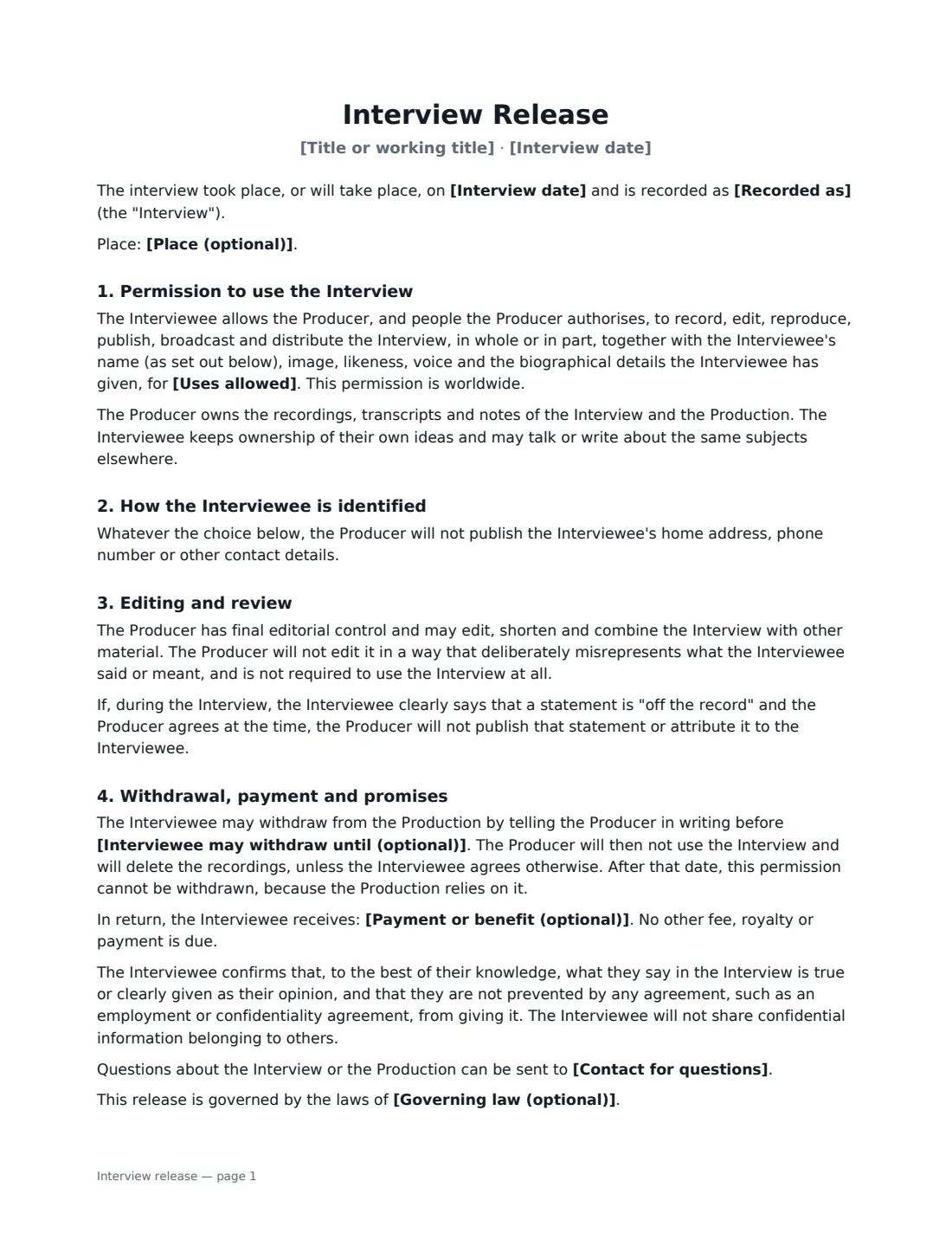
An interview release (also called an interview consent form or appearance release) is the permission a producer, journalist, podcaster, author or researcher gets from the person they interview. It confirms that the interview can be recorded, edited and published, that the interviewee's name, image, voice and background can appear with it, and on what terms. Distributors, broadcasters, publishers and insurers commonly ask to see signed releases before a documentary or series is released.
This template works for documentaries, podcasts, articles and books, video series, radio and TV programmes and research studies. You describe the production and the topic, choose how the interview is recorded, and set whether the interviewee is credited by full name, first name only or anonymously — the anonymous option commits you to disguising their face or voice. You can offer a quote-accuracy check or a full transcript review with a deadline, a date until which the interviewee may withdraw, and a payment or benefit. It includes an "off the record" clause, a promise not to deliberately misrepresent what was said, a parent or guardian version for under-18s, and extra wording on voluntary participation and data handling for research studies.
- Best for
- Documentaries, podcasts, journalism, books, oral history and research interviews
- Signed by
- The interviewee (or their parent or guardian) and the producer
- Credit options
- Full name, first name only, or anonymous
- Length
- About 2 pages
When to Use a interview release
- Contributors appearing on camera in an independent documentary
- Guests on a podcast or YouTube interview series
- Sources quoted at length in a book, long-form article or company publication
- Oral history projects recording community members' memories
- Qualitative research interviews that will be quoted in reports or papers
What You Fill In
17 blanks, then the name and email of each person who signs: interviewee, producer.
1 The production
- Producer (person or company)*
- Title or working title*
- Type of production* documentary · podcast · article or book · video series · radio or TV programme · research study
- What the interview is about*
2 The interview
- Interviewee's full name*
- Is the interviewee under 18?* No · Yes
- Interview date*
- Place (optional)
- Recorded as* audio and video · audio only · written notes and a transcript only
3 Use and credit
- Uses allowed*
- The interviewee is identified* by full name · by first name only · anonymously
- Review before publication* No review · The interviewee may check direct quotes for accuracy · The interviewee may review the transcript
- Review period (days)
- Interviewee may withdraw until (optional)
- Payment or benefit (optional)
- Contact for questions
- Governing law (optional)
4 Who signs
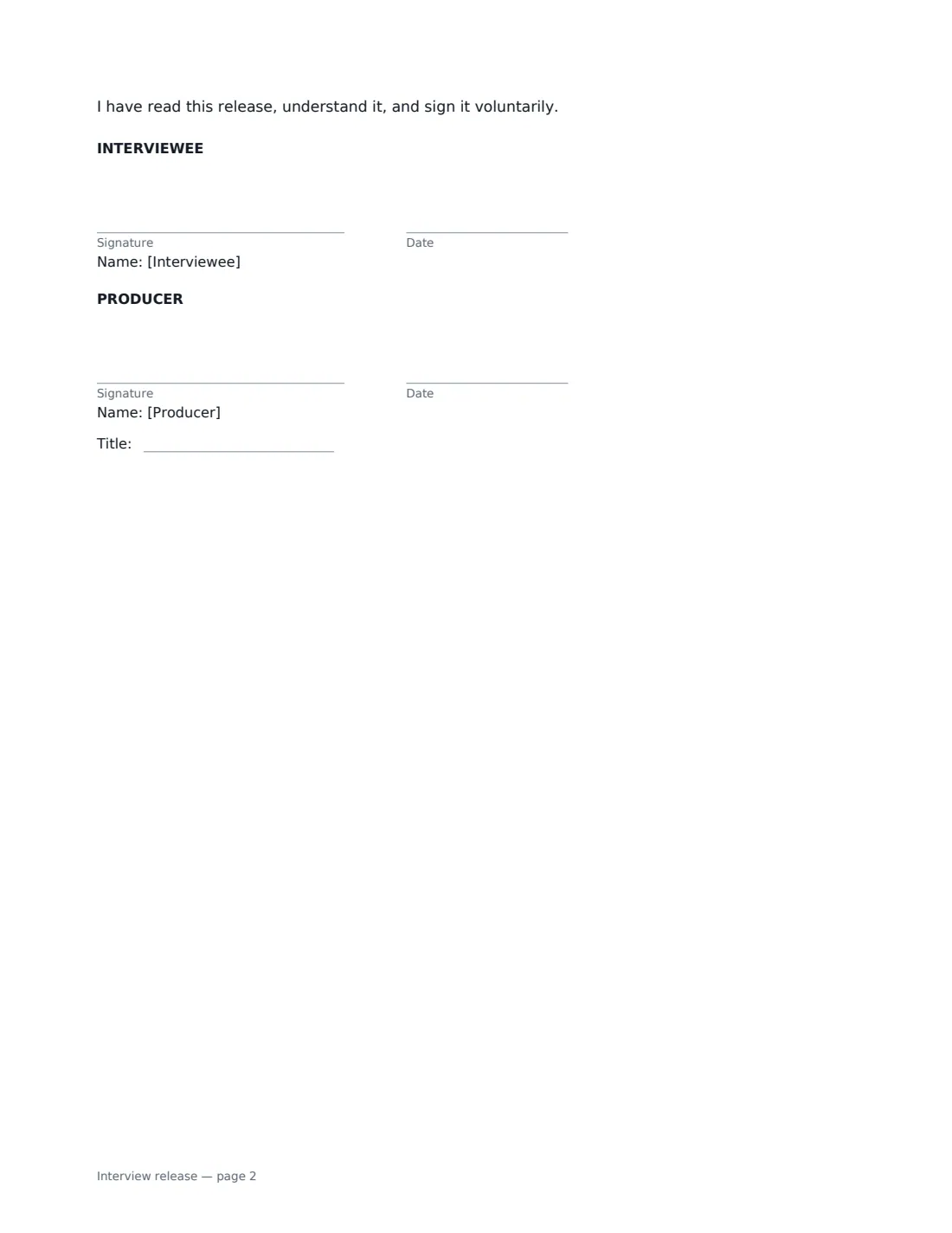
- Interviewee signature and date · The person interviewed — or their parent or guardian if they are under 18.
- Producer signature and date, job title · The producer, publisher, journalist or researcher responsible for the production.
What the interview release Covers
- Permission to use the Interview
- How the Interviewee is identified
- Editing and review
- Withdrawal, payment and promises
- Research participation
Using the interview release, step by step
1 Describe the production
Enter the title or working title, choose the type of production and say briefly what the interview is about. Choosing "research study" adds a section on voluntary participation, secure storage and your ethics approval.
2 Record the interview details
Add the interviewee's name, the date and place, and whether it is recorded as audio and video, audio only, or notes and a transcript. If the interviewee is under 18, choose "Yes" and the release is worded for their parent or guardian to sign.
3 Choose credit, review and withdrawal
Pick how the interviewee is identified, whether they can check quotes for accuracy or review the whole transcript, and how many days they have to reply. Add a withdrawal date if they can pull out before a deadline — otherwise the release says it cannot be withdrawn once the interview is given.
4 Send it before or right after the interview
Add the interviewee as a signer and sign as the producer. Signing before the interview is best; VergeHR files the signed release in Files with the rest of the production paperwork.
Tips Before You Send It
- Ask for the release before you start recording, and explain it in plain words — a release signed in a rush after a hard conversation is easier to dispute.
- If you promise anonymity, plan how you will keep it: disguise the face and voice, and remove place names and other identifying details in the edit.
- Offering a quote check for accuracy is not the same as giving approval over the story. The template keeps final editorial control with the producer.
- Research interviews usually need an information sheet and consent approved by an ethics committee as well — this release works alongside them, not instead of them.
- Keep releases with the raw footage and transcripts; you may need them years later when licensing the production.
Sign It Online In Minutes
- Fill in the blanks. Names, dates and amounts go straight into the agreement — the preview shows exactly where.
- Name who signs. Tick “This is me” for your own part. VergeHR builds the PDF with every signature, date box on the right line, and you can check or move anything before sending.
- Send it. Each signer gets a secure link and signs from any device — no account needed. The signed PDF, with an audit trail and a Certificate of Completion, is filed in Files and emailed to everyone.
Interview release: frequently asked questions
Do I need a release to interview someone?
Not always, but a signed release is standard practice for documentaries, podcasts and books, and distributors, broadcasters and insurers often require one. It also protects both sides by writing down how the interview will be used and credited.
Can the interviewee change their mind?
Only if you allow it. You can set a date until which the interviewee may withdraw, after which the permission is fixed. Without a date, the release says it cannot be withdrawn once the interview is given, because the producer invests in the production relying on it.
What does the "off the record" clause do?
If the interviewee clearly says a statement is off the record during the interview and the producer agrees at the time, the producer won't publish it or attribute it to them. Agreeing the ground rules before you start avoids confusion.
Is an electronically signed release valid?
Electronic signatures are generally valid for ordinary agreements like this in the US (ESIGN Act and UETA), the UK, the EU (eIDAS) and Canada. VergeHR keeps an audit trail and a Certificate of Completion with the signed PDF.
Is this template free?
Yes. It is free to use with the eSignature app in VergeHR, and interviewees don't need a VergeHR login to sign.