

What is a voice and likeness consent?
AI tools can now repair a mispronounced word in a narration, dub a course into another language, or generate hours of new speech from a short recording. For the performer, that is both work and risk: their voice or face could say things they never said. A voice and likeness consent sets the limits before the microphone goes on.
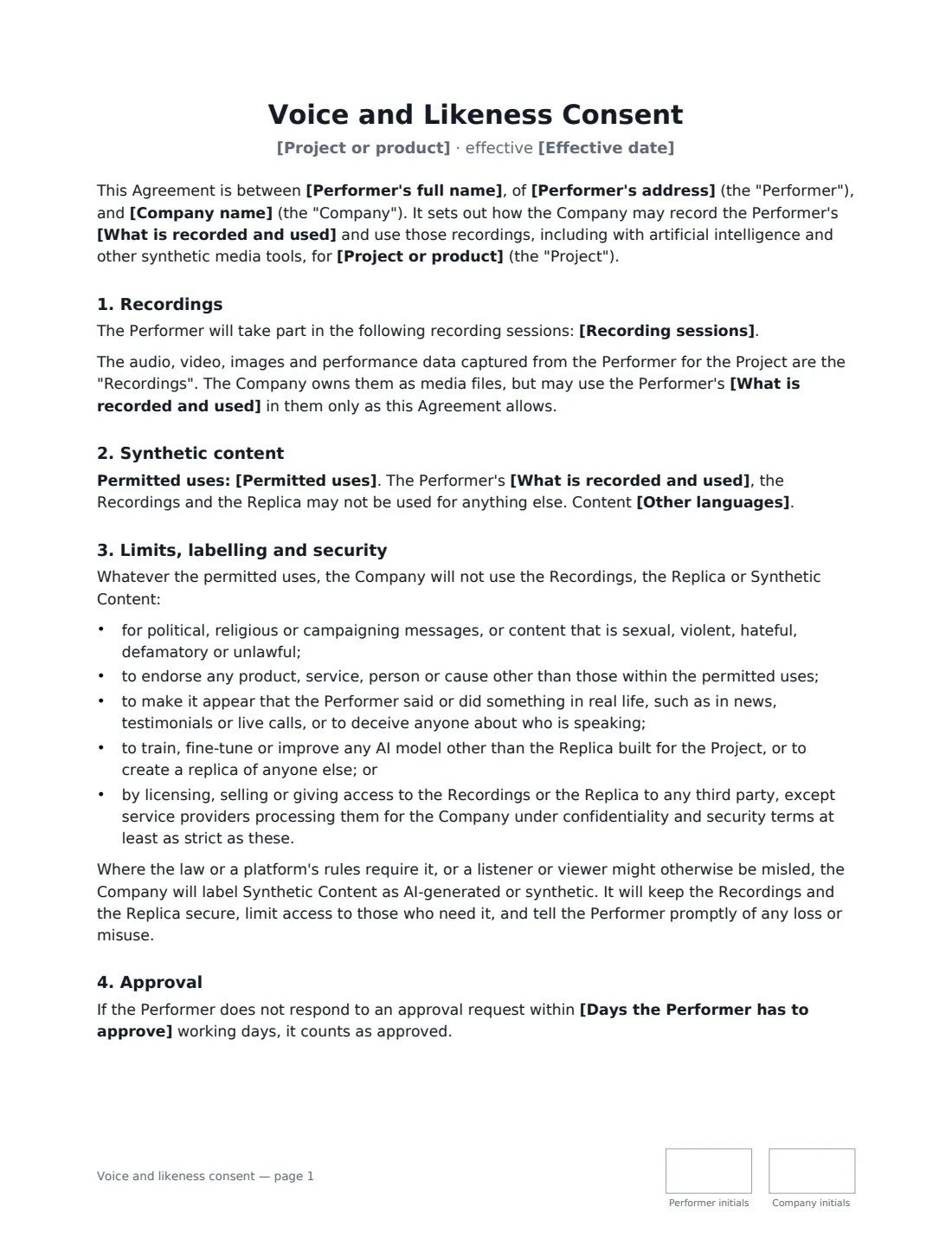
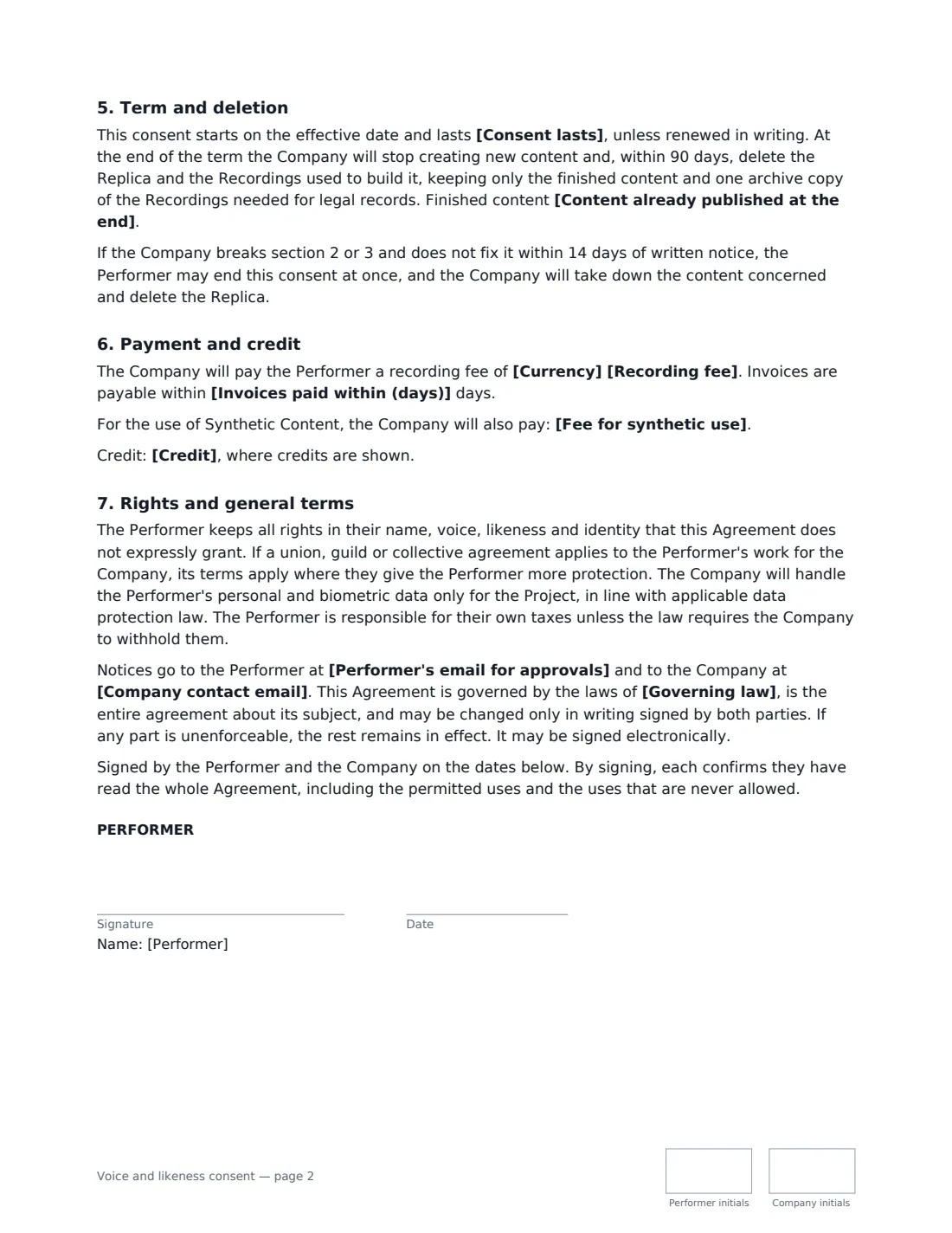
This template records what is captured — voice, likeness, or both — and the sessions. You choose between a narrow scope, where AI tools may only edit and patch the actual recording, and a digital replica that can generate new content for the permitted uses you list. Some uses are always banned: political or adult content, endorsing anything outside the permitted uses, making it look like the performer really said something, training other AI models, and giving the recordings or replica to third parties. You choose the approval right (each script, a sample, or none), whether translation or dubbing is allowed, and the term. The company labels synthetic content where required or where people might be misled, keeps everything secure, and deletes the replica at the end. It covers recording and usage fees, credit, union terms that give more protection, and biometric data.
- Best for
- Voice actors, narrators, presenters, instructors and spokespeople
- Signed by
- The performer and the company
- Key choices
- Edit-only or digital replica, permitted uses, approval, languages, term, fees
- Length
- 2 to 3 pages, both parties initial every page
When to Use a voice and likeness consent
- E-learning companies cloning a narrator's voice to update courses
- Brands creating an AI avatar of a presenter for product videos
- Audiobook or podcast producers patching recordings with AI tools
- Game studios using a voice actor's replica for dynamic dialogue
- Companies dubbing training videos into other languages in the original voice
What You Fill In
22 blanks, then the name and email of each person who signs: performer, company.
1 The parties
- Company name*
- Company contact email*
- Performer's full name*
- Performer's address
- Performer's email for approvals*
2 The project
- Effective date*
- Project or product*
- What is recorded and used* voice · likeness (face and body) · voice and likeness
- Recording sessions
3 Permitted use
- What synthetic content may be made* only edits, fixes and pick-ups to the Performer's recorded performance · new content for the permitted uses below, using a digital replica built from the recordings
- Permitted uses*
- Other languages* may not be translated or dubbed into other languages · may be translated or dubbed into other languages for the permitted uses
- Performer approval* each new script before content using it is published · a sample of the synthetic output before first use · no further approval within the permitted uses
- Days the Performer has to approve
4 Term and payment
- Consent lasts* 1 year · 2 years · 3 years · 5 years
- Content already published at the end* may stay in use, but no new content may be made · must be taken down within 90 days
- Currency*
- Recording fee*
- Fee for synthetic use
- Invoices paid within (days)*
- Credit
- Governing law*
5 Who signs
- Performer signature and date, initials on every page · The voice actor, presenter or person whose voice or likeness is recorded.
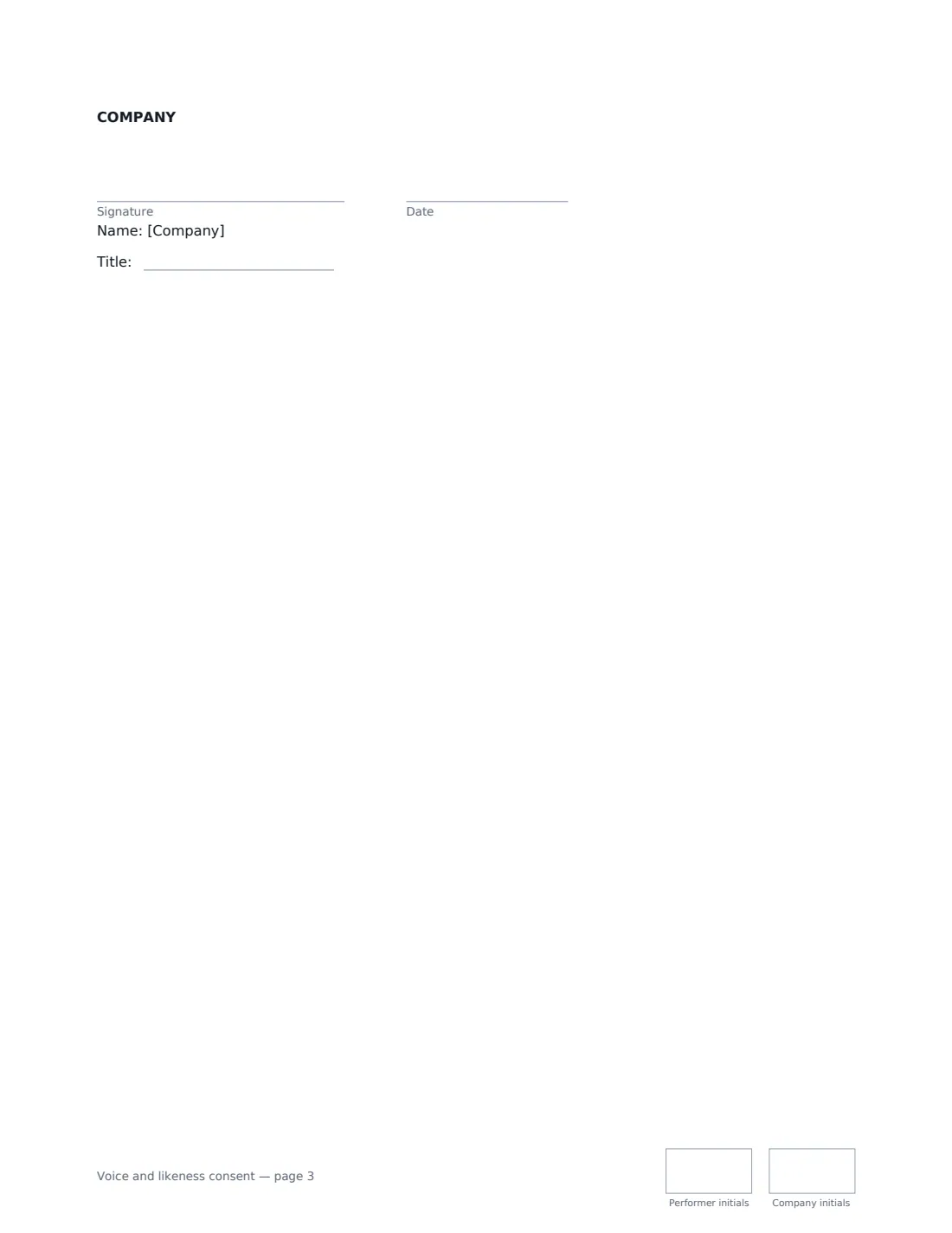
- Company signature and date, job title, initials on every page
What the voice and likeness consent Covers
- Recordings
- Synthetic content
- Limits, labelling and security
- Approval
- Term and deletion
- Payment and credit
- Rights and general terms
Using the voice and likeness consent, step by step
1 Pick the scope
"Only edits, fixes and pick-ups" allows AI tools to repair the real recording — no replica that can say new lines. The replica option lets the company generate new content, but only for the permitted uses you list.
2 Write the permitted uses narrowly
Anything not listed is not allowed. "Narration of our own online training courses and their promotional trailers" is a good example; "marketing" is not.
3 Set approval, languages and term
Choose whether the performer approves each script, a sample before first use, or nothing further. Decide if translation and dubbing are allowed, how long the consent lasts, and whether finished content stays up or comes down at the end.
4 Agree fees and credit
Add the recording fee and, for replica use, a usage fee — per year, per finished minute, or however you agree. Check any union or guild rates that apply.
5 Send for signature
Both sides initial each page and sign at the end. The signed agreement and its audit trail are filed in Files.
Tips Before You Send It
- Laws on voice, likeness, digital replicas and biometric data are changing fast and vary between places. Have the agreement checked locally before relying on it.
- If the performer is a union or guild member, its agreement may set minimum terms — the template gives those terms priority where they protect the performer more.
- Keep an access log for the replica. The company promises to limit access and report loss or misuse.
- Plan deletion on day one: know where the replica and training recordings are stored so they can actually be deleted at the end of the term.
Sign It Online In Minutes
- Fill in the blanks. Names, dates and amounts go straight into the agreement — the preview shows exactly where.
- Name who signs. Tick “This is me” for your own part. VergeHR builds the PDF with every signature, date and initials box on the right line, and you can check or move anything before sending.
- Send it. Each signer gets a secure link and signs from any device — no account needed. The signed PDF, with an audit trail and a Certificate of Completion, is filed in Files and emailed to everyone.
Voice and likeness consent: frequently asked questions
Can the company use my voice to train its AI?
Only to build the replica for the project if you choose the replica option, or a model used just to patch the real recording if you choose the edits-only option. The template bans using the recordings to train or improve any other AI model, or to create a replica of anyone else.
What happens when the consent ends?
The company stops creating new content and, within 90 days, deletes the replica and the recordings used to build it, keeping only finished content and one archive copy for legal records. You choose whether finished content may stay in use or must be taken down.
Will listeners know the content is synthetic?
The company labels synthetic content where the law or a platform requires it, and wherever a reasonable listener or viewer might otherwise be misled.
Is an electronic signature valid?
Generally yes for an ordinary commercial agreement like this — in the US (ESIGN and UETA), the UK, the EU (eIDAS) and Canada. Some places have specific rules on consent to digital replicas, so check whether any extra formalities apply where you work.