

What is a investigation confidentiality acknowledgement?
When an employer investigates a complaint — harassment, bullying, theft, a safety breach — the people interviewed are usually asked to keep it confidential. Done well, that protects the evidence and everyone's privacy. Done badly, a blanket gag can put people off reporting and, in some places, can itself break the law. This acknowledgement is designed to strike the balance.
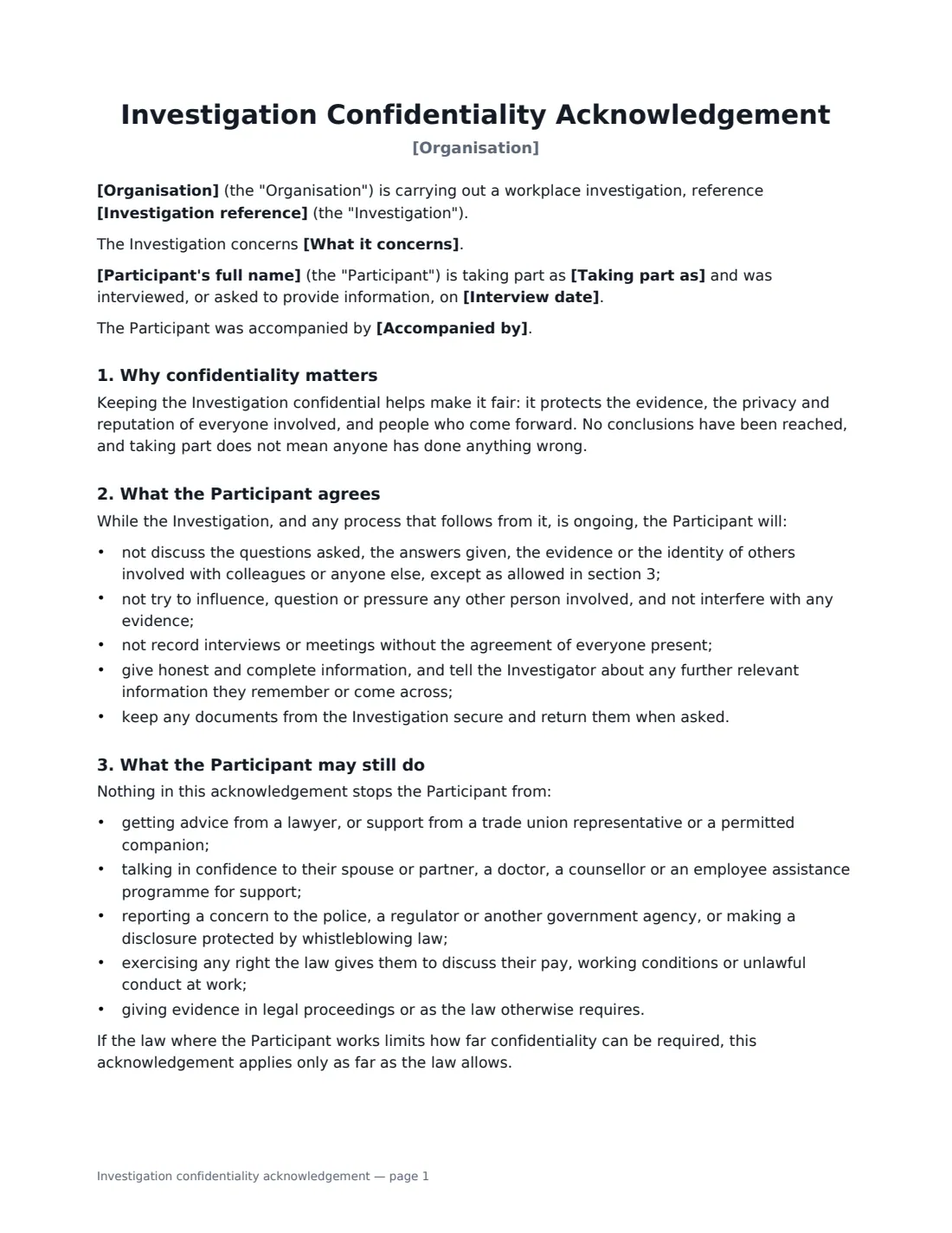
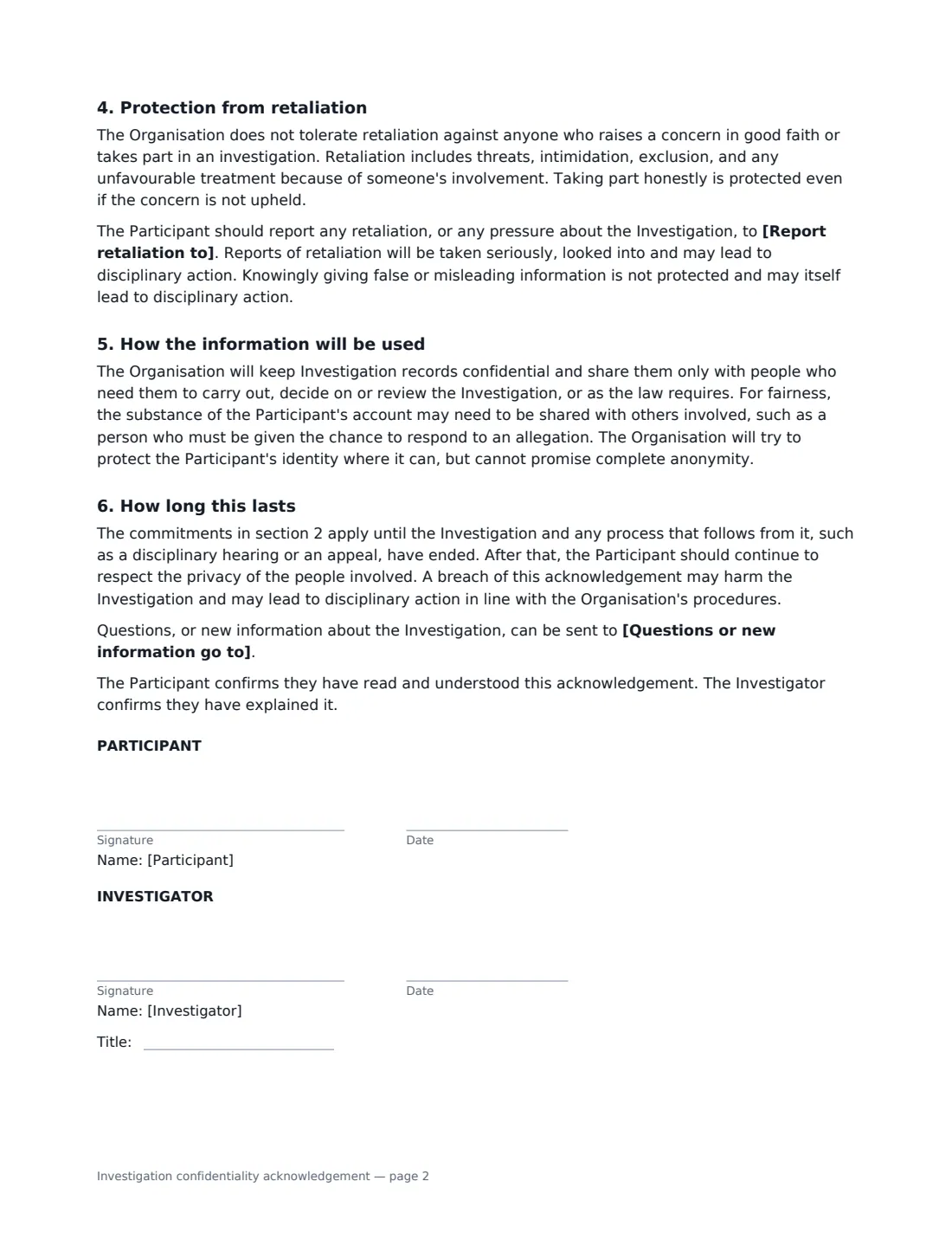
It records the investigation reference and a neutral description, who is taking part and in what capacity — witness, the person who raised the concern, or the person it is about — the interview date and any companion. The participant agrees not to discuss the interview or evidence, not to influence other witnesses or record meetings without agreement, and to be honest. Just as clearly, it lists what they may still do: take legal or union advice, get personal support, report to the police or a regulator, make a protected whistleblowing disclosure, and use any legal right to discuss pay, working conditions or unlawful conduct. It sets out protection from retaliation, how information will be used, and how long confidentiality lasts.
- Best for
- HR, workplace and misconduct investigations
- Signed by
- The participant and the investigator
- For
- Witnesses, the person who raised the concern, or the person it is about
- Length
- 2 pages
When to Use a investigation confidentiality acknowledgement
- Interviewing witnesses in a harassment or bullying complaint
- Investigating suspected theft, fraud or a data breach
- Taking the account of the person who raised a grievance
- Interviewing the person a complaint is about, with their companion present
- External investigators working for an employer who need a consistent form
What You Fill In
9 blanks, then the name and email of each person who signs: participant, investigator.
1 The investigation
- Organisation*
- Investigation reference
- What it concerns
2 The participant
- Participant's full name*
- Taking part as* a witness · the person who raised the concern · the person the concern is about
- Interview date*
- Accompanied by
3 Contacts
- Report retaliation to*
- Questions or new information go to
4 Who signs
- Participant signature and date · The witness, complainant or person the concern is about.
- Investigator signature and date, job title · The person carrying out the interview or investigation.
What the investigation confidentiality acknowledgement Covers
- Why confidentiality matters
- What the Participant agrees
- What the Participant may still do
- Protection from retaliation
- How the information will be used
- How long this lasts
Using the investigation confidentiality acknowledgement, step by step
1 Describe the investigation neutrally
Add a reference and, if appropriate, a short neutral description such as "a concern raised about conduct in the dispatch team". Don't name anyone or suggest a conclusion — leave it empty if even that is sensitive.
2 Record who is taking part
Enter the participant's name, choose their role in the investigation, the interview date, and anyone who accompanied them.
3 Say where to report retaliation
Name who the participant should go to if they experience retaliation or pressure — by default, the investigator or HR — and optionally who to contact with new information.
4 Go through it at the interview
Explain the acknowledgement at the start of the interview, then send it for signature. The participant signs to confirm they understood; the investigator signs to confirm they explained it.
Tips Before You Send It
- Explain the document in person — don't just send it. People are more open when they understand what confidentiality does and doesn't mean.
- Never use confidentiality to stop someone reporting to a regulator or the police, or from exercising legal rights to discuss working conditions — the template protects these.
- Don't promise complete anonymity; the template explains why it can't be guaranteed.
- Tell participants when the investigation has closed, where appropriate.
Sign It Online In Minutes
- Fill in the blanks. Names, dates and amounts go straight into the agreement — the preview shows exactly where.
- Name who signs. Tick “This is me” for your own part. VergeHR builds the PDF with every signature, date box on the right line, and you can check or move anything before sending.
- Send it. Each signer gets a secure link and signs from any device — no account needed. The signed PDF, with an audit trail and a Certificate of Completion, is filed in Files and emailed to everyone.
Investigation confidentiality acknowledgement: frequently asked questions
Can an employer require witnesses to keep an investigation confidential?
Generally employers can ask for confidentiality during an investigation, but how far they can require it depends on local law. In some places, broad rules that stop employees discussing working conditions, or that stop reporting to authorities, are not allowed. The template lists what the participant may still do and says it applies only as far as the law allows.
Is the participant protected from retaliation?
The template states that retaliation against anyone who raises a concern in good faith or takes part in an investigation won't be tolerated, explains what counts as retaliation and names who to report it to. Honest participation is protected even if the concern isn't upheld.
Will what the participant says be shared?
Records are kept confidential and shared only with people who need them. For fairness, the substance of an account may need to be shared with others involved, such as someone responding to an allegation.
Is an electronically signed acknowledgement valid?
Electronic signatures are generally valid for ordinary employment documents in the US (ESIGN Act and UETA), the UK, the EU (eIDAS) and Canada. VergeHR keeps an audit trail and a Certificate of Completion with the signed PDF.
Is this template free?
Yes. It is free to use with the eSignature app in VergeHR, and participants don't need a VergeHR login to sign.