


What is a lab safety agreement?
Most science departments ask students to sign a lab safety contract before they do any practical work, and ask a parent to sign too. It makes sure every student has read the same rules, gives the teacher a chance to learn about allergies or contact lenses before they matter, and gives the school a record that the rules were explained.
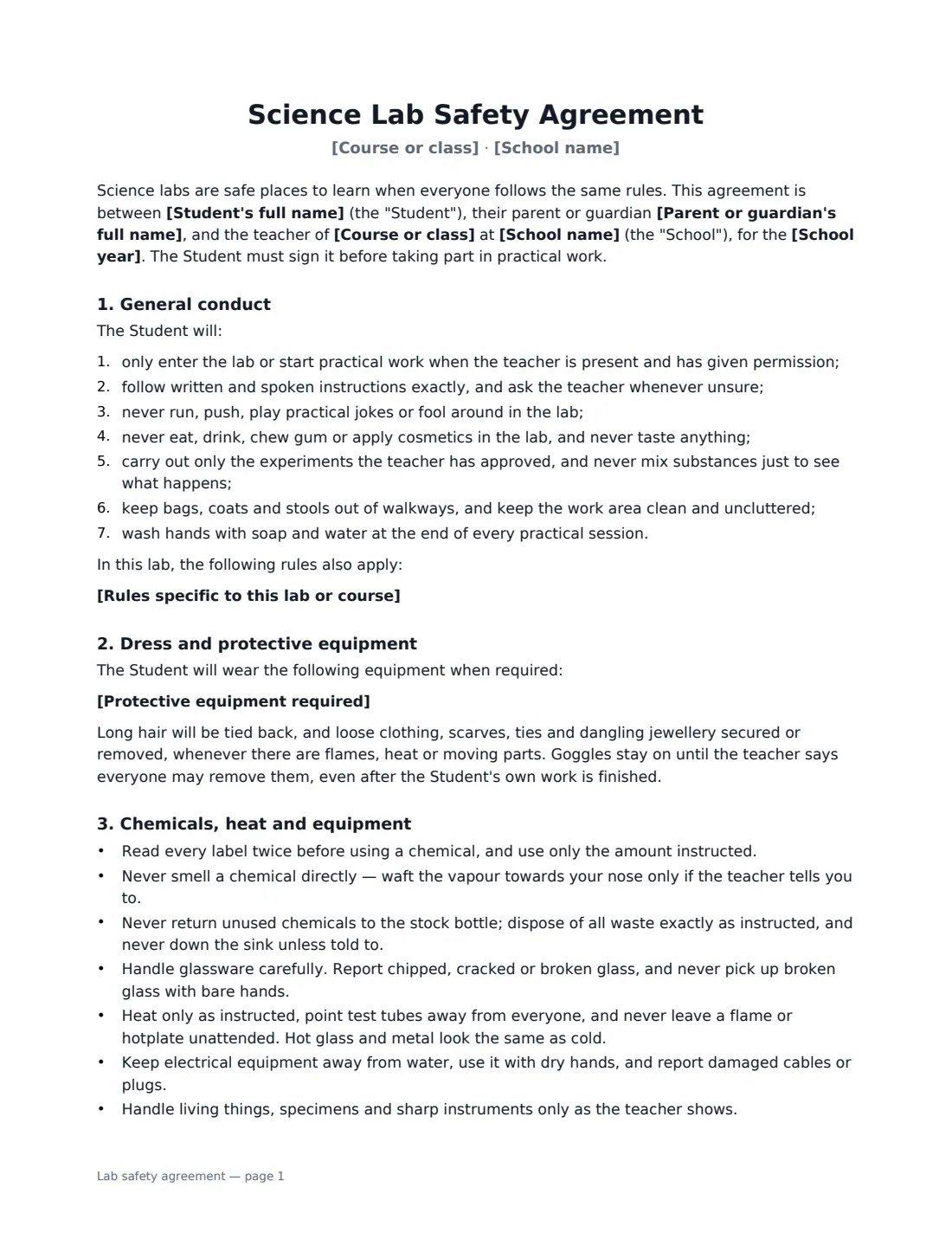
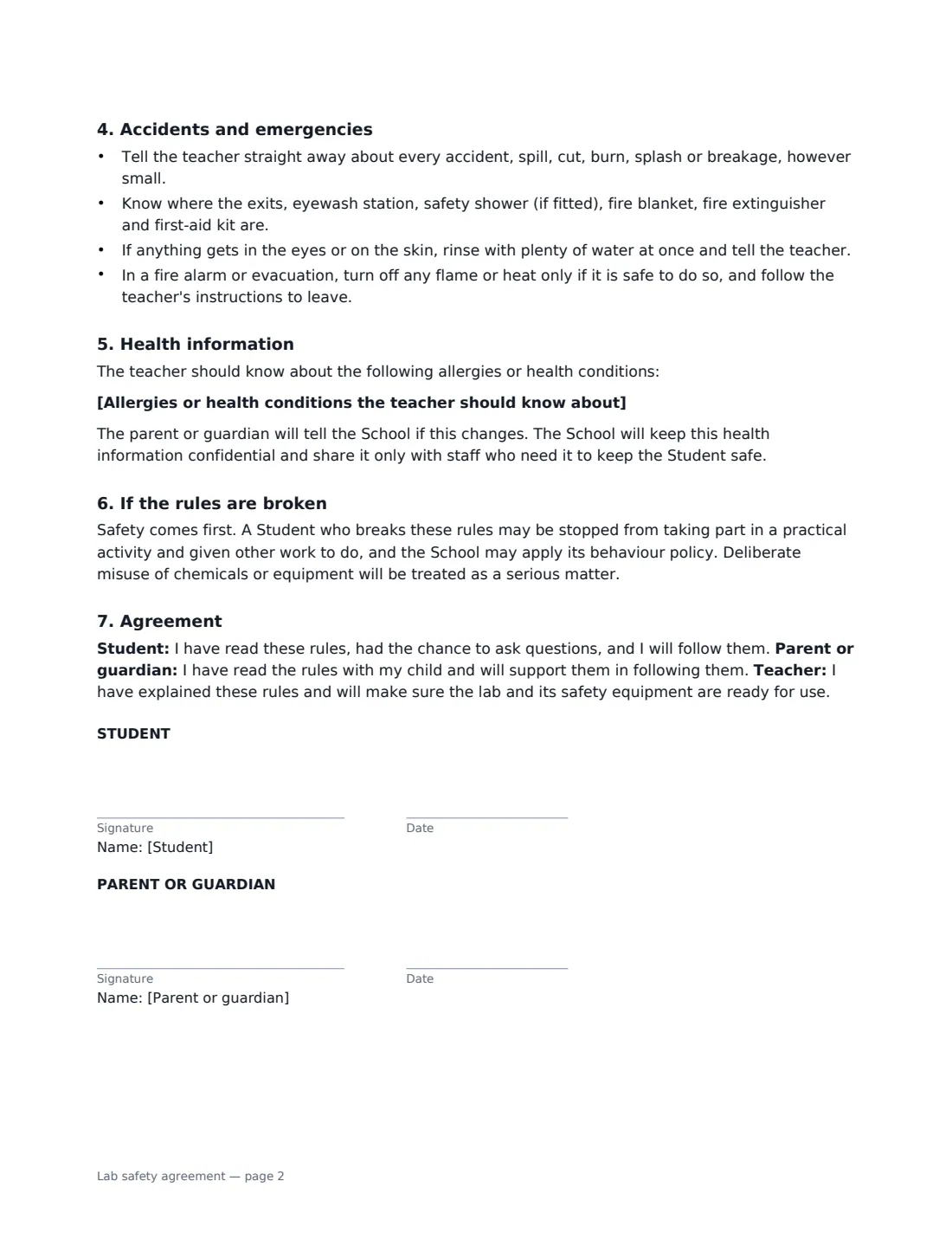
This template sets out general lab conduct (no unsupervised work, no food or drink, only approved experiments), dress and protective equipment — with an editable list that defaults to splash-proof goggles, a lab coat or apron and gloves when instructed, and closed-toe shoes — then chemicals, heat and equipment rules, what to do in an accident or emergency, and how breaches are handled. It records whether the student wears contact lenses and any allergies or health conditions the teacher should know about, and you can add rules specific to your lab. The student, a parent or guardian and the teacher each sign.
- Best for
- Middle and high school chemistry, biology, physics and general science classes
- Signed by
- The student, a parent or guardian, and the science teacher
- Health notes
- Contact lenses, allergies (such as latex) and conditions like asthma
- Length
- 2–3 pages
When to Use a lab safety agreement
- The first week of a chemistry, biology or physics course
- Students joining a science class partway through the year
- After-school science clubs and summer science programmes
- Courses that include dissection or work with living organisms
- Refreshing the rules after an incident or near miss
What You Fill In
9 blanks, then the name and email of each person who signs: student, parent or guardian, teacher.
1 The course
- School name*
- Course or class*
- School year*
2 Student and parent
- Student's full name*
- Parent or guardian's full name*
3 Lab rules
- Protective equipment required*
- Rules specific to this lab or course
4 Health
- Does the student wear contact lenses?* No · Yes
- Allergies or health conditions the teacher should know about
5 Who signs
- Student signature and date · The student taking the science course.
- Parent or guardian signature and date · A parent or legal guardian of the student.
- Teacher signature and date, job title · The science teacher responsible for the class.
What the lab safety agreement Covers
- General conduct
- Dress and protective equipment
- Chemicals, heat and equipment
- Accidents and emergencies
- Health information
- If the rules are broken
- Agreement
Using the lab safety agreement, step by step
1 Name the course
Enter the school, the course or class (for example "Grade 9 Chemistry, Period 3") and the school year.
2 Check the protective equipment list
The PPE list starts with a sensible default; edit it to match what your lab provides and requires. Add any rules specific to your lab, such as how Bunsen burners are lit or how dissection tools are signed out.
3 Record health information
Note whether the student wears contact lenses and any allergies or conditions the teacher should know about. If you leave health notes empty, the agreement says the parent knows of none and will tell the school if that changes.
4 Send to the family
The student and parent each sign from their own email link, and you sign as the teacher, confirming you explained the rules and the lab's safety equipment is ready. The signed copy is filed in Files.
Tips Before You Send It
- Walk students round the lab to find the eyewash, fire blanket, extinguisher, first-aid kit and exits before they sign.
- Use the same agreement for every class so rules are consistent across the department.
- Keep health notes confidential and share them only with staff who need them.
- The agreement doesn't replace risk assessments for each practical — keep those separately.
Sign It Online In Minutes
- Fill in the blanks. Names, dates and amounts go straight into the agreement — the preview shows exactly where.
- Name who signs. Tick “This is me” for your own part. VergeHR builds the PDF with every signature, date box on the right line, and you can check or move anything before sending.
- Send it. Each signer gets a secure link and signs from any device — no account needed. The signed PDF, with an audit trail and a Certificate of Completion, is filed in Files and emailed to everyone.
Lab safety agreement: frequently asked questions
Why does it ask about contact lenses?
So the teacher can advise on eye protection and, if something gets in the student's eye, make sure the lenses are dealt with correctly during first aid.
What happens if a student breaks the rules?
They may be stopped from taking part in that practical and given other work, and the school may apply its behaviour policy. Deliberate misuse of chemicals or equipment is treated as serious.
Do parents have to sign?
It is common practice, and it means parents have seen the rules and can share health information. The template has a parent or guardian signature block alongside the student's and the teacher's.
Is an electronic signature valid?
Electronic signatures are generally valid for agreements and acknowledgements like this in the US (ESIGN Act and UETA), the UK, the EU (eIDAS) and Canada. VergeHR keeps an audit trail of who signed and when.