

What is a letter of financial support?
Universities, visa offices and landlords often need to know how a student or relative will pay their way. When a parent, relative or other sponsor is paying, they ask for a letter of financial support (sometimes called a sponsorship letter): the sponsor's signed confirmation of how much they will provide, for what, for how long, and where the money comes from.
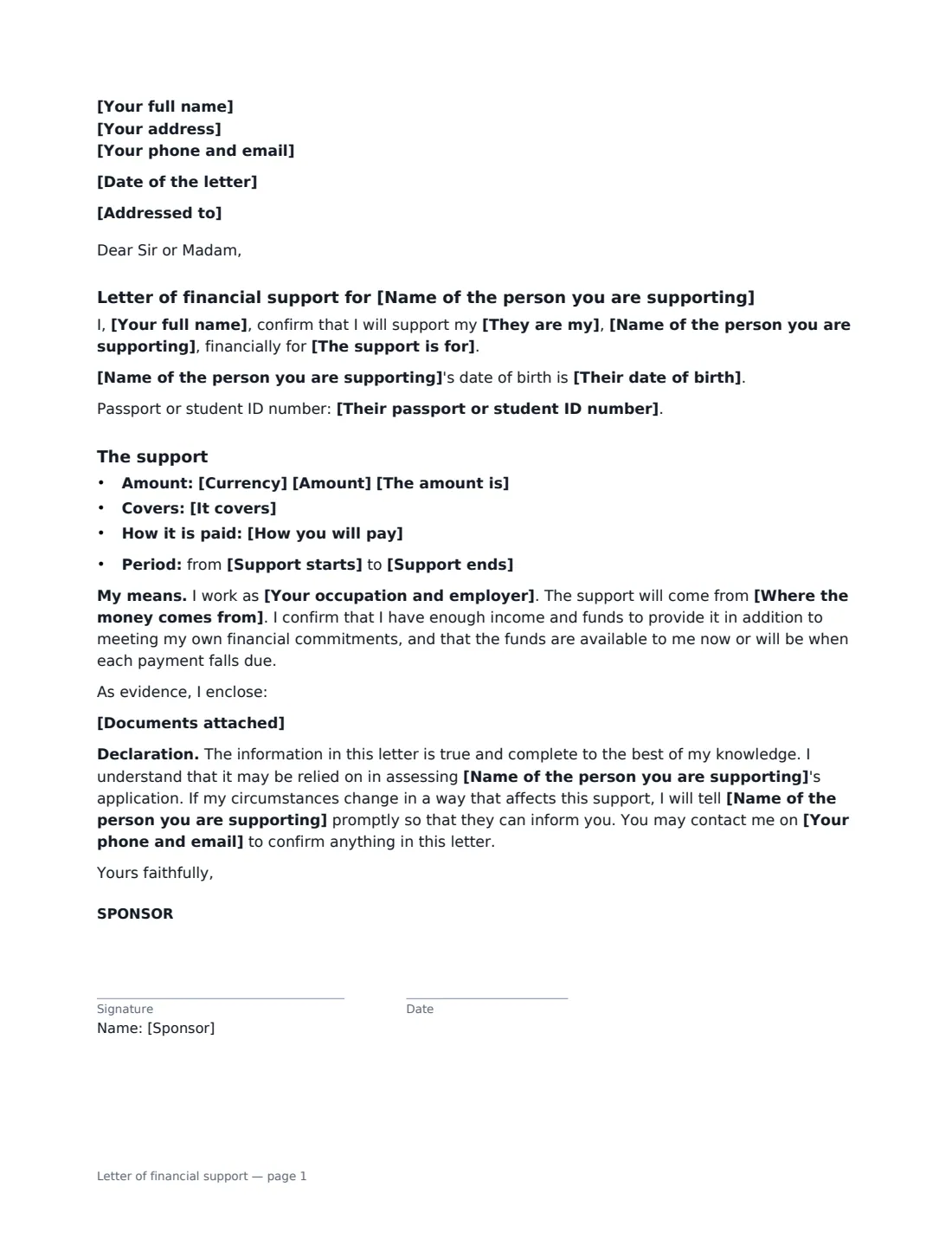
This template produces a letter from the sponsor, addressed to the institution or office. It names the person supported, your relationship and what the support is for — a named course, a visa application or a tenancy — with their date of birth and passport or student ID if needed. It sets out the amount (per year, month, term or in total), what it covers (tuition, living costs, rent or all expenses), how it is paid and the period. It states your occupation and source of funds, confirms you can afford it alongside your own commitments, lists the evidence you enclose such as bank statements, and ends with a declaration that the information is true and that you'll pass on any change in circumstances. Only the sponsor signs.
Institutions and immigration authorities often have their own sponsor forms and strict rules on what evidence of funds they accept — how recent, how much and held for how long. Check theirs first; where they have a form, use it.
- Best for
- University and school admissions, student and visitor visas, rental applications
- Signed by
- The sponsor (the person paying)
- Covers
- Amount, what it pays for, period, payment method, source of funds, evidence
- Length
- 1 page
When to Use a letter of financial support
- Parents funding a child's studies abroad
- A relative supporting a student's living costs while they study
- A sponsor supporting a family member's visit or stay
- A parent confirming they'll cover a student's rent for a landlord
- A family member supporting someone between jobs or during training
What You Fill In
20 blanks, then the name and email of each person who signs: sponsor.
1 The letter
- Date of the letter*
- Addressed to
2 You (the sponsor)
- Your full name*
- Your address*
- Your phone and email*
- Your occupation and employer
- Where the money comes from*
3 The person supported
- Name of the person you are supporting*
- Their date of birth
- Their passport or student ID number
- They are my*
4 The support
- The support is for*
- It covers* tuition fees and living costs · tuition fees only · living costs only · rent and living costs · all their expenses
- Currency*
- Amount*
- The amount is* per year · per month · per term or semester · in total for the whole period
- Support starts*
- Support ends
- How you will pay*
5 Supporting documents
- Documents attached
6 Who signs
- Sponsor signature and date · The person providing the money. They sign to confirm the support and that they can afford it.
What the letter of financial support Covers
- The support
Using the letter of financial support, step by step
1 Check the recipient's rules
Find out whether the university, visa office or landlord has its own sponsor form, and what evidence of funds it accepts. Enter who the letter is addressed to.
2 Describe the person and the purpose
Enter their name and your relationship, and describe what you are funding as specifically as you can — the course and start date, or the stay. Add their date of birth and ID number if the recipient needs them.
3 Set out the support
Enter the amount and whether it is per year, per month, per term or in total, choose what it covers, and say how you'll pay — directly to the university, or monthly transfers. Set the start date, and an end date if there is one.
4 Show your means and sign
Give your occupation and where the money comes from, list the statements you'll attach, then sign. Send the signed PDF with your evidence to the student to include in their application.
Tips Before You Send It
- Make sure the amount matches what the institution or visa office says is needed — too little can mean a refusal.
- Attach evidence that matches the letter: statements showing the funds and your income.
- Be accurate about your means. The letter says it may be relied on, and inconsistent figures cause delays.
- Keep a copy in Files — you may be asked for it again at renewal or extension.
Sign It Online In Minutes
- Fill in the blanks. Names, dates and amounts go straight into the agreement — the preview shows exactly where.
- Name who signs. Tick “This is me” for your own part. VergeHR builds the PDF with every signature, date box on the right line, and you can check or move anything before sending.
- Send it. Each signer gets a secure link and signs from any device — no account needed. The signed PDF, with an audit trail and a Certificate of Completion, is filed in Files and emailed to everyone.
Letter of financial support: frequently asked questions
Is a letter of financial support legally binding?
It is a signed statement of your intention and means, relied on by the recipient. Whether it creates legal obligations depends on its wording and local law. Some countries' formal sponsorship undertakings — often on official forms — are legally binding, and this letter is not a substitute for those.
What evidence should I attach?
Usually recent bank statements showing the funds and something showing your income, such as an employment letter or tax return. Requirements differ, so follow the institution's or visa office's guidance.
Can I sponsor someone who isn't family?
Often yes, but some institutions and visa categories only accept sponsors who are parents or close relatives. Check the rules.
Will an e-signed letter be accepted?
Many universities and visa offices accept an electronically signed letter, and electronic signatures are generally valid in the US (ESIGN Act and UETA), the UK, the EU (eIDAS) and Canada. Some processes require wet ink or notarisation, so check first.
Is this template free?
Yes. The template is free to use with the eSignature app in VergeHR.