

What is a gift letter?
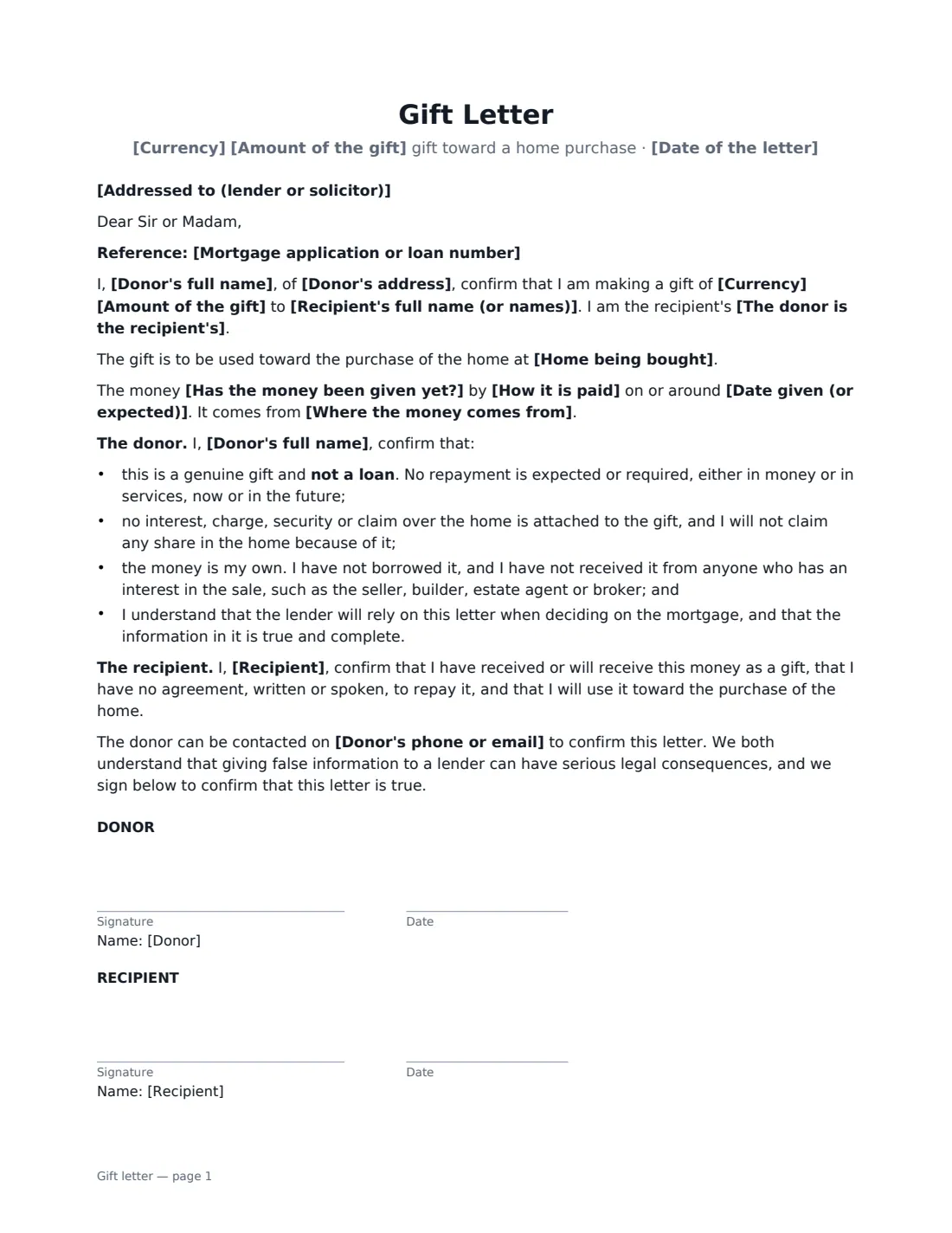
When family help with a deposit or down payment, mortgage lenders want to know that the money will not have to be paid back — a hidden loan would change what the buyer can afford. A gift letter is the donor's signed statement that the money is a genuine gift, where it comes from, and that there is no expectation of repayment or claim on the home.
This template produces a one-page letter addressed to your lender, solicitor or closing agent (or "To whom it may concern"), with an optional mortgage application number. It states the donor's name, address and relationship to the buyer, the amount, the home being bought if you know it, whether the money has already been given or will be, how it is paid and which account it comes from. The donor confirms it is not a loan, that no interest, security or share in the home comes with it, and that the money is their own and not from anyone with an interest in the sale. The recipient confirms they have no agreement to repay it. Both sign, and the donor's phone or email is included so the lender can check.
Many lenders have their own gift letter form or require particular wording, so ask yours first — if they insist on their form, use it.
- Best for
- Family help with a deposit or down payment on a home
- Signed by
- The donor and the buyer (recipient)
- What it confirms
- Gift amount, source of funds, relationship, no repayment and no claim on the home
- Length
- 1 page
When to Use a gift letter
- Parents giving their child money toward a first home
- A grandparent helping with a deposit or down payment
- A relative topping up closing costs before completion
- A lender or conveyancer asking for written confirmation that family money is a gift
- Recording a large family gift so there is no later dispute about whether it was a loan
What You Fill In
15 blanks, then the name and email of each person who signs: donor, recipient.
1 The letter
- Date of the letter*
- Addressed to (lender or solicitor)
- Mortgage application or loan number
2 The donor
- Donor's full name*
- Donor's address*
- Donor's phone or email*
- The donor is the recipient's*
3 The recipient
- Recipient's full name (or names)*
- Home being bought
4 The gift
- Currency*
- Amount of the gift*
- Has the money been given yet?* has already been given · will be given
- Date given (or expected)
- How it is paid*
- Where the money comes from*
5 Who signs
- Donor signature and date · The relative giving the money. They confirm it is a gift and does not have to be repaid.
- Recipient signature and date · The person buying the home. They confirm they will not repay the gift. If two people are buying together, name both in the letter and choose which one signs here.
Using the gift letter, step by step
1 Check what your lender needs
Ask your lender or broker whether they accept a letter like this or need their own form, and which relatives they accept gifts from. Enter the lender's name and address and your application number if they gave you one.
2 Describe the donor and the relationship
Enter the donor's full name, address and a phone number or email the lender can use to check the letter, and how they are related to you — for example mother, grandfather or aunt.
3 Record the gift
Enter the amount, choose whether the money has already been given or will be, add the date and how it is paid, and say which account it comes from. Lenders often ask to see the money leave the donor's account and arrive in yours, so keep the statements.
4 Both sign
Add the donor as a signer and sign as the recipient yourself. The signed PDF, with its audit trail, is filed in Files and emailed to both of you, ready to send to your lender.
Tips Before You Send It
- Only sign if it is true. If the money is really a loan — even an informal one — say so to your lender; a promissory note is the right document for a family loan.
- Keep the donor's bank statement showing the money leaving their account, and yours showing it arrive. Lenders often ask for both.
- Give the gift well before completion where you can, so the paper trail is clear.
- Large gifts can have gift-tax or inheritance-tax effects for the donor in some countries. The donor may want to check before giving.
Sign It Online In Minutes
- Fill in the blanks. Names, dates and amounts go straight into the agreement — the preview shows exactly where.
- Name who signs. Tick “This is me” for your own part. VergeHR builds the PDF with every signature, date box on the right line, and you can check or move anything before sending.
- Send it. Each signer gets a secure link and signs from any device — no account needed. The signed PDF, with an audit trail and a Certificate of Completion, is filed in Files and emailed to everyone.
Gift letter: frequently asked questions
Will my lender accept this gift letter?
Many will, but lenders set their own rules on gift letters, which relatives can give gifts and what evidence they need. Some require their own form. Ask your lender first and use their form if they insist.
Does the recipient need to sign?
Many lenders ask for both signatures, so the template has both: the donor confirms it is a gift, and the recipient confirms there is no agreement to repay it.
Is a gift letter the same as a loan agreement?
No — it is the opposite. A gift letter says the money never has to be repaid. If the family member expects to be paid back, use a promissory note instead and tell your lender.
Is an electronically signed gift letter valid?
Electronic signatures are generally valid for documents like this in the US (ESIGN Act and UETA), the UK, the EU (eIDAS) and Canada, and many lenders accept them. VergeHR keeps an audit trail and a Certificate of Completion with the signed PDF. A lender can still ask for a wet-ink or notarised copy under its own rules.
Is this template free?
Yes. The template is free to use with the eSignature app in VergeHR, and the donor doesn't need a VergeHR login to sign.