

What is a relocation assistance agreement?
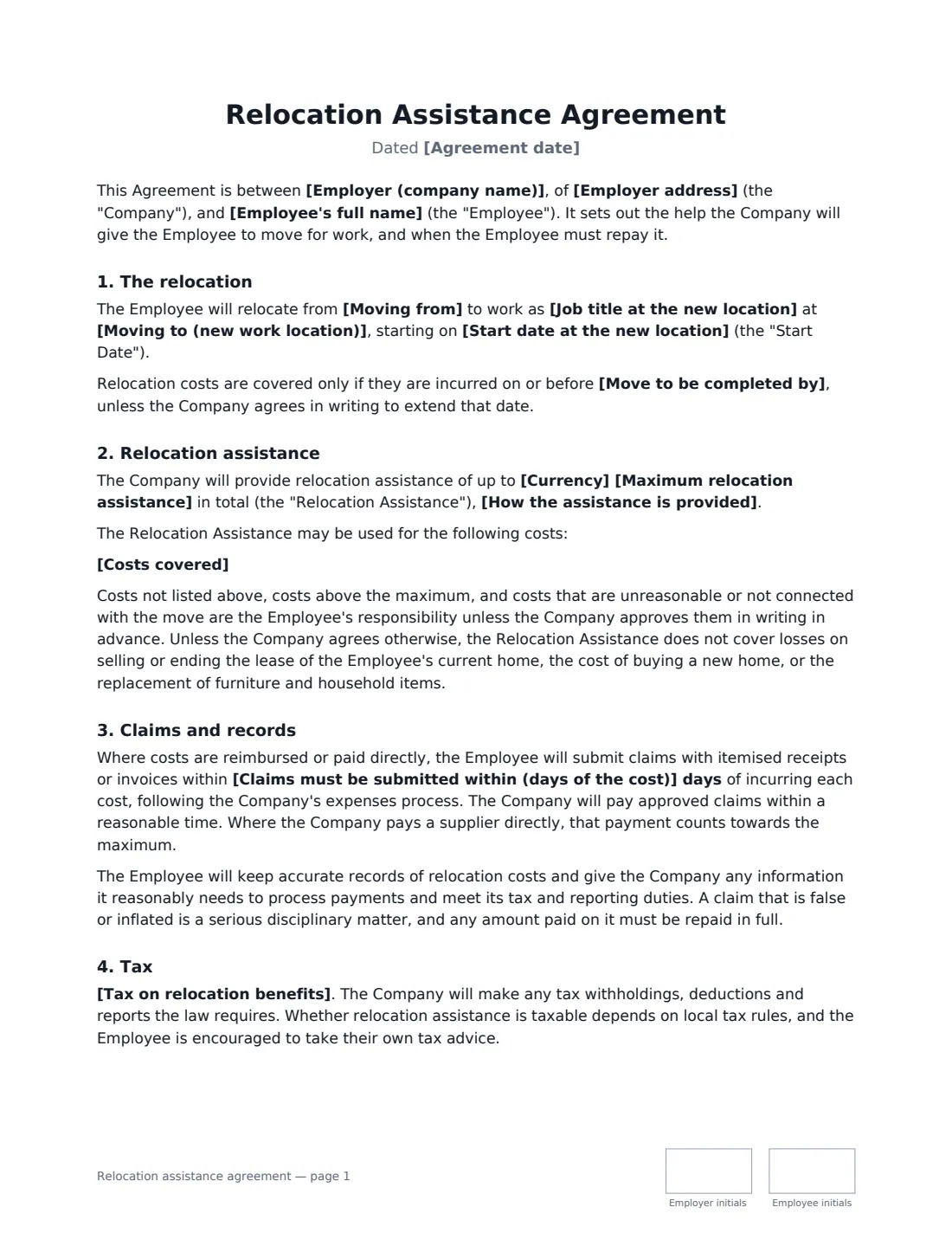
A relocation assistance agreement records the help an employer gives an employee who moves home for work — a new hire coming from another city, or an existing employee transferring to a different office or site. It sets the maximum the company will spend, whether that money is reimbursed against receipts, paid straight to the moving company or given as a lump-sum allowance, and which costs it can be used for.
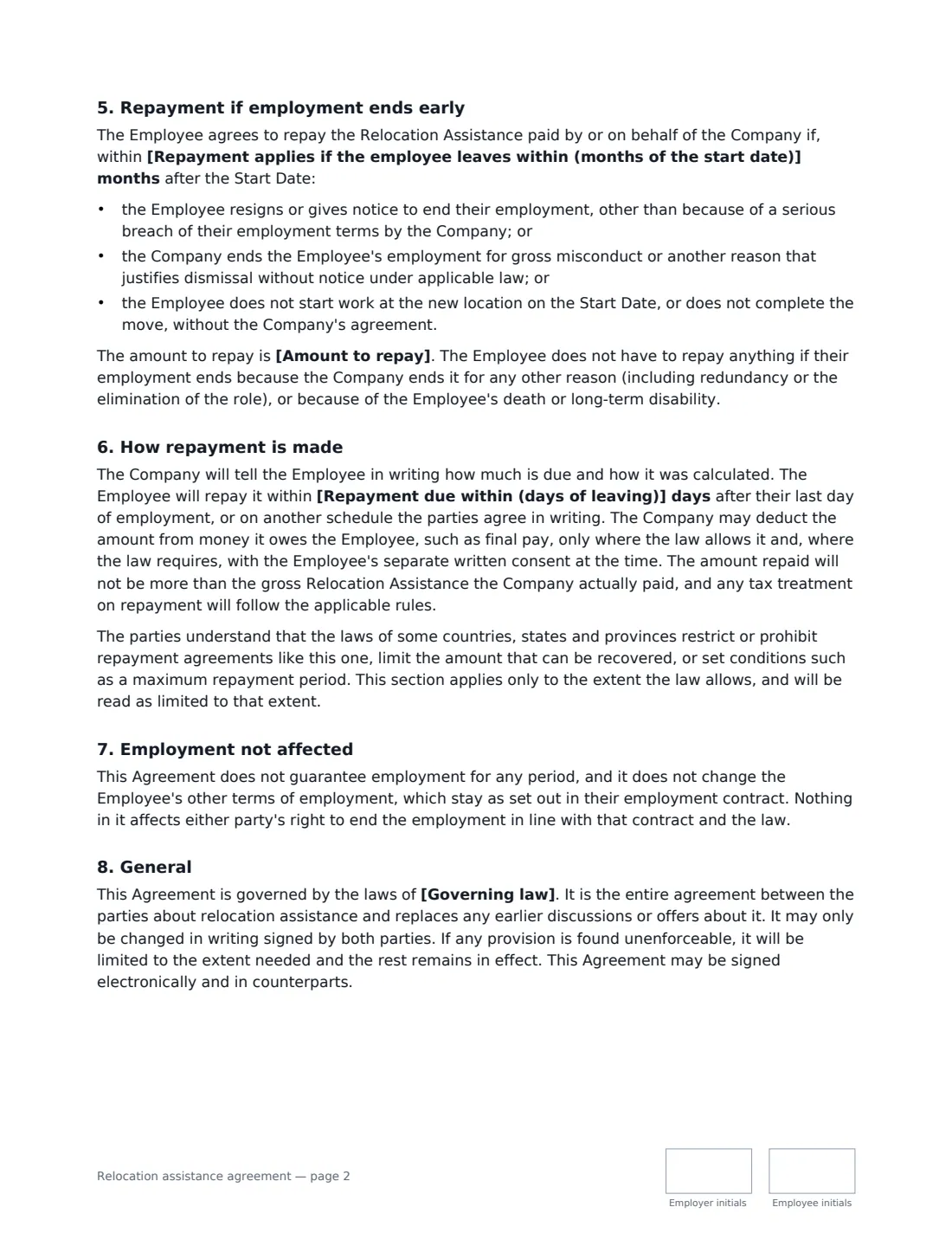
Because relocation is expensive, most employers also ask for some or all of it back if the employee leaves soon after the move. This template sets a repayment period in months from the start date, lets you choose full or pro-rata repayment, limits repayment to resignations and dismissals for gross misconduct (not redundancy, death or disability), and says clearly that deductions from final pay happen only where the law allows. It also covers claim deadlines, tax on relocation benefits (including an optional gross-up), and a governing-law blank. Repayment terms are restricted or prohibited in some places, and the agreement says so.
- Best for
- New hires moving for a job, internal transfers, moves to a new office or site
- Signed by
- The employer (with job title) and the employee
- Payment options
- Reimbursed against receipts, paid directly to suppliers, or a lump-sum allowance
- Repayment
- You set the period and choose full or pro-rata repayment
- Length
- About 3 pages, initialled on every page
When to Use a relocation assistance agreement
- Hiring someone from another city or country who needs help with the move
- Transferring an employee to open or run a new office, plant or store
- Offering a fixed relocation allowance instead of managing receipts
- Putting a verbal relocation promise from an offer letter into signed terms
- Protecting a large relocation spend with a fair, time-limited repayment clause
What You Fill In
19 blanks, then the name and email of each person who signs: employer, employee.
1 The parties
- Agreement date*
- Employer (company name)*
- Employer address
- Employee's full name*
- Job title at the new location
2 The move
- Moving from*
- Moving to (new work location)*
- Start date at the new location*
- Move to be completed by
3 Relocation package
- Currency*
- Maximum relocation assistance*
- How the assistance is provided* by reimbursing the Employee's actual, reasonable costs against receipts · by paying approved costs directly to the suppliers, such as the moving company · as a single lump-sum relocation allowance, paid through payroll
- Costs covered
- Claims must be submitted within (days of the cost)
- Tax on relocation benefits* The Employee is responsible for any personal income tax due on the relocation assistance · The Company will pay an additional amount (a "gross-up") to cover the Employee's income tax on taxable relocation assistance
4 Repayment
- Repayment applies if the employee leaves within (months of the start date)*
- Amount to repay* the Relocation Assistance paid, reduced by an equal amount for each full month of employment completed after the Start Date, so that nothing is repayable once the repayment period has ended · the full amount of the Relocation Assistance paid
- Repayment due within (days of leaving)*
5 The parties
- Governing law*
6 Who signs
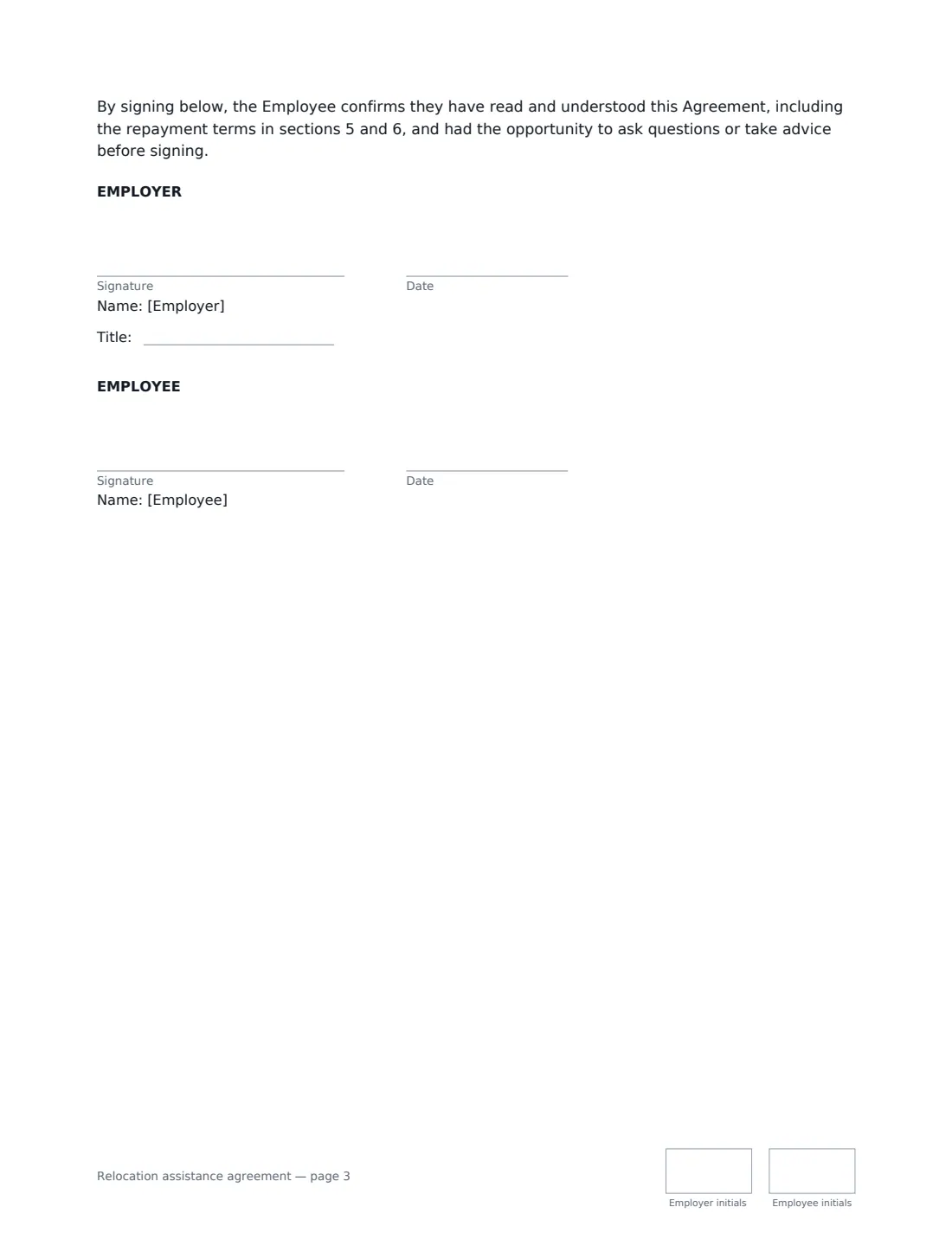
- Employer signature and date, job title, initials on every page · Someone authorised to approve relocation costs, such as HR or the hiring manager.
- Employee signature and date, initials on every page · The employee who is moving.
What the relocation assistance agreement Covers
- The relocation
- Relocation assistance
- Claims and records
- Tax
- Repayment if employment ends early
- How repayment is made
- Employment not affected
- General
Using the relocation assistance agreement, step by step
1 Describe the move
Enter where the employee is moving from and to, the start date at the new location and, if you want a cut-off, the date by which costs must be incurred to be covered.
2 Set the package
Enter the maximum amount and choose how it is paid. For reimbursement or direct payment, list the costs covered — packing and moving, travel, temporary accommodation, a house-hunting trip — and the number of days the employee has to submit receipts. For a lump sum, you can leave the list empty and let the employee decide how to spend it.
Choose who bears the income tax on the assistance: the employee, or the company through a gross-up.
3 Choose the repayment terms
Set how many months after the start date repayment applies, whether it is the full amount or reduced pro rata for each full month worked, and how many days the employee has to repay after leaving. Check local law first: some places cap or prohibit these terms.
4 Send it for signature
Add the employee's name and email and send. Both signers initial each page and sign at the end. The signed agreement is filed in Files, where it sits alongside the employee's other HR paperwork.
Tips Before You Send It
- Send the relocation agreement together with, or soon after, the offer letter, so the employee knows the repayment terms before they resign from their current job.
- Pro-rata repayment is generally seen as fairer than full repayment, and is easier to justify if the employee leaves late in the period.
- Keep the repayment period proportionate to the amount spent — a modest package with a long lock-in can look unreasonable.
- Ask HR or your payroll provider how relocation benefits are taxed where the employee works before you promise a gross-up.
- If the employee is moving countries, check immigration and tax rules separately — this agreement does not deal with visas or work permits.
Sign It Online In Minutes
- Fill in the blanks. Names, dates and amounts go straight into the agreement — the preview shows exactly where.
- Name who signs. Tick “This is me” for your own part. VergeHR builds the PDF with every signature, date and initials box on the right line, and you can check or move anything before sending.
- Send it. Each signer gets a secure link and signs from any device — no account needed. The signed PDF, with an audit trail and a Certificate of Completion, is filed in Files and emailed to everyone.
Relocation assistance agreement: frequently asked questions
Can an employer make an employee repay relocation costs?
Often, yes, if the employee agreed to it in writing before the money was spent and the terms are reasonable. But some countries, states and provinces restrict repayment agreements, limit what can be recovered or ban deductions from final pay. The template says repayment applies only as far as the law allows, and you should check the rules where the employee works.
What does pro-rata repayment mean here?
The amount to repay goes down by an equal amount for each full month the employee works after the start date. With a 12-month period, an employee who leaves after 9 full months repays 3/12 of the assistance.
Does the employee repay if they are laid off?
No. Under this template, repayment applies when the employee resigns (other than because of a serious breach by the employer), is dismissed for gross misconduct, or does not start or complete the move. It does not apply to redundancy, other dismissals, death or long-term disability.
Is an electronically signed relocation agreement valid?
Electronic signatures are generally valid for ordinary employment agreements like this in the US (ESIGN Act and UETA), the UK, the EU (eIDAS) and Canada. VergeHR records an audit trail and a Certificate of Completion with the signed PDF.
Is this template free?
Yes. It is free to use with the eSignature app in VergeHR, and the employee does not need a VergeHR login to sign.