

What is a salary advance agreement?
A salary advance agreement records that an employer has paid an employee some of their wages early — often to help with an unexpected bill — and how the employee will pay it back. Putting it in writing protects both sides: the employee knows exactly what will come out of each pay, and the employer has the written authorization it usually needs to recover the advance through payroll.
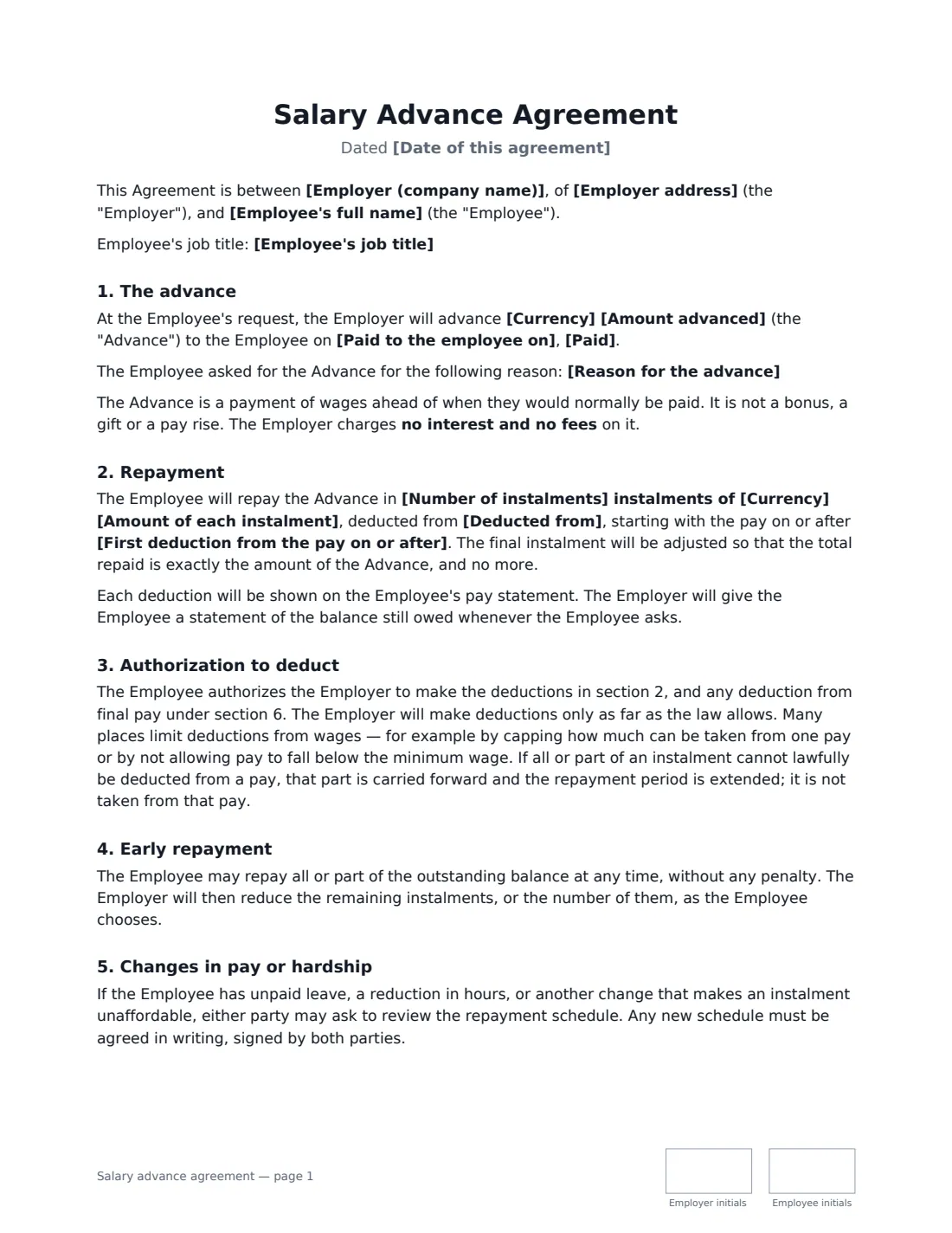
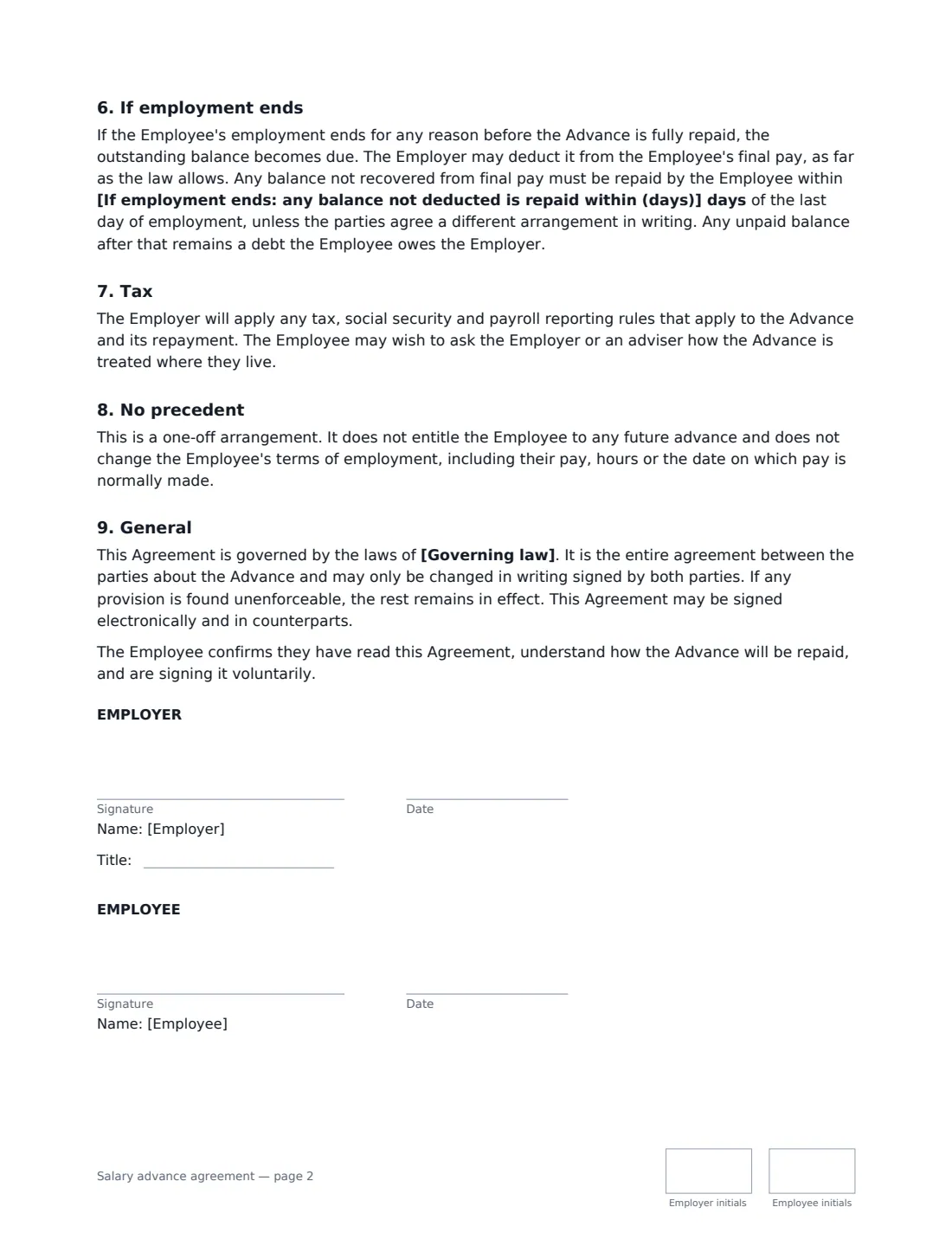
This template sets out the amount advanced, when and how it is paid, and that it is interest-free with no fees. Repayment is a fixed number of instalments deducted from each pay or the first pay of each month, with the final instalment adjusted so exactly the advance is repaid. It covers the employee's authorization to deduct within wage-law limits, early repayment without penalty, reviewing the schedule if pay drops, what happens if employment ends, tax, and that the advance is a one-off. Both parties sign and initial every page.
- Best for
- One-off hardship or emergency advances of wages
- Signed by
- The employer and the employee
- Interest
- None — interest-free, no fees
- Length
- 2 pages, initialled on every page
When to Use a salary advance agreement
- An employee faces an urgent car repair or medical bill before payday
- A new starter needs help with a rental deposit before their first full pay
- An employee asks for part of next month's salary early to cover a family emergency
- A small business wants a consistent, written process for every advance it agrees to
What You Fill In
16 blanks, then the name and email of each person who signs: employer, employee.
1 The parties
- Date of this agreement*
- Employer (company name)*
- Employer address
- Employee's full name*
- Employee's job title
2 The advance
- Currency*
- Amount advanced*
- Paid to the employee on*
- Paid* by bank transfer to the Employee's usual pay account · as a separate payment through payroll · by cheque
- Reason for the advance
3 Repayment
- Number of instalments*
- Amount of each instalment*
- Deducted from* each regular pay · the first pay of each month
- First deduction from the pay on or after*
4 Other terms
- If employment ends: any balance not deducted is repaid within (days)*
- Governing law*
5 Who signs
- Employer signature and date, job title, initials on every page · A manager or payroll lead who can approve the advance.
- Employee signature and date, initials on every page · The person receiving the advance.
What the salary advance agreement Covers
- The advance
- Repayment
- Authorization to deduct
- Early repayment
- Changes in pay or hardship
- If employment ends
- Tax
- No precedent
- General
Using the salary advance agreement, step by step
1 Record the advance
Enter the amount, the currency, the date it is paid and how — bank transfer, a separate payroll payment or cheque. The reason is optional; many employers leave it out to protect the employee's privacy.
2 Agree the repayment schedule
Enter the number of instalments, the amount of each and the first pay they come from. Keep instalments affordable — the agreement already says that anything that can't lawfully be deducted from a pay is carried forward, not taken.
3 Set what happens if employment ends
Any balance becomes due and can be deducted from final pay as far as the law allows. Choose how many days the employee then has to repay anything left over.
4 Add the governing law and send
Enter the country, state or province whose law applies, then send it to the employee. Both of you sign and initial each page; the signed copy is filed in Files.
Tips Before You Send It
- Make sure the instalments add up to the advance — the last one is adjusted if they don't, but a clean schedule avoids questions.
- Check local wage law on deductions from pay and from final pay before relying on the schedule.
- In some places an interest-free loan to an employee can have tax consequences; ask your payroll provider or accountant if the amount is large.
- Treat every request the same way, so advances aren't seen as favouritism.
Sign It Online In Minutes
- Fill in the blanks. Names, dates and amounts go straight into the agreement — the preview shows exactly where.
- Name who signs. Tick “This is me” for your own part. VergeHR builds the PDF with every signature, date and initials box on the right line, and you can check or move anything before sending.
- Send it. Each signer gets a secure link and signs from any device — no account needed. The signed PDF, with an audit trail and a Certificate of Completion, is filed in Files and emailed to everyone.
Salary advance agreement: frequently asked questions
What is the difference between a salary advance and an employee loan?
A salary advance is wages paid early, repaid from the pay the employee would have received anyway. A loan is usually a larger sum repaid over a longer period, sometimes with interest. For a larger personal loan, a promissory note may fit better.
Can the employer deduct the advance from the employee's final pay?
The agreement allows it as far as the law allows. Some places restrict deductions from final pay or require fresh consent at that time; anything not recovered from final pay must be repaid within the number of days you set.
Can the employee repay early?
Yes, at any time and without penalty. The remaining instalments are then reduced, or there are fewer of them, as the employee chooses.
Is an electronically signed salary advance agreement valid?
Electronic signatures are generally valid for ordinary contracts like this in the US (ESIGN Act and UETA), the UK, the EU (eIDAS) and Canada. VergeHR keeps an audit trail and a Certificate of Completion with the signed PDF.
Is this template free?
Yes. It is free to use with the eSignature app in VergeHR, and the employee doesn't need a VergeHR login to sign.