

What is a salon stylist commission agreement?
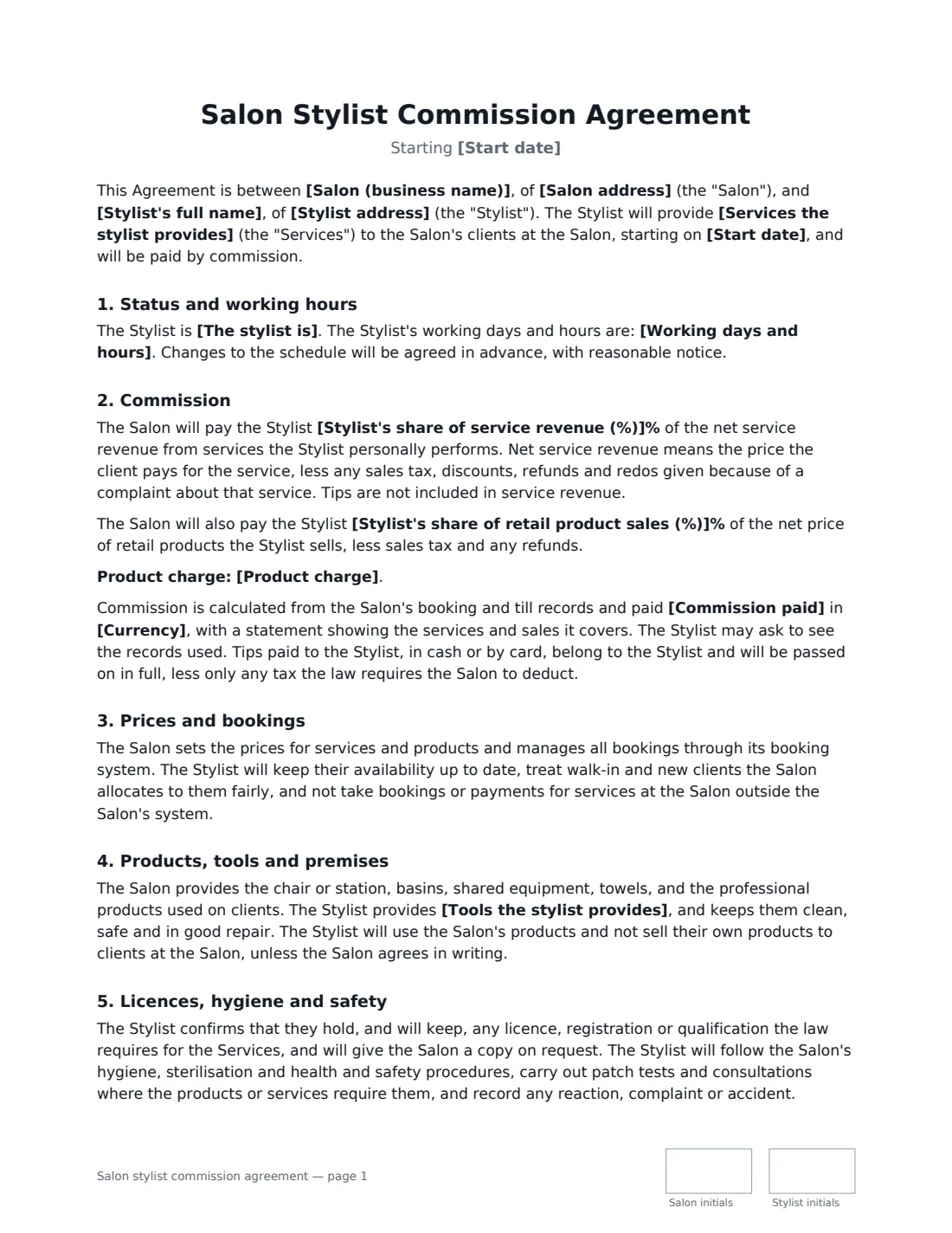
Many hair salons, barbershops, nail bars and beauty salons pay their stylists by commission: a percentage of what clients pay for the services the stylist performs, often with a smaller percentage of the retail products they sell. Disputes usually come down to three questions — what exactly the percentage is calculated on, who owns the client list, and what happens when a stylist moves to another salon. This agreement answers them up front.
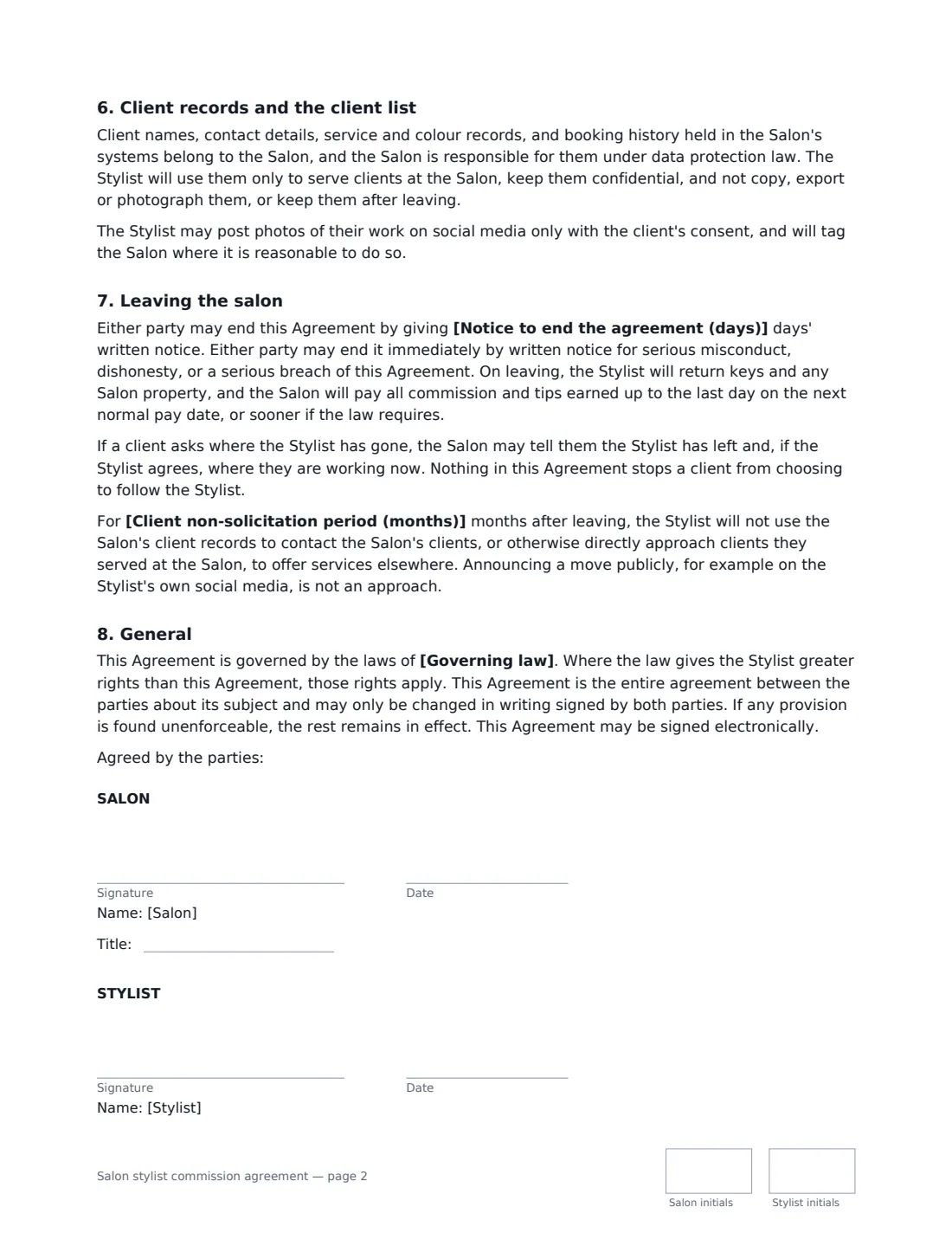
The template names the services and working hours and lets you record whether the stylist is an employee paid by commission or a self-employed contractor, adding the matching paragraph on deductions, holiday and minimum-wage top-up, or on the stylist's own taxes and insurance. It sets the stylist's share of net service revenue (with a clear definition that excludes sales tax, discounts, refunds, redos and tips), an optional retail commission and product charge, and how often commission is paid, with statements and access to the records. It covers prices and bookings through the salon's system, products, tools and premises, licences, hygiene and patch tests, ownership and confidentiality of client records, social media photos with client consent, notice, final pay, and an optional, limited promise not to approach salon clients after leaving.
- Best for
- Hair salons, barbershops, nail and beauty salons paying staff by commission
- Signed by
- The salon and the stylist
- Commission
- Your percentage of net service revenue, plus optional retail commission
- Length
- 2 to 3 pages, initialled on every page
When to Use a salon stylist commission agreement
- Taking on a new hairdresser or barber on a commission split
- Moving an existing stylist from an hourly wage to commission
- A nail technician, lash artist or beauty therapist working on commission
- Writing down an informal commission arrangement that has never been documented
- Clarifying client-list and social media rules with a stylist who is building a following
What You Fill In
17 blanks, then the name and email of each person who signs: salon, stylist.
1 The parties
- Salon (business name)*
- Salon address*
- Stylist's full name*
- Stylist address
2 The role
- Start date*
- Services the stylist provides*
- The stylist is* an employee of the Salon, paid by commission · a self-employed contractor, paid by commission
- Working days and hours*
3 Commission
- Stylist's share of service revenue (%)*
- Stylist's share of retail product sales (%)
- Product charge
- Commission paid* weekly · every two weeks · twice a month · monthly
- Currency*
4 Salon and tools
- Tools the stylist provides*
5 Leaving the salon
- Notice to end the agreement (days)*
- Client non-solicitation period (months)
- Governing law*
6 Who signs
- Salon signature and date, job title, initials on every page · The salon owner or manager.
- Stylist signature and date, initials on every page · The stylist, barber, therapist or technician.
What the salon stylist commission agreement Covers
- Status and working hours
- Commission
- Prices and bookings
- Products, tools and premises
- Licences, hygiene and safety
- Client records and the client list
- Leaving the salon
- General
Using the salon stylist commission agreement, step by step
1 Enter the salon and stylist
Add the salon's business name and address, the stylist's name and address, the start date and the services they provide.
2 Record the working relationship
Choose whether the stylist is an employee paid by commission or a self-employed contractor, and enter their working days and hours. The paragraph that follows changes with your choice. Choose carefully: the right answer depends on how the relationship really works, not on the label.
3 Set the commission
Enter the stylist's percentage of service revenue and, if you pay it, of retail sales. Describe any product charge for backbar products, how often commission is paid and the currency. Leave the product charge empty if you don't make one.
4 Agree leaving terms and send
List the tools the stylist provides, choose the notice period, and set the number of months for the client non-solicitation promise — or leave it empty to remove it. Add the governing law, add the stylist as signer and send.
Tips Before You Send It
- Show a worked example when you discuss the split — for example, what the stylist earns on a typical colour service after the product charge.
- If the stylist is an employee, check that commission plus any top-up meets minimum wage for every pay period, and that deductions such as product charges are allowed where you are.
- Keep client records in your booking system rather than stylists' personal phones — it makes the client-records clause workable.
- Chair or booth rental, where the stylist pays the salon rent and keeps their own takings, is a different arrangement — use a booth rental agreement for that; this template is for commission.
Sign It Online In Minutes
- Fill in the blanks. Names, dates and amounts go straight into the agreement — the preview shows exactly where.
- Name who signs. Tick “This is me” for your own part. VergeHR builds the PDF with every signature, date and initials box on the right line, and you can check or move anything before sending.
- Send it. Each signer gets a secure link and signs from any device — no account needed. The signed PDF, with an audit trail and a Certificate of Completion, is filed in Files and emailed to everyone.
Salon stylist commission agreement: frequently asked questions
Who owns the client list when a stylist leaves?
Under this agreement, client records held in the salon's systems belong to the salon, and the stylist may not copy or keep them. Clients are still free to follow a stylist, and a public announcement of a move isn't treated as an approach.
Is a commission stylist an employee or self-employed?
It depends on how the relationship works — who sets the hours, prices and methods, and whose products and booking system are used. Many commission stylists are employees. The template lets you record either and adds the matching terms, but it can't change the legal answer.
Are tips included in the commission?
No. Tips are excluded from service revenue, belong to the stylist and are passed on in full, less only any tax the law requires the salon to deduct.
Can the stylist sign on their phone?
Yes. They receive a secure link and can sign and initial on any device without a VergeHR account. Electronic signatures are generally valid for ordinary contracts like this in the US (ESIGN Act and UETA), the UK, the EU (eIDAS) and Canada.