

What is a family caregiving cost sharing agreement?
Caring for an ageing parent is usually shared between brothers, sisters and other relatives, and it works best when everyone knows what they have signed up for. Without that, one person tends to carry most of the load, costs get paid ad hoc, and resentment builds. A family caregiving agreement puts the plan on paper: the care the parent needs, each person's duties, how the costs are split and how money is handled.
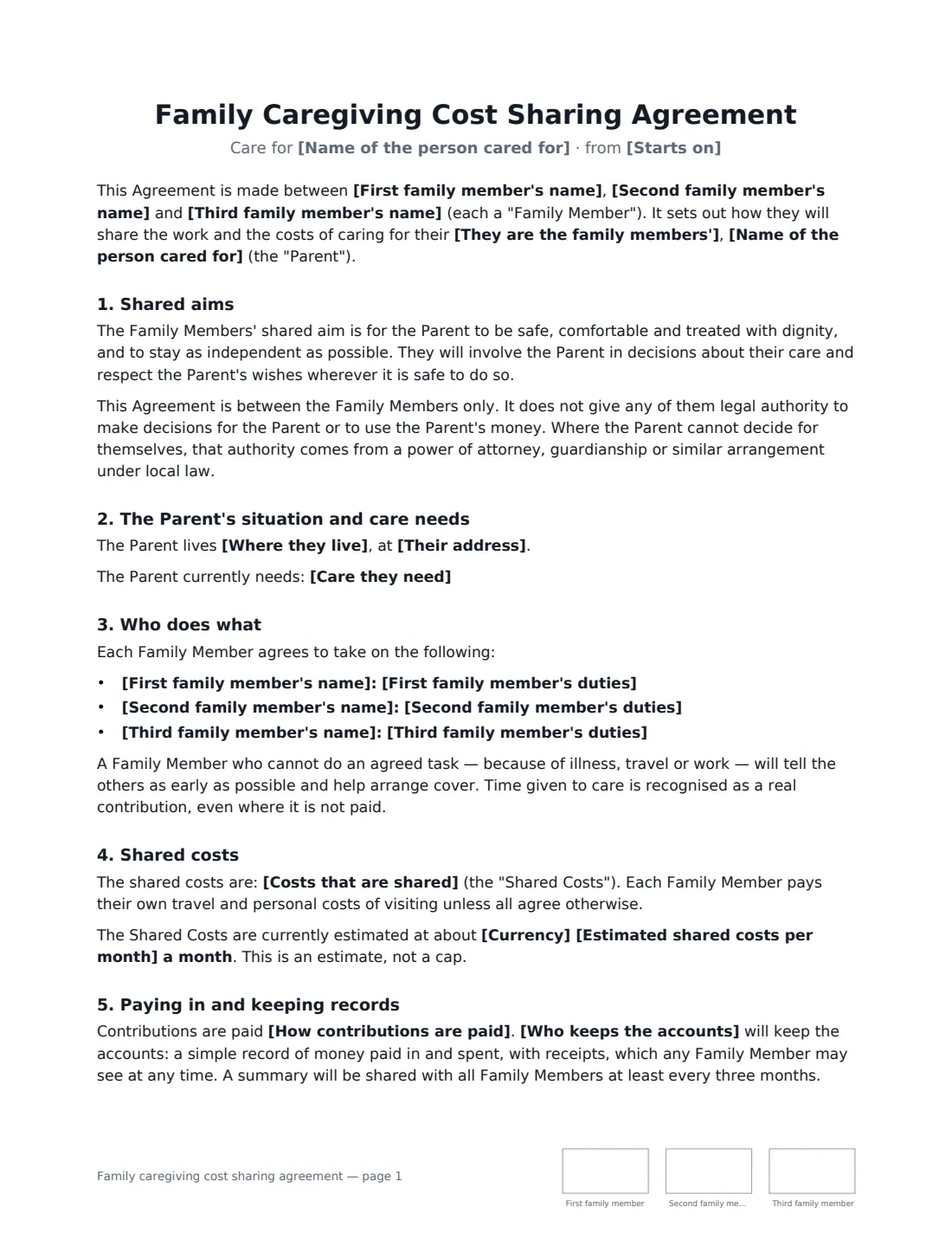
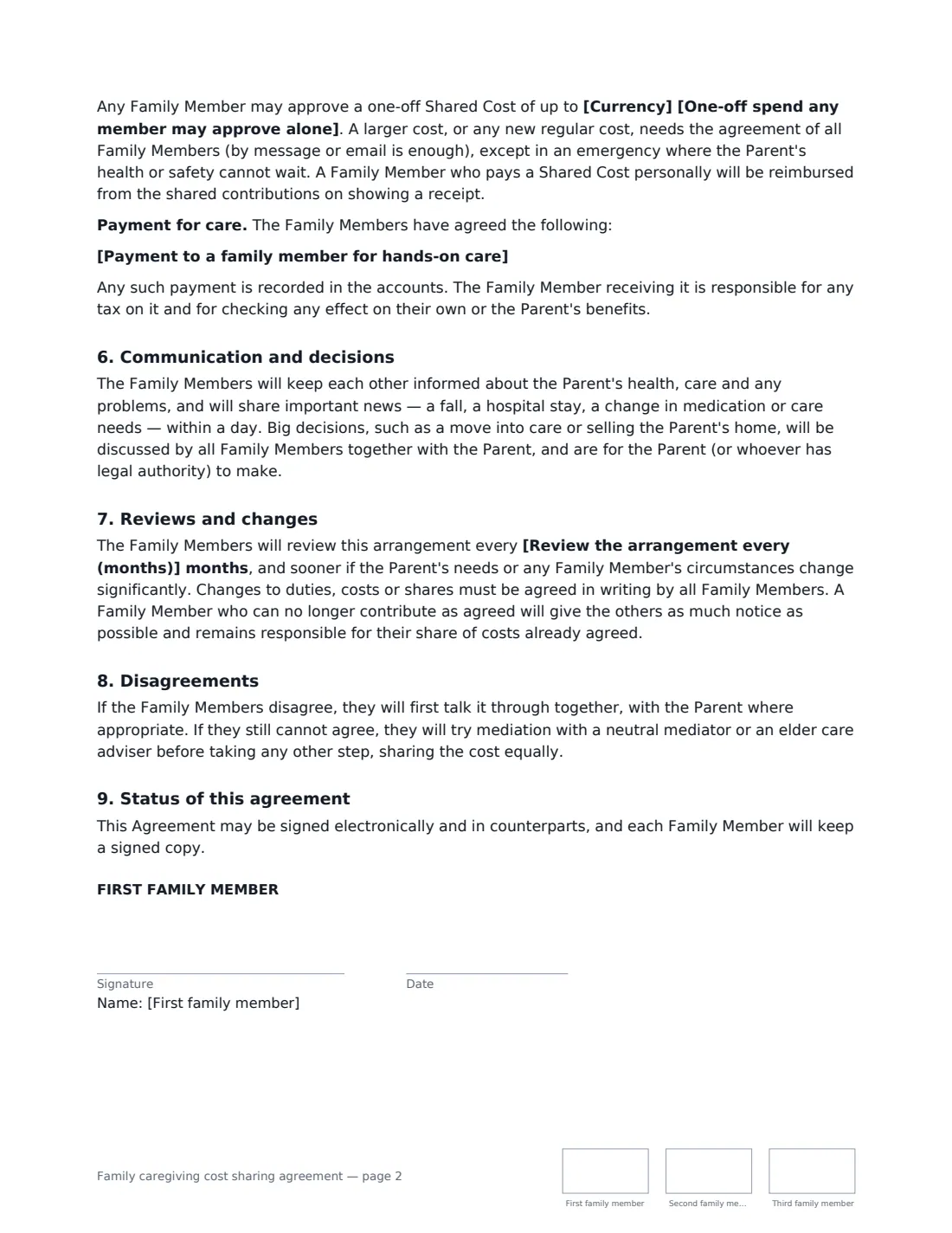
This template is for three family members. It records the parent's living situation and care needs, each member's duties (including care from a distance, such as daily calls or covering breaks), and which costs are shared. You choose whether the parent's own income is used first, and whether costs are split equally, by percentage or by fixed monthly amounts. One person keeps the accounts; everyone can see them. Any member can approve one-off costs up to a limit you set, and larger or new regular costs need everyone's agreement except in emergencies. It can record an agreed payment to a family member who gives hands-on care, and covers communication, big decisions, reviews, mediation for disagreements — and whether you mean the agreement to be legally binding or a statement of family intentions.
It is an agreement between the siblings only: it does not give anyone authority over the parent's decisions or money. That comes from a power of attorney or similar arrangement under local law.
- Best for
- Siblings and relatives sharing care and costs for a parent or grandparent
- Signed by
- Three family members
- Cost split
- Equally, by percentage, or by fixed monthly amounts
- Length
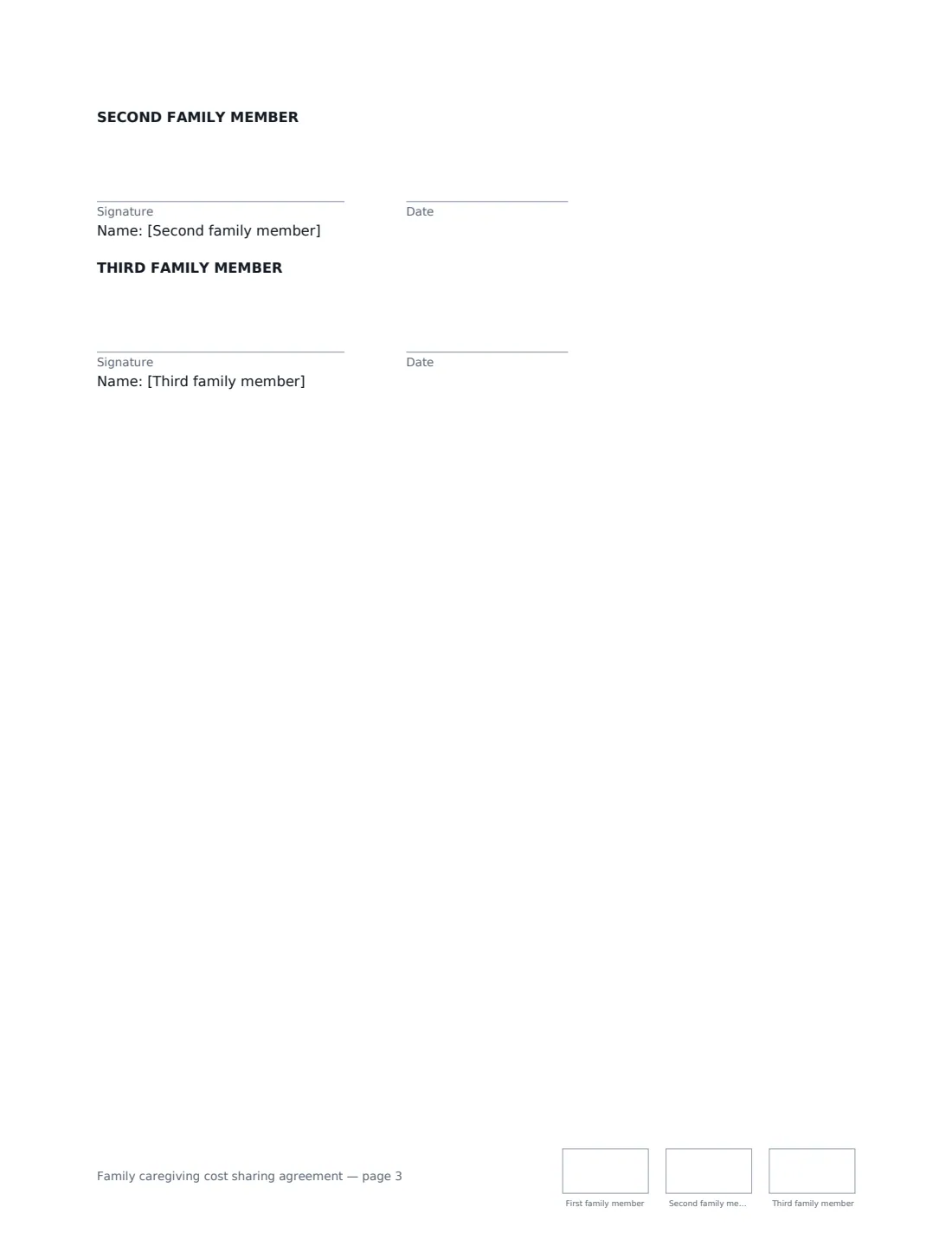
- 3 pages, initialled on every page
When to Use a family caregiving cost sharing agreement
- Three siblings sharing the cost of a paid carer so a parent can stay at home
- A parent moving in with one child while the others contribute money and respite
- Splitting care home or assisted living fees the parent's savings don't cover
- A sibling abroad contributing money and phone support while others help in person
- Agreeing to pay the sibling who gives daily hands-on care
What You Fill In
27 blanks, then the name and email of each person who signs: first family member, second family member, third family member.
1 The person cared for
- Starts on*
- Name of the person cared for*
- They are the family members'*
- Where they live* in their own home · with one of the family members · in a care home or assisted living
- Their address
- Care they need*
2 Who does what
- First family member's name*
- First family member's duties*
- Second family member's name*
- Second family member's duties*
- Third family member's name*
- Third family member's duties*
3 Costs
- Currency*
- Costs that are shared*
- Parent's own money* Used first, then the family shares the rest · Not used — the family pays the shared costs
- Estimated shared costs per month
- How the shared costs are split* Equally · By the percentages below · By fixed monthly amounts below
- First family member's share
- Second family member's share
- Third family member's share
4 Money handling
- How contributions are paid*
- Who keeps the accounts*
- One-off spend any member may approve alone*
- Payment to a family member for hands-on care
5 Reviews and disagreements
- Review the arrangement every (months)*
- Is this legally binding?* Yes — a binding agreement · No — a statement of family intentions
- Governing law
6 Who signs
- First family member signature and date, initials on every page · Each of the three family members sharing the care signs. The person being cared for does not sign, but should be involved in the plan.
- Second family member signature and date, initials on every page
- Third family member signature and date, initials on every page
What the family caregiving cost sharing agreement Covers
- Shared aims
- The Parent's situation and care needs
- Who does what
- Shared costs
- Paying in and keeping records
- Communication and decisions
- Reviews and changes
- Disagreements
- Status of this agreement
Using the family caregiving cost sharing agreement, step by step
1 Describe the parent's situation
Enter their name, where they live and the care they currently need — practical help, appointments, a paid carer, supervision. Talk to your parent first; the agreement commits you to involve them and respect their wishes.
2 Share out the duties
Write each person's duties in plain words. Count time as well as money: the sibling who drives to appointments every week is contributing as much as the one who pays more.
3 Agree the money
List the shared costs, decide whether your parent's own money is used first, estimate the monthly total, and choose how to split it. Name who keeps the accounts, how contributions are paid, and the spending limit any one person can approve alone.
4 Set reviews and sign
Choose how often to review — needs change quickly — and whether the agreement is legally binding. Add your siblings as signers; all three sign and initial each page, and each gets the PDF.
Tips Before You Send It
- Have the conversation before the paperwork. The agreement should record a plan you've already talked through together.
- Make sure someone holds a power of attorney (or local equivalent) while your parent can still grant one, so decisions and bills don't stall.
- Paying a family carer can affect tax and benefits for both the carer and your parent in some countries — check before you agree it.
- Keep receipts and share the accounts regularly. Transparency prevents most disputes.
Sign It Online In Minutes
- Fill in the blanks. Names, dates and amounts go straight into the agreement — the preview shows exactly where.
- Name who signs. Tick “This is me” for your own part. VergeHR builds the PDF with every signature, date and initials box on the right line, and you can check or move anything before sending.
- Send it. Each signer gets a secure link and signs from any device — no account needed. The signed PDF, with an audit trail and a Certificate of Completion, is filed in Files and emailed to everyone.
Family caregiving cost sharing agreement: frequently asked questions
Does this let us manage our parent's money?
No. It only covers what the siblings agree between themselves. Using a parent's money or making decisions for them needs their consent or legal authority, such as a power of attorney, guardianship or local equivalent.
Is a caregiving agreement between siblings legally binding?
You choose. Pick "binding" to make the agreed contributions enforceable under the governing law you name, or "a statement of family intentions" for a written plan without court claims between family. Enforceability still depends on local law.
What if there are only two of us, or more than three?
This template is built for exactly three family members, each with their own duties, share and signature. A relative who helps only occasionally can still be one of the three. For two, or four or more, this version doesn't fit as it stands: write your own agreement and upload it to VergeHR eSignature to place each person's signature boxes.
Is this different from a caregiver agreement with a parent?
Yes. A personal care agreement is between the parent and a paid carer (often a family member) and is sometimes used in benefits or long-term care planning. This agreement is between the siblings about sharing the work and costs.
Can we sign it electronically?
Yes. Electronic signatures are generally valid for ordinary agreements in the US (ESIGN Act and UETA), the UK, the EU (eIDAS) and Canada, which is handy when siblings live in different places. VergeHR keeps an audit trail and a Certificate of Completion with the signed PDF.