

What is a idea submission agreement?
Companies receive ideas from customers, inventors, writers and designers all the time. Accepting one without any terms is risky for both sides: the submitter worries the idea will be taken, and the company worries about being accused of stealing something its own team was already building. An idea submission agreement sets the rules before anyone looks.
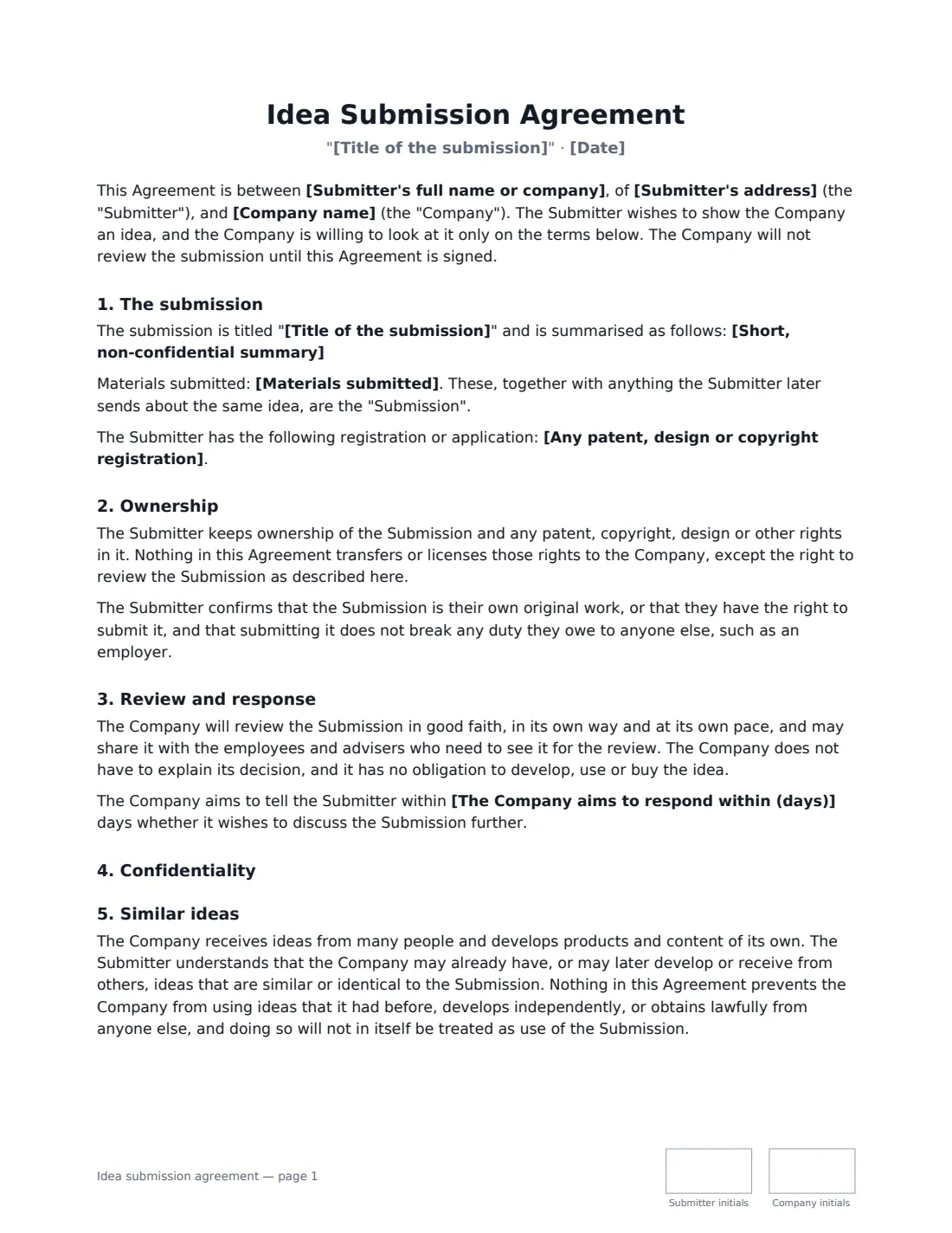
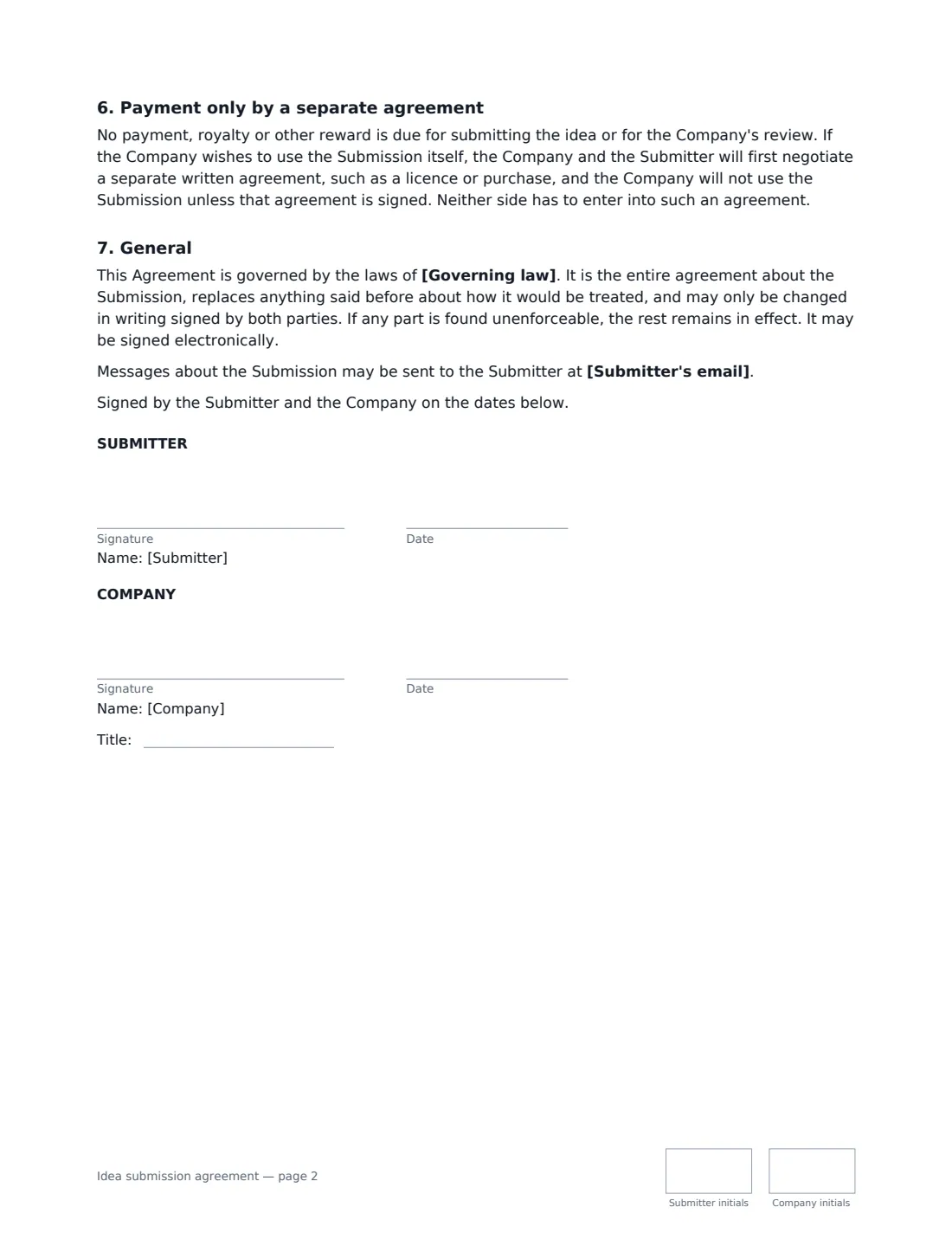
This template identifies the submission by title and a short non-confidential summary, lists the materials sent, and notes any patent, design or copyright registration. The submitter keeps ownership and confirms the idea is theirs to submit. The company reviews in good faith with no obligation to use or buy it. You choose whether the company keeps the submission confidential or receives it on a non-confidential basis — in which case the submitter is told to protect it first. A similar-ideas clause records that the company may already have, or independently develop, similar ideas. And no payment is due unless the parties sign a separate licence or purchase agreement — without which the company will not use the submission.
- Best for
- Product ideas, inventions, designs, pitches, scripts and marketing concepts
- Signed by
- The submitter and the company
- Key choice
- Confidential or non-confidential review
- Length
- 2 pages, initialled on every page
When to Use a idea submission agreement
- A consumer brand receiving product suggestions from customers or inventors
- A toy or games company reviewing outside game concepts
- A production company accepting script or format pitches
- An agency or retailer inviting design submissions
- An inventor pitching a patented or patent-pending product to a manufacturer
What You Fill In
12 blanks, then the name and email of each person who signs: submitter, company.
1 The parties
- Company name*
- Submitter's full name or company*
- Submitter's address
- Submitter's email
2 The submission
- Date*
- Title of the submission*
- Short, non-confidential summary*
- Materials submitted
- Any patent, design or copyright registration
3 Review terms
- Confidentiality* The Company will keep the submission confidential · The submission is not confidential
- The Company aims to respond within (days)
- Governing law*
4 Who signs
- Submitter signature and date, initials on every page · The person or business submitting the idea.
- Company signature and date, job title, initials on every page
What the idea submission agreement Covers
- The submission
- Ownership
- Review and response
- Confidentiality
- Similar ideas
- Payment only by a separate agreement
- General
Using the idea submission agreement, step by step
1 Identify the submission
Give it a title and a short summary that identifies it without giving the details away, then list the materials — a PDF of sketches, a video, a prototype. The same idea sent later is covered too.
2 Decide on confidentiality
Choose carefully. If the company keeps it confidential, it may use the submission only to decide whether to pursue it, and returns or destroys the materials on request. If not, the submitter is warned to protect the idea before sending it — but either way the company may not use the submission without a separate agreement. Only promise confidentiality you can actually keep.
3 Add response time and law
Optionally set how many days the company aims to respond in, and fill in the governing law — usually where the company is based.
4 Sign before reviewing
The agreement says the company will not review the submission until it is signed. Both sides initial each page and sign, and the signed copy is filed in Files with a record of what was received.
Tips Before You Send It
- Submitters: file a patent or design application, or at least keep dated records, before sharing anything valuable.
- Companies: route all outside ideas through one channel so you can show which teams saw what and when.
- Keep the summary non-confidential so it can sit safely in the agreement itself.
- If the company wants to use the idea, the next step is a licence or purchase agreement — this template deliberately doesn't grant either.
Sign It Online In Minutes
- Fill in the blanks. Names, dates and amounts go straight into the agreement — the preview shows exactly where.
- Name who signs. Tick “This is me” for your own part. VergeHR builds the PDF with every signature, date and initials box on the right line, and you can check or move anything before sending.
- Send it. Each signer gets a secure link and signs from any device — no account needed. The signed PDF, with an audit trail and a Certificate of Completion, is filed in Files and emailed to everyone.
Idea submission agreement: frequently asked questions
Does the company get any rights to my idea by signing?
No. The submitter keeps ownership of the idea and any patent, copyright or design rights. The company only gets to review it. Using it requires a separate written agreement.
Why would a company refuse to keep an idea confidential?
Because it may already be working on something similar. Receiving ideas in confidence could make it harder to use its own independent work. Many companies therefore only accept ideas on a non-confidential basis, and the template supports both approaches.
What if the company later launches something similar?
The similar-ideas clause says the company may use ideas it had already, develops independently or gets lawfully from others, and that doing so is not in itself use of the submission. It does not permit using the submission itself without a separate agreement.
Can this be signed electronically?
Yes. Electronic signatures are generally valid for ordinary commercial agreements like this in the US (ESIGN and UETA), the UK, the EU (eIDAS) and Canada.