

What is a employee written warning?
A written warning is a formal step in most disciplinary procedures. It tells an employee clearly that their conduct, performance or attendance has fallen short, what they need to do differently, and what could happen if nothing changes. Just as important, it creates a dated record that the employee was told — which matters if the issue comes up again.
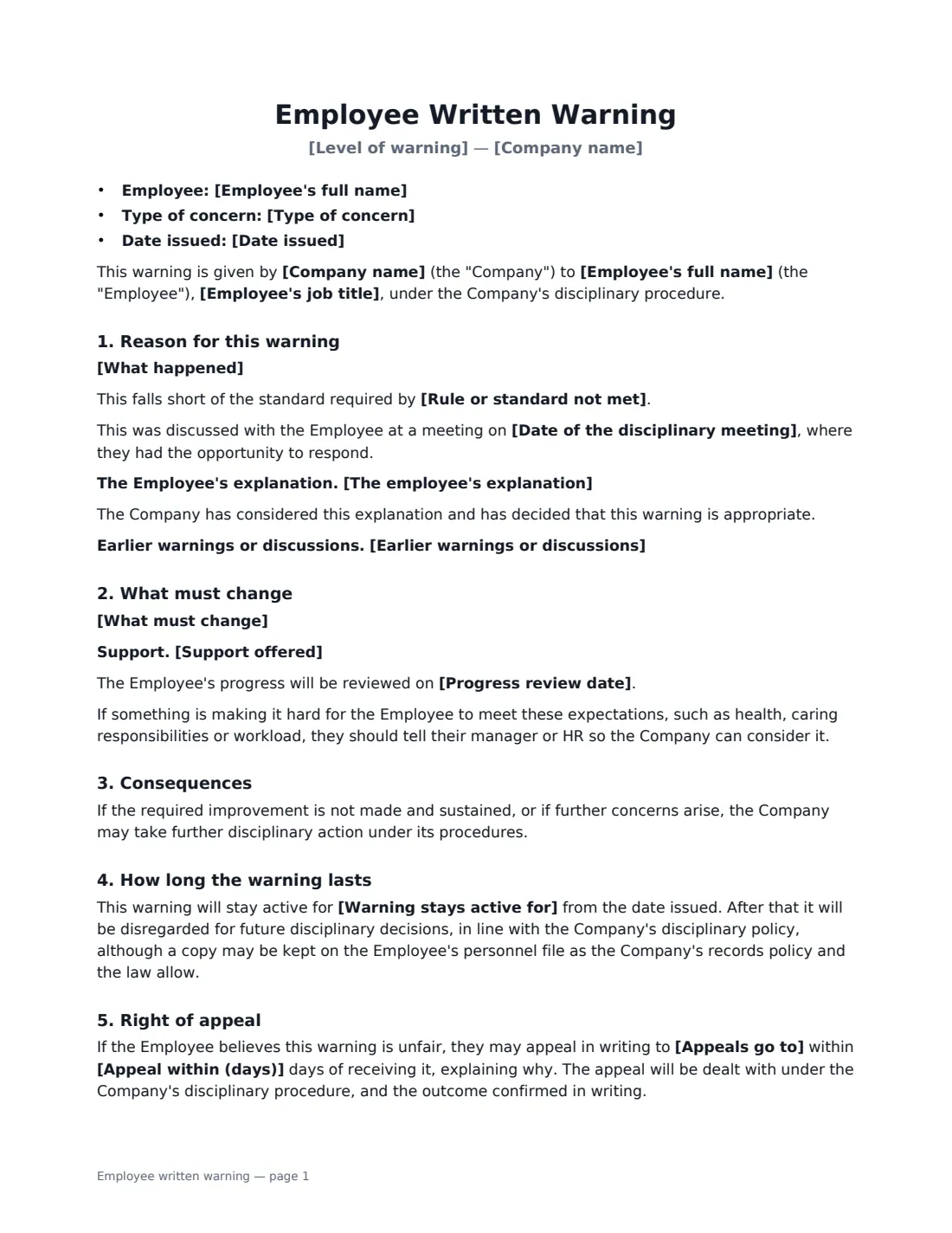
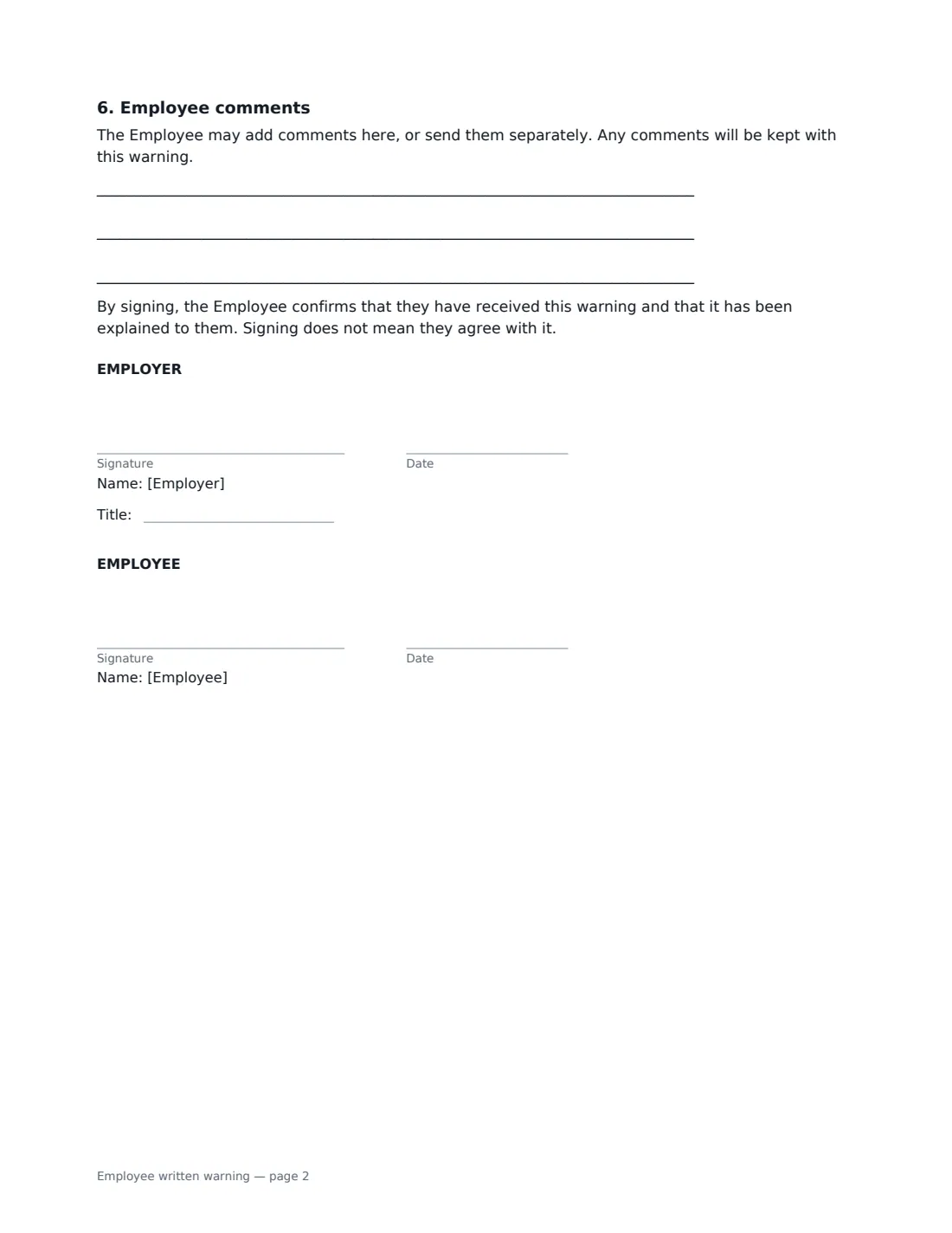
This template covers first and final written warnings for conduct, performance or attendance and timekeeping. It records the facts with dates, the rule or standard that wasn't met, the disciplinary meeting and the employee's explanation, any earlier warnings, the change required and any support, how long the warning stays active, and the right to appeal. The consequences paragraph changes with the level you pick: a first warning points to a possible final warning, a final warning says further action may include dismissal. The employee signs to confirm receipt — the document says clearly that signing is not agreement — and there is space for their own comments.
- Best for
- First or final written warnings about conduct, performance or attendance
- Signed by
- The employer (manager or HR) and the employee, who acknowledges receipt
- Stays active for
- You choose: 3 to 24 months, as your disciplinary policy says
- Length
- About 2 pages, with space for employee comments
When to Use a employee written warning
- Repeated lateness or unauthorised absence after an informal conversation
- A breach of a workplace policy, such as safety rules or acceptable IT use
- Performance that hasn't improved after a performance improvement plan
- A final warning after an earlier first warning for the same kind of issue
- Any disciplinary outcome you need recorded consistently and acknowledged
What You Fill In
17 blanks, then the name and email of each person who signs: employer, employee.
1 The warning
- Company name*
- Date issued*
- Employee's full name*
- Employee's job title
- Level of warning* First written warning · Final written warning
- Type of concern* Conduct · Performance · Attendance and timekeeping
2 What happened
- What happened*
- Rule or standard not met
- Date of the disciplinary meeting
- The employee's explanation
- Earlier warnings or discussions
3 Expected change
- What must change*
- Support offered
- Progress review date
4 Duration and appeal
- Warning stays active for* 3 months · 6 months · 9 months · 12 months · 18 months · 24 months
- Appeals go to*
- Appeal within (days)*
5 Who signs
- Employer signature and date, job title · The manager or HR person issuing the warning
- Employee signature and date · Signs to confirm receipt, not agreement — add a Text box over the comment lines in the editor if they should type comments
What the employee written warning Covers
- Reason for this warning
- What must change
- Consequences
- How long the warning lasts
- Right of appeal
- Employee comments
Using the employee written warning, step by step
1 Choose the level and the type of concern
Pick a first or final written warning, and conduct, performance or attendance. Use the stage your disciplinary policy says applies.
2 Write down the facts
Describe what happened with dates, the rule or standard it breaches, and when you held the disciplinary meeting. Summarise the employee's explanation fairly if they gave one, and list any earlier warnings.
3 Say what must change
Be specific about the improvement you expect and any support you'll give, and set a review date if you want one. Then choose how long the warning stays active and who hears appeals, and how many days the employee has to appeal.
4 Send it after the meeting
Add yourself as the employer and the employee as the second signer. If you want the employee to type comments, place a Text box for them over the comment lines in the editor before sending.
Tips Before You Send It
- Hold a meeting first and let the employee respond before deciding on a warning. Many procedures — and in some places the law — expect this.
- Stick to facts you can support. Leave out opinions and anything not raised at the meeting.
- Use the same active period and appeal window as your written disciplinary policy.
- Ideally, someone who wasn't involved in the decision should hear any appeal.
- If the employee refuses to sign, keep a note of when the warning was given and who was present. The document says signing is only an acknowledgement of receipt, not agreement.
Sign It Online In Minutes
- Fill in the blanks. Names, dates and amounts go straight into the agreement — the preview shows exactly where.
- Name who signs. Tick “This is me” for your own part. VergeHR builds the PDF with every signature, date box on the right line, and you can check or move anything before sending.
- Send it. Each signer gets a secure link and signs from any device — no account needed. The signed PDF, with an audit trail and a Certificate of Completion, is filed in Files and emailed to everyone.
Employee written warning: frequently asked questions
Does the employee's signature mean they agree with the warning?
No. The document states that signing confirms the employee received the warning and had it explained, and does not mean they agree. They can add comments, and they have a right to appeal.
What is the difference between a first and a final written warning?
A first written warning is usually the first formal stage and says further issues may lead to a final written warning. A final written warning says further issues may lead to dismissal. Serious misconduct can sometimes go straight to a final warning — follow your own procedure.
How long does a written warning stay on file?
You choose the active period, from 3 to 24 months, to match your policy. After it expires, the warning is disregarded for future disciplinary decisions, though a copy may be kept on file as your records policy and the law allow.
Can a written warning be signed electronically?
Generally, yes. Electronic signatures are widely accepted for workplace documents in the US (ESIGN Act and UETA), the UK, the EU (eIDAS) and Canada, and the audit trail shows exactly when the employee received and signed it.