

What is a youth sports code of conduct?
A youth sports code of conduct sets the tone for a season. It tells young players what good sportsmanship looks like, tells parents what is and isn't acceptable on the sidelines, and — just as important — sets out what the club promises in return. When a problem does come up, a signed code means everyone agreed to the same standards in advance, and the club can point to a fair, stepped process instead of making it up on the spot.
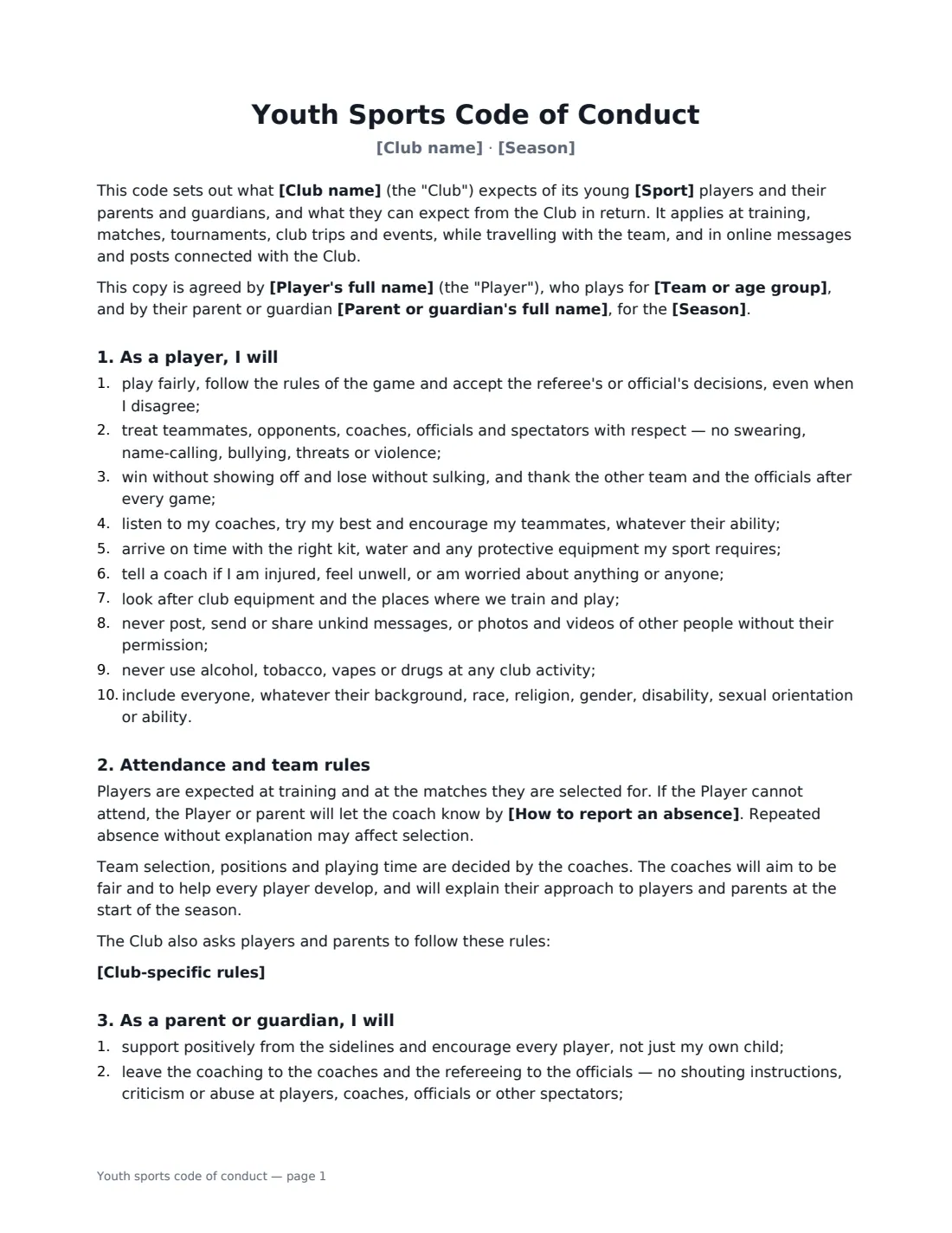
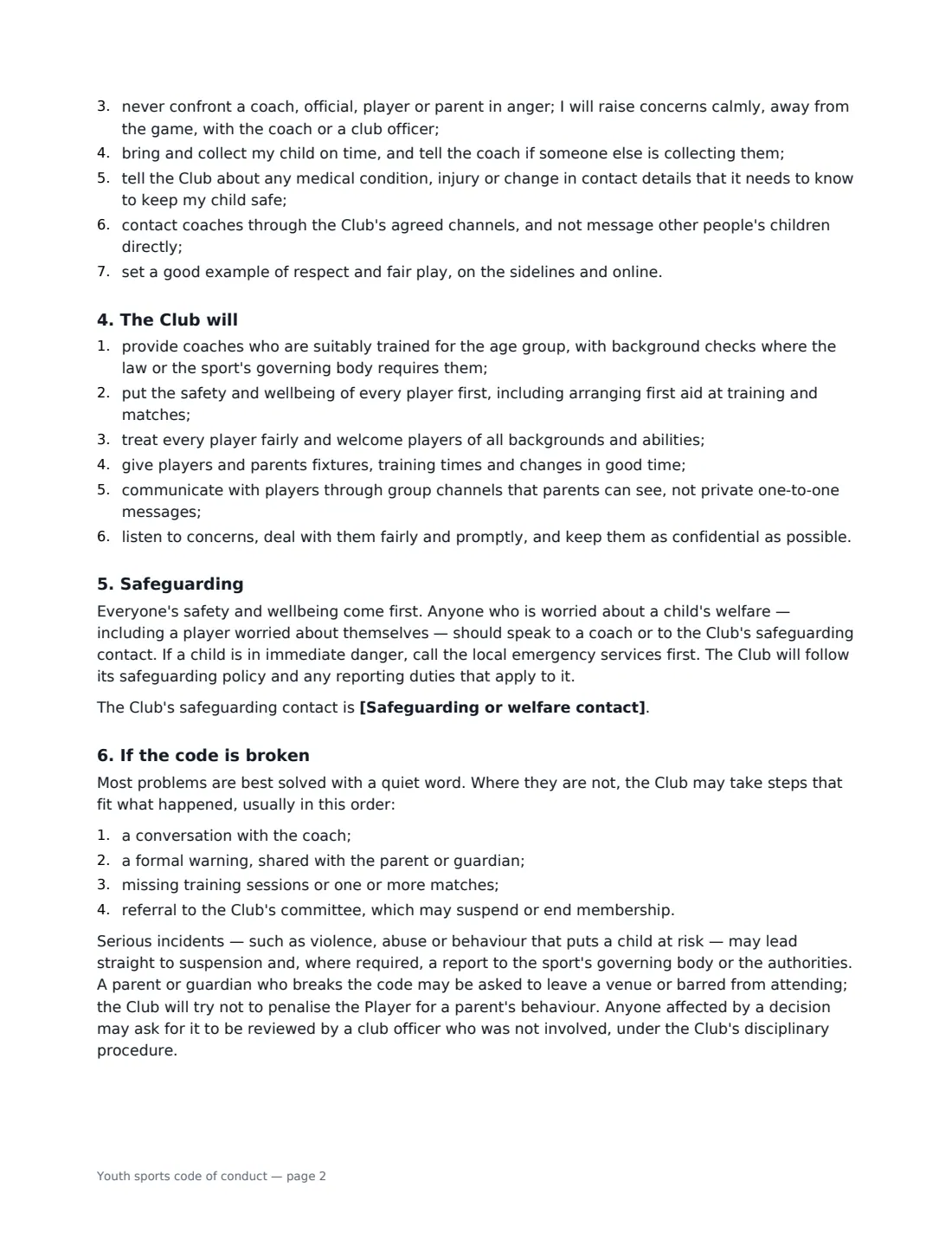
This template has three signers: the player, their parent or guardian, and the club. Players commit to fair play, respect for officials and opponents, effort, kit and punctuality, telling a coach about injuries or worries, kind behaviour online, and no alcohol, tobacco, vapes or drugs. Parents commit to positive support, leaving the coaching and refereeing to others, raising concerns calmly, safe pickup, and using the club's communication channels. The club commits to suitably trained and checked coaches, safety first, fairness and inclusion, timely communication and group — not private — messaging. It adds a safeguarding section with your welfare contact, your absence rule, any club-specific rules, and a clear order of consequences with a right to have decisions reviewed.
- Best for
- Youth soccer, basketball, hockey, rugby, swimming, gymnastics and other junior clubs
- Signed by
- The player, a parent or guardian, and a coach or club officer
- Covers
- Player and parent conduct, club commitments, safeguarding, consequences
- Length
- 2–3 pages
When to Use a youth sports code of conduct
- Season registration for a junior club or league team
- A new player joining mid-season
- Resetting expectations after sideline behaviour problems
- Tournament or travel teams where players spend time away from home
- School sports teams and academies wanting a written code for families
What You Fill In
9 blanks, then the name and email of each person who signs: player, parent or guardian, club.
1 The club
- Club name*
- Sport*
- Season*
- Team or age group
- Safeguarding or welfare contact
2 Player and parent
- Player's full name*
- Parent or guardian's full name*
3 Team rules
- How to report an absence*
- Club-specific rules
4 Who signs
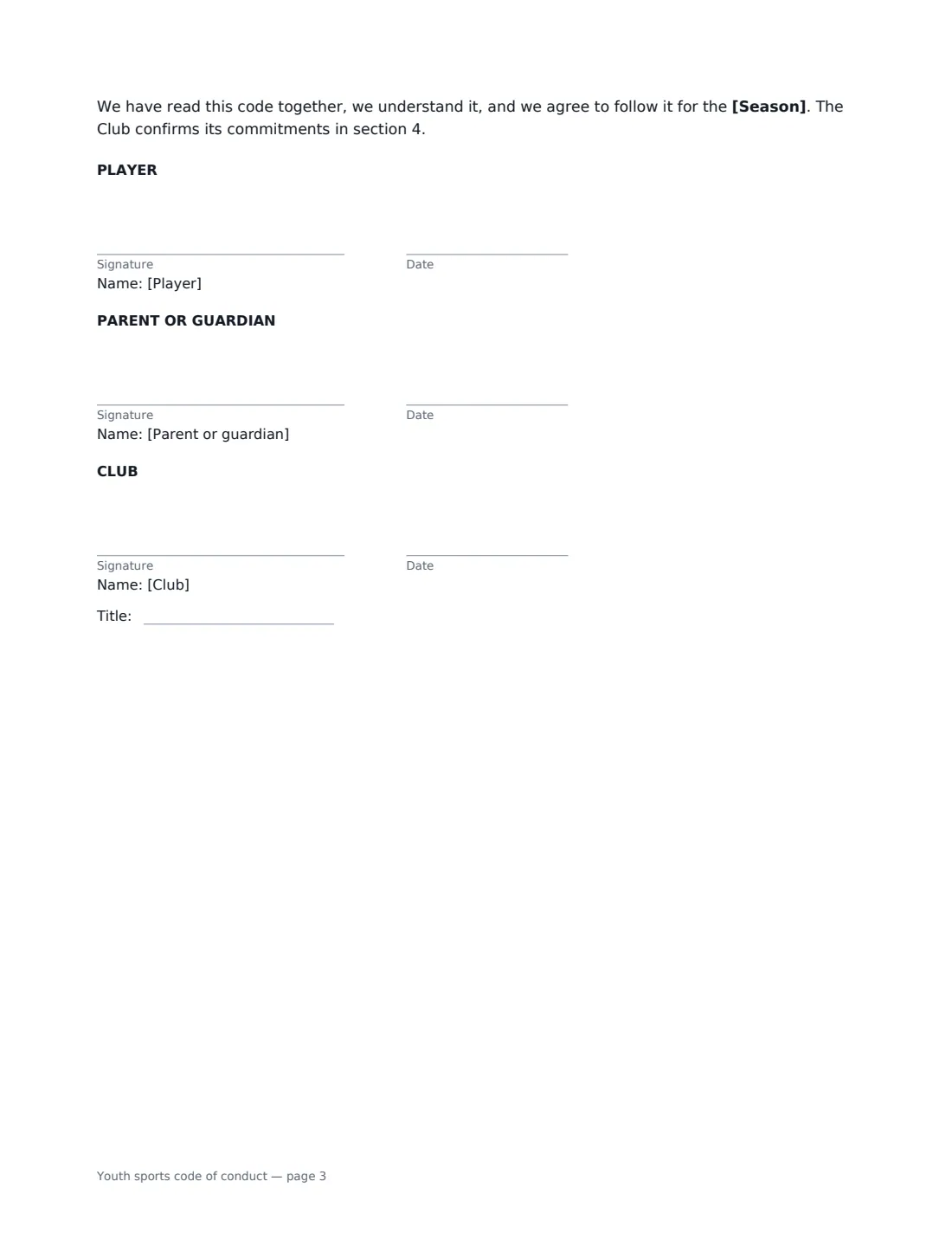
- Player signature and date · The young player. Younger children can sign with a parent's help.
- Parent or guardian signature and date · A parent or legal guardian of the player.
- Club signature and date, job title · A coach, team manager or club officer.
What the youth sports code of conduct Covers
- As a player, I will
- Attendance and team rules
- As a parent or guardian, I will
- The Club will
- Safeguarding
- If the code is broken
Using the youth sports code of conduct, step by step
1 Set up the club and season
Enter your club name, the sport, the season and optionally the team or age group. Add your safeguarding or welfare contact — the person families can go to with a concern.
2 Adjust the team rules
The absence rule defaults to "a message to the coach at least 24 hours beforehand, except in an emergency"; change it to match how your team works. Add club-specific rules one per line, such as arrival times, kit or jewellery rules.
3 Send to the family
Enter the player's and parent's names and emails. Younger players can sign with a parent's help. You countersign as the coach or club officer.
4 Keep it for the season
The signed code is filed in Files. If an issue arises, the consequences section gives a fair, stepped process — a conversation, a formal warning, missed sessions or matches, then the committee — with serious incidents handled straight away.
Tips Before You Send It
- Go through the code with players at the first training session so it means something to them, not just their parents.
- Make sure your welfare contact is someone players and parents can actually reach, with an email or phone number.
- Explain your approach to selection and playing time early — the code says the coaches will, and it heads off many disputes.
- Pair this with a parental consent form for medical details and trips, and a photo release if you post team photos.
Sign It Online In Minutes
- Fill in the blanks. Names, dates and amounts go straight into the agreement — the preview shows exactly where.
- Name who signs. Tick “This is me” for your own part. VergeHR builds the PDF with every signature, date box on the right line, and you can check or move anything before sending.
- Send it. Each signer gets a secure link and signs from any device — no account needed. The signed PDF, with an audit trail and a Certificate of Completion, is filed in Files and emailed to everyone.
Youth sports code of conduct: frequently asked questions
Can a child sign an agreement like this?
A code of conduct is mainly about agreeing to behaviour standards, and having the player sign helps them take ownership. The parent or guardian also signs, confirming they have read the code with their child and agree to the parent commitments themselves.
Does this replace our safeguarding policy?
No. The code points to your safeguarding contact and commits the club to following its safeguarding policy and any reporting duties. You still need the policy itself, and background checks where the law or your governing body requires them.
What if a parent, not the player, breaks the code?
The club may ask the parent to leave a venue or bar them from attending. The code says the club will try not to penalise the player for a parent's behaviour.
Is an electronic signature valid for a code of conduct?
Electronic signatures are generally valid for agreements like this in the US (ESIGN Act and UETA), the UK, the EU (eIDAS) and Canada. VergeHR records who signed and when in an audit trail and Certificate of Completion.