

What is a horse boarding agreement?
A horse boarding agreement — called a livery agreement in the UK and Ireland — records what a stable does for a horse and what the owner remains responsible for. Most disputes between barns and boarders come from unwritten assumptions: who calls the vet at 2am, whether the fee is still due while the horse is away at a show, who books the farrier, and what happens if the owner can't be reached.
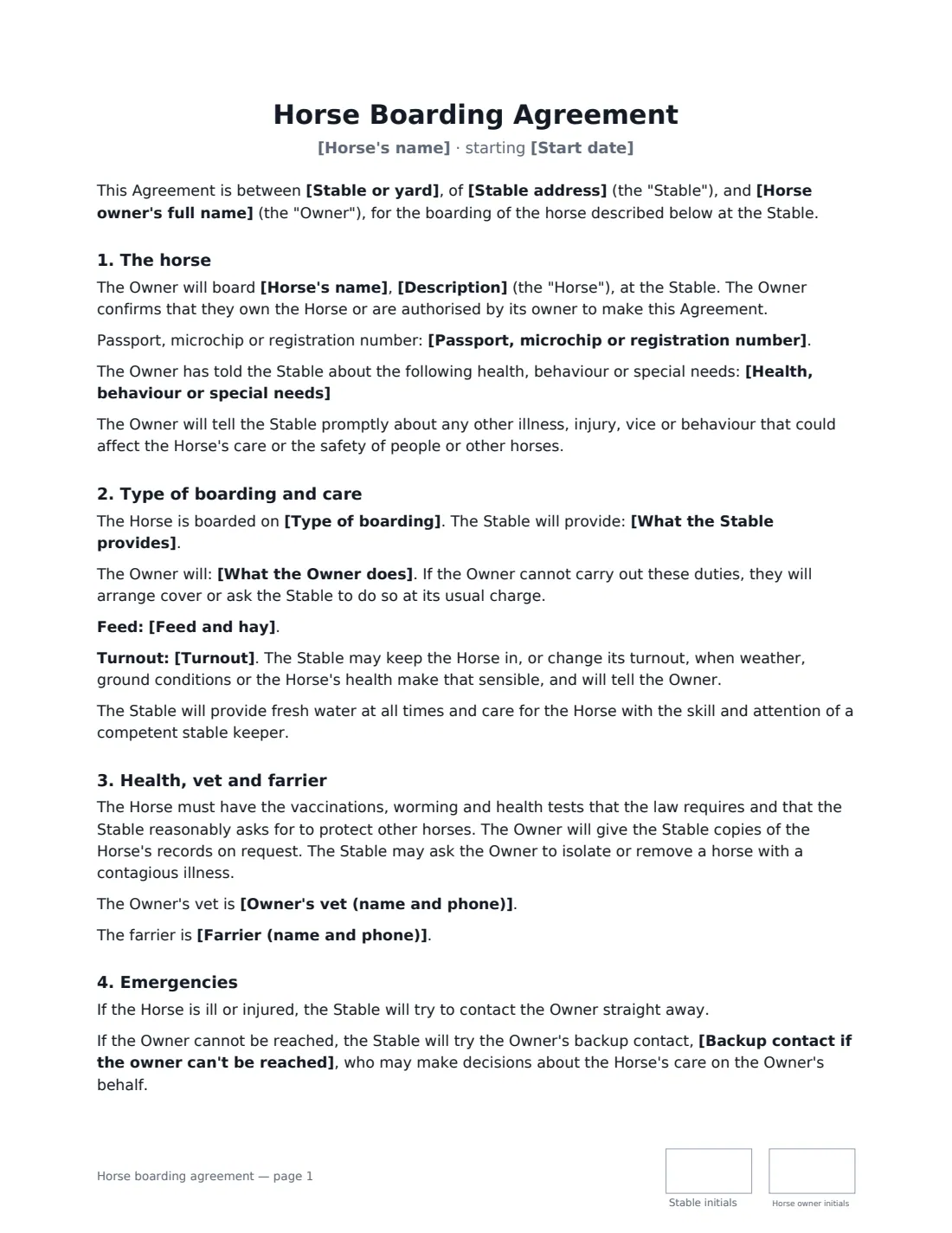
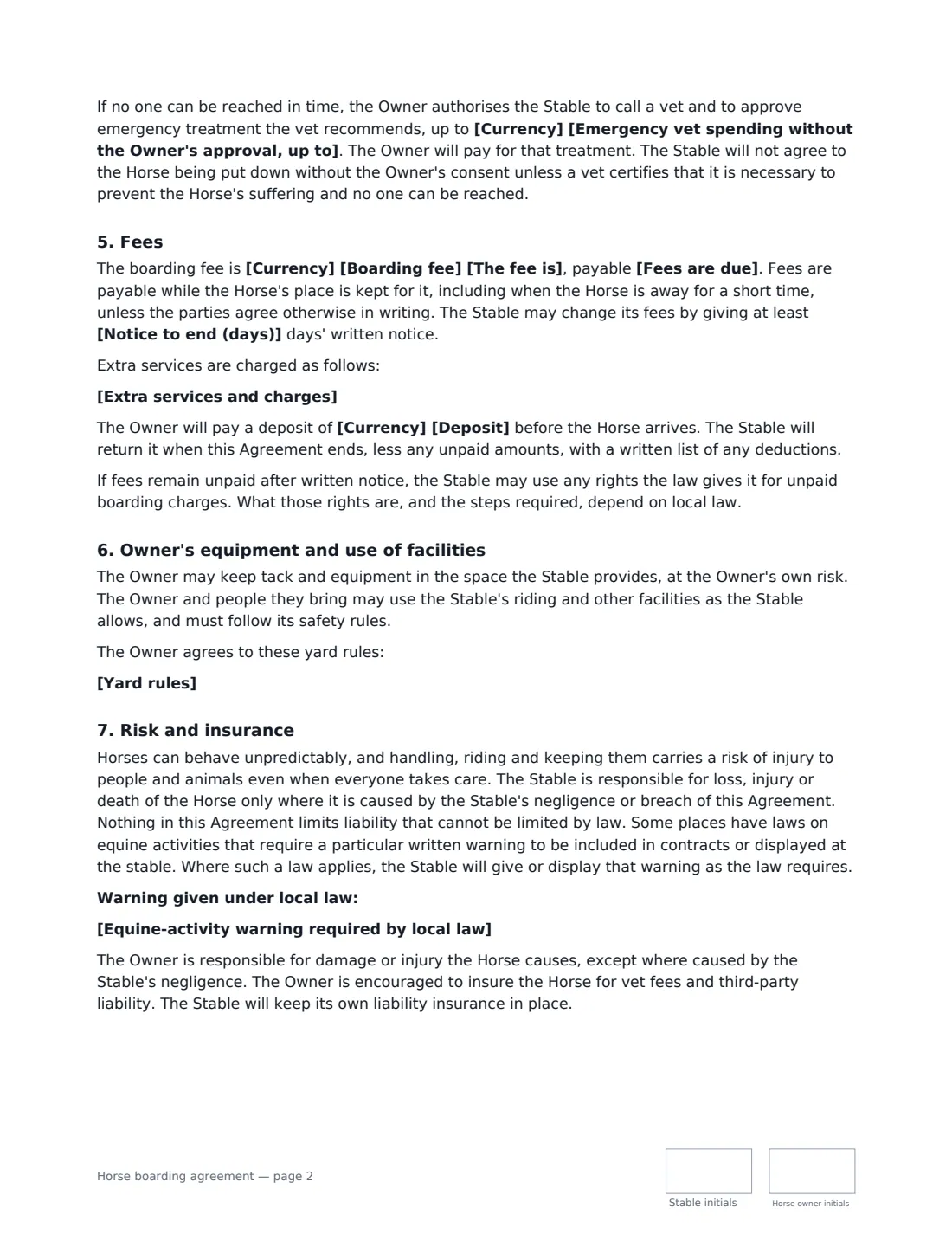
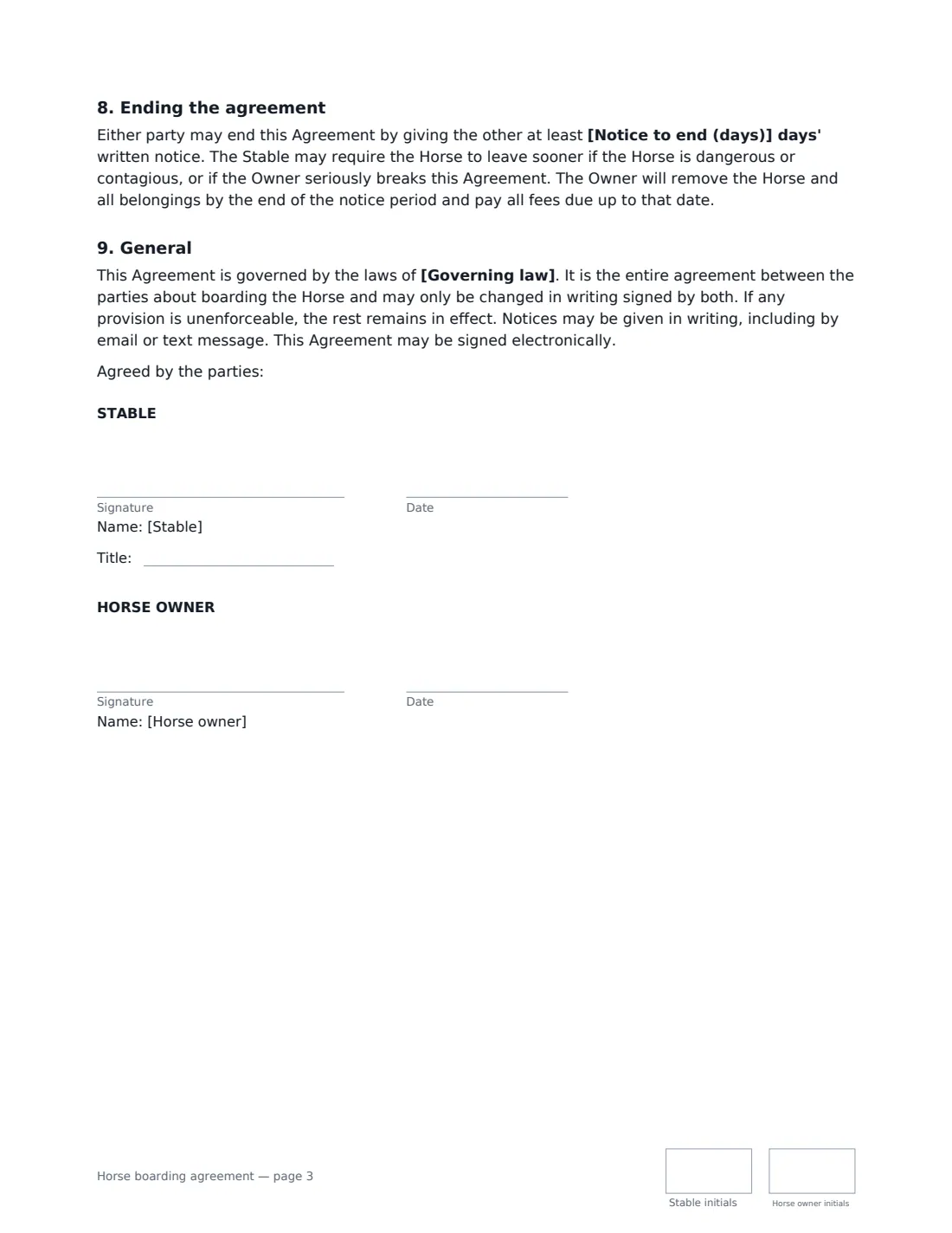
This template covers the horse's identity and any health or behaviour notes, the type of boarding and exactly what the stable provides and what the owner does, feed and turnout, vaccinations and health requirements, whether the stable or the owner books the vet and farrier, an emergency-treatment spending limit and a backup contact, fees and extras, the owner's tack and use of facilities, yard rules, risk and insurance (with room for any equine-activity warning your local law requires), and notice to leave. VergeHR places both signatures and initials on every page.
- Best for
- Boarding barns, livery yards, riding schools and private owners boarding a horse or two
- Livery types
- Full, part, DIY or pasture (grass) livery
- Signed by
- The stable (with job title) and the horse owner
- Length
- About 3 pages, initialled on every page
When to Use a horse boarding agreement
- A boarding barn taking on a new full-livery horse
- A yard offering part livery where the owner rides and the yard feeds and turns out
- A landowner renting grazing and a field shelter on pasture board
- A DIY yard setting out rules and fees for owners who do their own care
- Updating terms for existing boarders when fees or services change
What You Fill In
29 blanks, then the name and email of each person who signs: stable, horse owner.
1 The parties
- Stable or yard*
- Stable address*
- Horse owner's full name*
- Horse owner's phone*
- Backup contact if the owner can't be reached
2 The horse
- Horse's name*
- Description*
- Passport, microchip or registration number
- Health, behaviour or special needs
3 Care
- Type of boarding* full livery · part livery · DIY livery · pasture (grass) livery
- What the Stable provides*
- What the Owner does
- Feed and hay*
- Turnout*
4 Vet and farrier
- Vet, farrier, worming and dental care* The Owner books and pays for them directly · The Stable arranges routine visits and passes on the cost
- Owner's vet (name and phone)
- Farrier (name and phone)
- Emergency vet spending without the Owner's approval, up to*
5 Fees and term
- Start date*
- Currency*
- Boarding fee*
- The fee is* per month · per week
- Fees are due*
- Extra services and charges
- Deposit
- Notice to end (days)*
6 Other terms
- Yard rules
- Equine-activity warning required by local law
- Governing law*
7 Who signs
- Stable signature and date, job title, initials on every page · The stable, barn or yard owner or manager boarding the horse.
- Horse owner signature and date, initials on every page · The owner of the horse, or the person responsible for it.
What the horse boarding agreement Covers
- The horse
- Type of boarding and care
- Health, vet and farrier
- Emergencies
- Fees
- Owner's equipment and use of facilities
- Risk and insurance
- Ending the agreement
- General
Using the horse boarding agreement, step by step
1 Identify the horse
Enter the horse's name and a description (colour, breed, sex, age, height, markings), plus its passport, microchip or registration number. Note any health, behaviour or special needs — laminitis, box-walking, kicking at feed time — so everyone who handles the horse knows.
2 Describe the care
Choose the livery type, then list what the stable provides and, for part, DIY or pasture livery, what the owner does. Describe the feed and hay ration and the turnout routine. The agreement lets the stable keep the horse in when weather, ground or health make that sensible.
3 Agree vet, farrier and emergencies
Choose whether the owner books vet, farrier, worming and dental care directly, or the stable arranges routine visits and passes on the cost. Add the owner's vet and farrier, a backup contact, and the most the stable may approve for emergency treatment if no one can be reached.
4 Set fees and send
Enter the boarding fee, when it's due, any extras (holding for the farrier, clipping, extra hay) and a deposit if you take one. Add your yard rules and the notice period, then send it to the owner to sign. The signed copy is filed in Files.
Tips Before You Send It
- Agree the emergency spending limit carefully — colic surgery can cost far more than a routine call-out, and the owner should know what the stable can authorise.
- Some places have equine-activity laws that require a warning in exact wording to be displayed or included in contracts. Check whether yours does, and paste the exact wording into the warning field so it prints in the agreement.
- Rights to hold a horse for unpaid board depend on local law and usually require formal steps. Don't rely on them without checking.
- Encourage owners to carry vet-fee and third-party liability insurance — the agreement makes the owner responsible for damage the horse causes.
Sign It Online In Minutes
- Fill in the blanks. Names, dates and amounts go straight into the agreement — the preview shows exactly where.
- Name who signs. Tick “This is me” for your own part. VergeHR builds the PDF with every signature, date and initials box on the right line, and you can check or move anything before sending.
- Send it. Each signer gets a secure link and signs from any device — no account needed. The signed PDF, with an audit trail and a Certificate of Completion, is filed in Files and emailed to everyone.
Horse boarding agreement: frequently asked questions
Is the stable liable if the horse is injured?
Under this template the stable is responsible for loss, injury or death only where it is caused by the stable's negligence or breach of the agreement, and nothing limits liability that the law does not allow to be limited. Horses can be injured even with good care, which is why the agreement recommends insurance.
Can the stable have the horse put down in an emergency?
Only with the owner's consent, unless a vet certifies that it is necessary to prevent the horse's suffering and neither the owner nor the backup contact can be reached. Make sure the owner is comfortable with this before signing.
Does the owner still pay while the horse is away?
Yes, by default — fees continue while the horse's place is kept for it, including short absences, unless you agree otherwise in writing.
Can we sign it electronically?
In the US (ESIGN Act and UETA), the UK, the EU (eIDAS) and Canada, electronic signatures are generally valid for ordinary contracts like this one. VergeHR keeps an audit trail and a Certificate of Completion with the signed PDF as evidence of who signed and when.
Is this template free?
Yes. The template is free to use with the eSignature app in VergeHR. The other party doesn't need a VergeHR login to sign.