

What is a horse lease agreement?
Leasing lets a rider have a horse without buying one, and lets an owner share the cost and work of keeping one. It also raises plenty of questions: which days the lessee rides, who pays the farrier or the vet, whether they can jump or compete, what happens if the horse goes lame, and who is responsible if someone gets hurt. A horse lease agreement answers them up front.
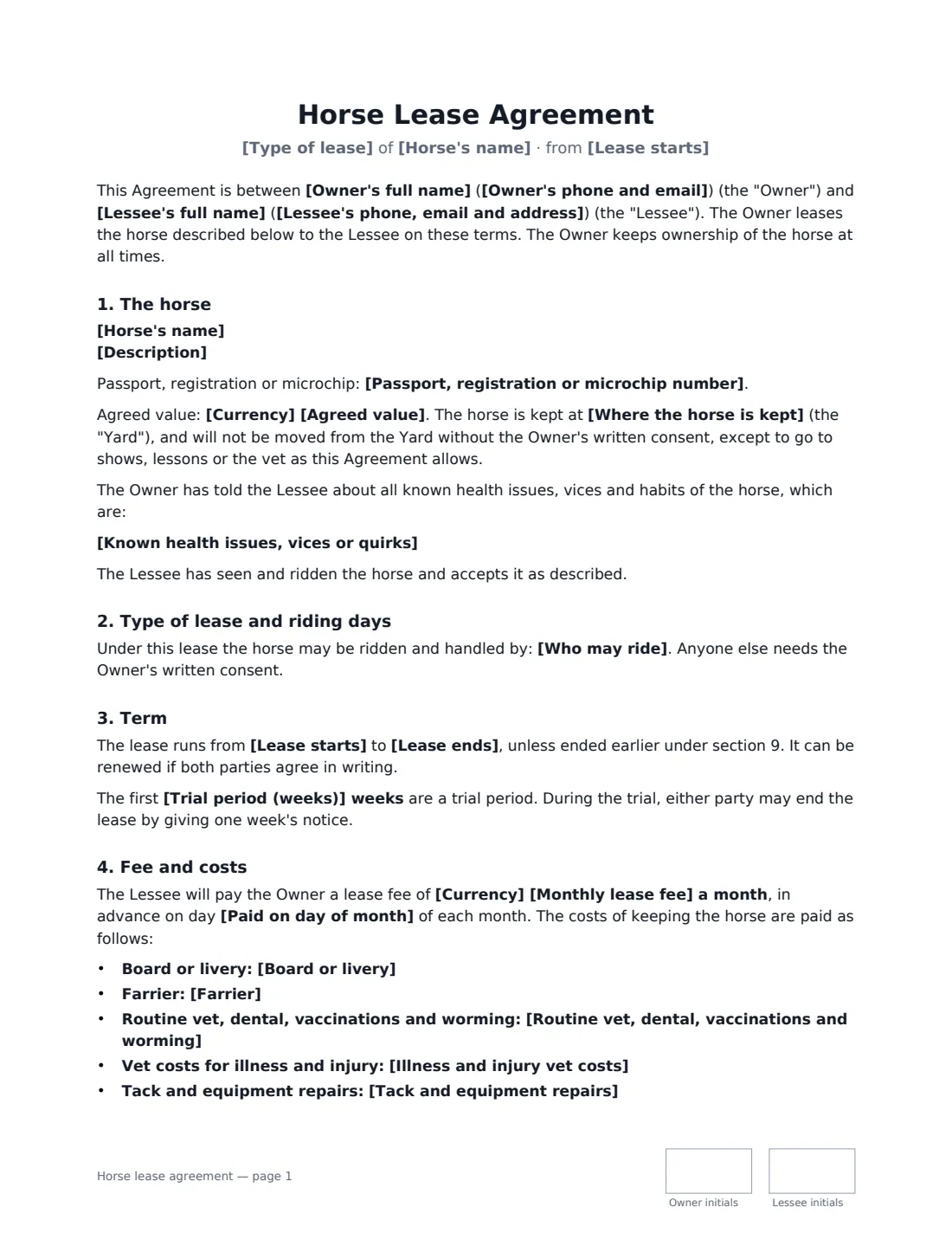
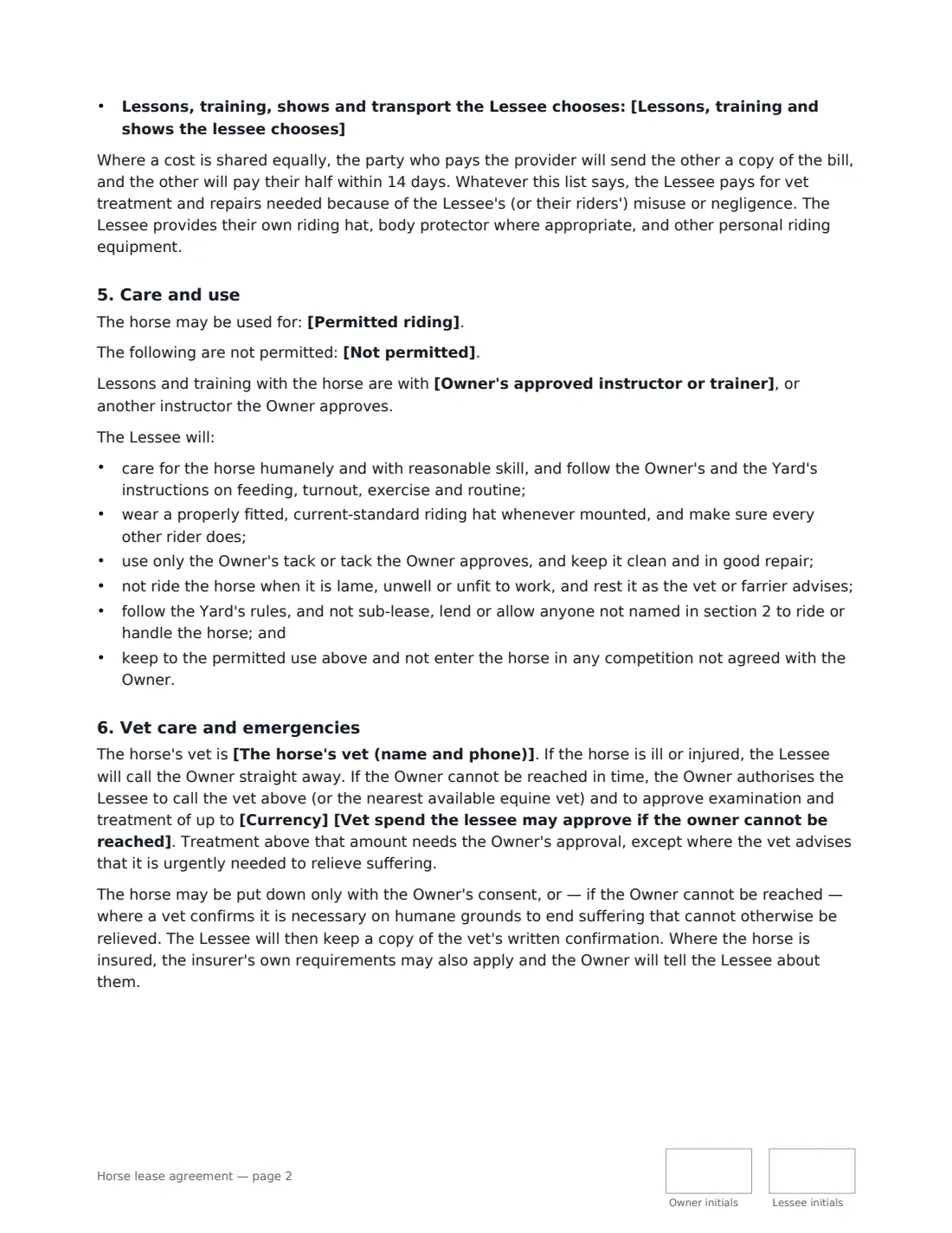
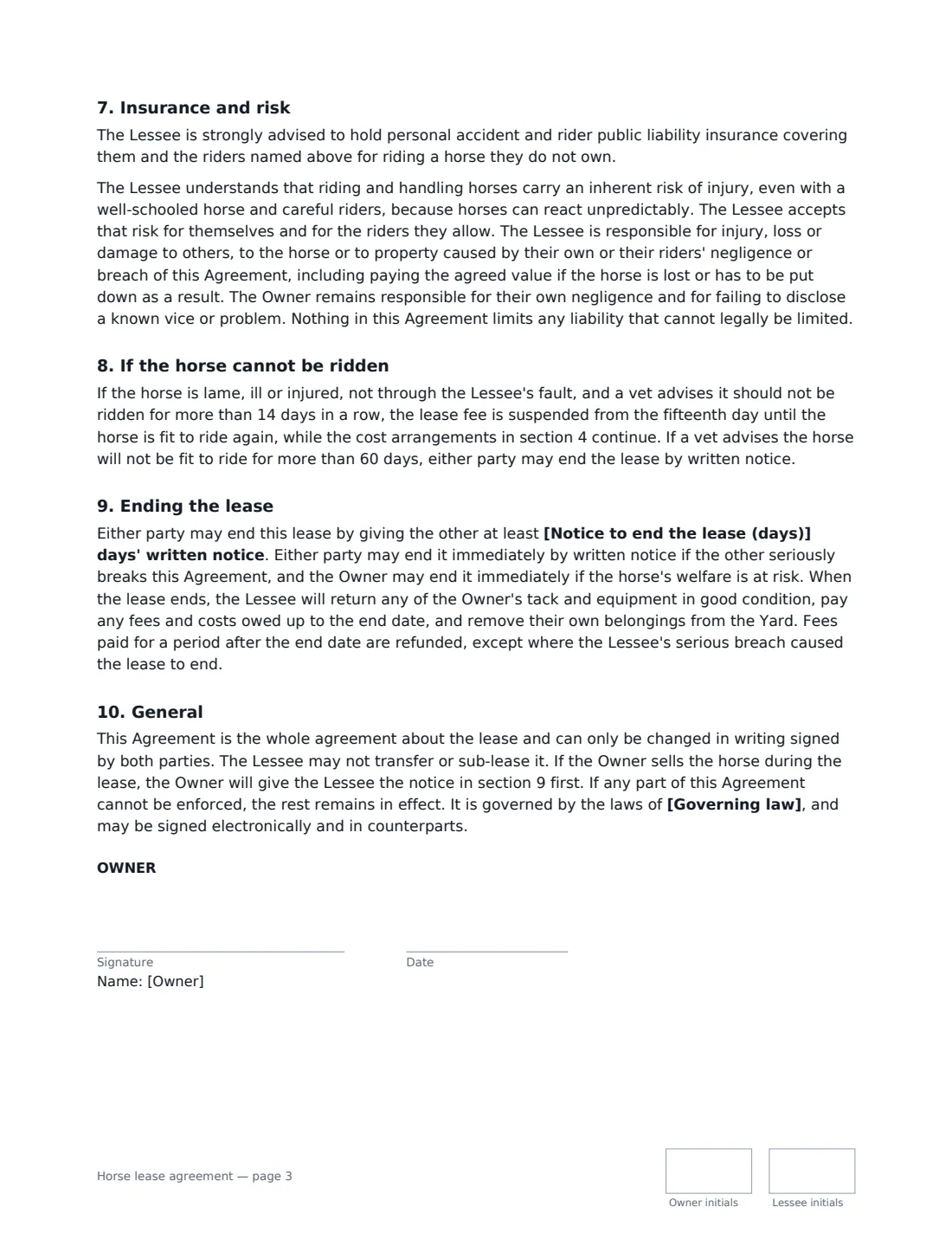
This template describes the horse (breed, colour, age, height, markings, passport or microchip), its agreed value, known health issues and vices, and the yard where it's kept. You choose a full lease (sole use) or a part lease with set riding days, name who may ride, and set the start date, optional end date and optional trial period. It sets an optional monthly fee and lets you choose, item by item, whether the owner, the lessee or both equally pay board, farrier, routine vet care, illness and injury vet costs, tack repairs and lessons or shows. It covers permitted and prohibited riding, an approved instructor, the lessee's care duties including hats, vet emergencies with a spending limit the lessee can approve, when a horse may be put down, insurance, the inherent risk of riding and responsibility for negligence, what happens when the horse can't be ridden, and ending the lease with notice. Both sign and initial every page.
- Best for
- Full leases, part leases, half leases and horse shares
- Signed by
- The owner and the lessee (a parent for a rider under 18)
- Costs
- You choose who pays each: board, farrier, vet, tack, lessons and shows
- Length
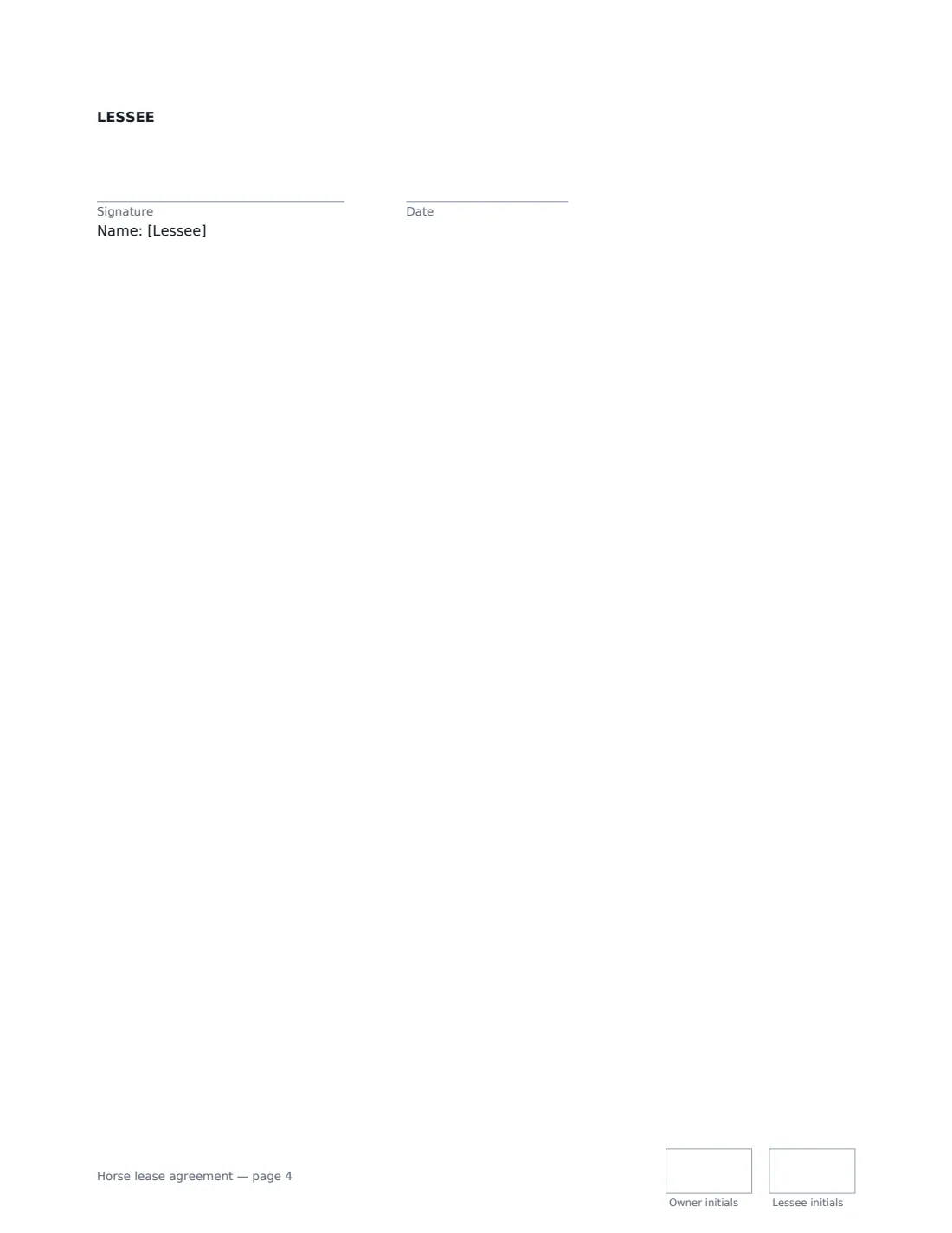
- 3 pages, initialled on every page
When to Use a horse lease agreement
- A part lease where a rider has the horse three days a week
- A full lease while the owner is injured, pregnant or working away
- Leasing a pony to a young rider's family for a season
- A horse share at a livery yard, splitting board and farrier costs
- Trying a horse on a lease with a trial period before deciding to buy
What You Fill In
33 blanks, then the name and email of each person who signs: owner, lessee.
1 The parties
- Owner's full name*
- Owner's phone and email*
- Lessee's full name*
- Lessee's phone, email and address*
- Who may ride*
2 The horse
- Horse's name*
- Description*
- Passport, registration or microchip number
- Agreed value*
- Known health issues, vices or quirks*
- Where the horse is kept*
3 The lease
- Type of lease* Full lease · Part lease
- Riding days (part lease)
- Lease starts*
- Lease ends
- Trial period (weeks)
- Notice to end the lease (days)*
4 Fee
- Currency*
- Monthly lease fee
- Paid on day of month*
5 Who pays for what
- Board or livery* Owner · Lessee · Shared equally
- Farrier* Owner · Lessee · Shared equally
- Routine vet, dental, vaccinations and worming* Owner · Lessee · Shared equally
- Illness and injury vet costs* Owner · Lessee · Shared equally
- Tack and equipment repairs* Owner · Lessee · Shared equally
- Lessons, training and shows the lessee chooses* Owner · Lessee · Shared equally
6 Use of the horse
- Permitted riding*
- Not permitted
- Owner's approved instructor or trainer
7 Emergencies
- The horse's vet (name and phone)*
- Vet spend the lessee may approve if the owner cannot be reached*
- Horse insurance* The Owner keeps the horse insured · The horse is not insured
- Governing law*
8 Who signs
- Owner signature and date, initials on every page · The horse's owner, or someone with authority to lease the horse.
- Lessee signature and date, initials on every page · The rider leasing the horse. If the rider is under 18, a parent or guardian should sign as the lessee.
What the horse lease agreement Covers
- The horse
- Type of lease and riding days
- Term
- Fee and costs
- Care and use
- Vet care and emergencies
- Insurance and risk
- If the horse cannot be ridden
- Ending the lease
- General
Using the horse lease agreement, step by step
1 Describe the horse honestly
Enter its name and full description, passport or microchip number and an agreed value. List known health issues, vices and quirks — the owner's honesty here protects both of you.
2 Choose the lease type and terms
Pick full or part lease; for a part lease, set the riding days. Name everyone allowed to ride, set the start and optional end date, and add a trial period if you want one.
3 Split the costs
Set the monthly fee (or leave it empty if the lessee only shares costs), then choose for each cost — board, farrier, routine vet, illness and injury vet, tack, lessons and shows — whether the owner, the lessee or both equally pay.
4 Agree use, emergencies and notice
Describe permitted riding and anything not allowed, name the vet, set the amount the lessee can approve in an emergency, choose the insurance position and the notice period. Then send for signature and initials.
Tips Before You Send It
- Have a vet check the horse before the lease starts, so both of you know its condition at the start.
- Tell the horse's insurer about the lease — some policies need the lessee named or approved.
- The lessee should consider rider liability and personal accident insurance.
- Some US states have equine activity liability laws that require a particular warning to be printed in contracts. If yours does, add it — check your state's law.
Sign It Online In Minutes
- Fill in the blanks. Names, dates and amounts go straight into the agreement — the preview shows exactly where.
- Name who signs. Tick “This is me” for your own part. VergeHR builds the PDF with every signature, date and initials box on the right line, and you can check or move anything before sending.
- Send it. Each signer gets a secure link and signs from any device — no account needed. The signed PDF, with an audit trail and a Certificate of Completion, is filed in Files and emailed to everyone.
Horse lease agreement: frequently asked questions
What is the difference between a full lease and a part lease?
In a full lease the lessee has sole use of the horse and usually most of the costs and care. In a part (or half) lease the lessee rides on set days and shares the horse — and usually the costs — with the owner or other riders.
Who pays the vet bills?
You choose for routine care and for illness or injury separately. Whatever you choose, the lessee pays for treatment needed because of their own or their riders' misuse or negligence.
What if the horse goes lame?
If the horse can't be ridden for more than 14 days in a row through no fault of the lessee, the lease fee pauses from day 15 while the cost-sharing continues, and either of you can end the lease if it will last more than 60 days.
Does the agreement protect the owner if the rider is hurt?
The lessee acknowledges that riding carries inherent risk and accepts it, and each party stays responsible for their own negligence. How far such terms protect an owner depends on local law, and some places have specific equine liability rules — take advice if you're unsure.
Can we sign a horse lease online?
Yes. Electronic signatures are generally valid for ordinary contracts like this in the US (ESIGN Act and UETA), the UK, the EU (eIDAS) and Canada. VergeHR keeps an audit trail and a Certificate of Completion with the signed PDF.