

What is a on-call agreement?
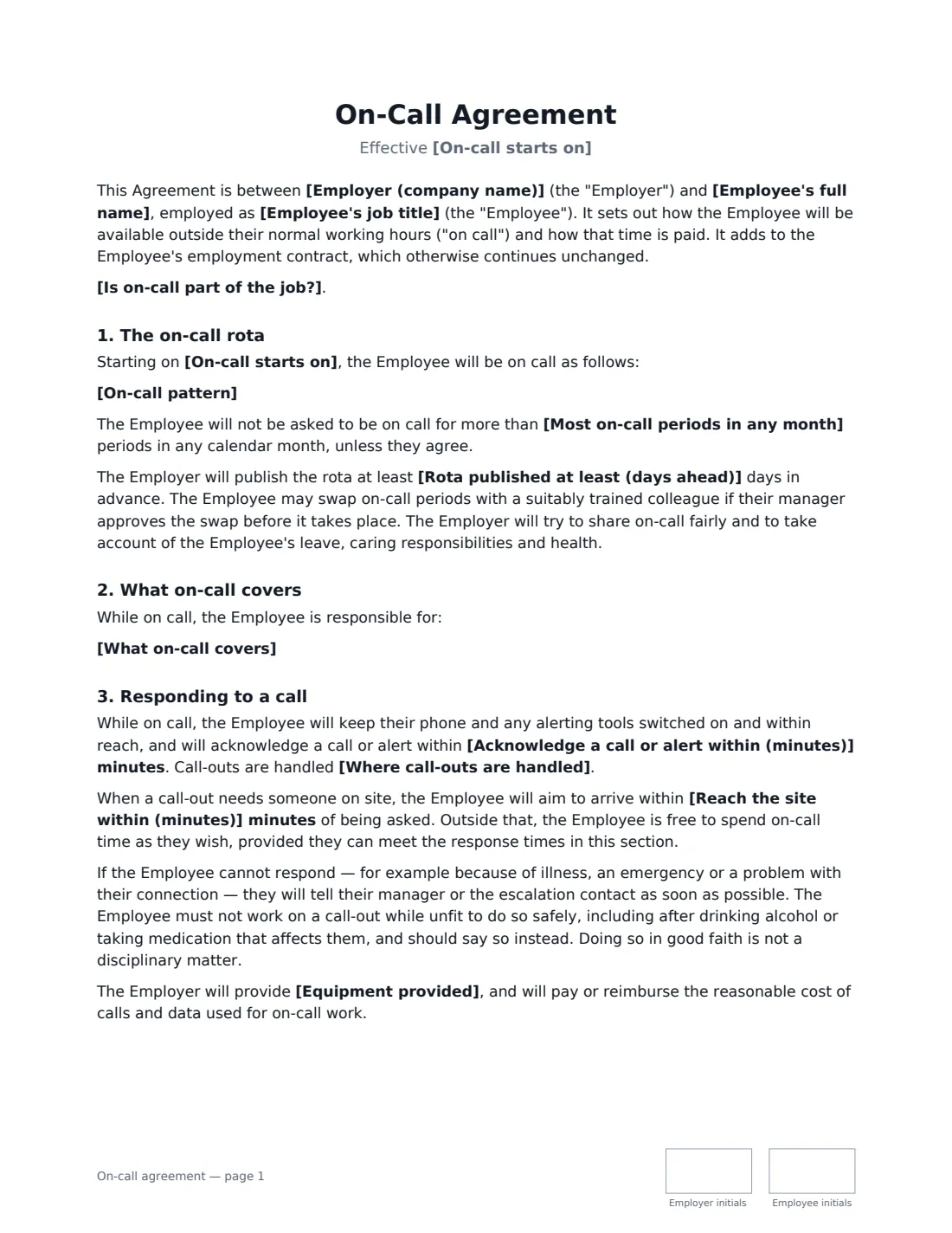
An on-call agreement sets the rules for employees who are available outside normal hours: IT and engineering teams on incident rotas, maintenance technicians, care and facilities staff, and anyone else who may be called out at night or at the weekend. Without one, arguments start over how often someone is on the rota, whether a five-minute phone call counts, and what happens to the next morning after a long call-out.
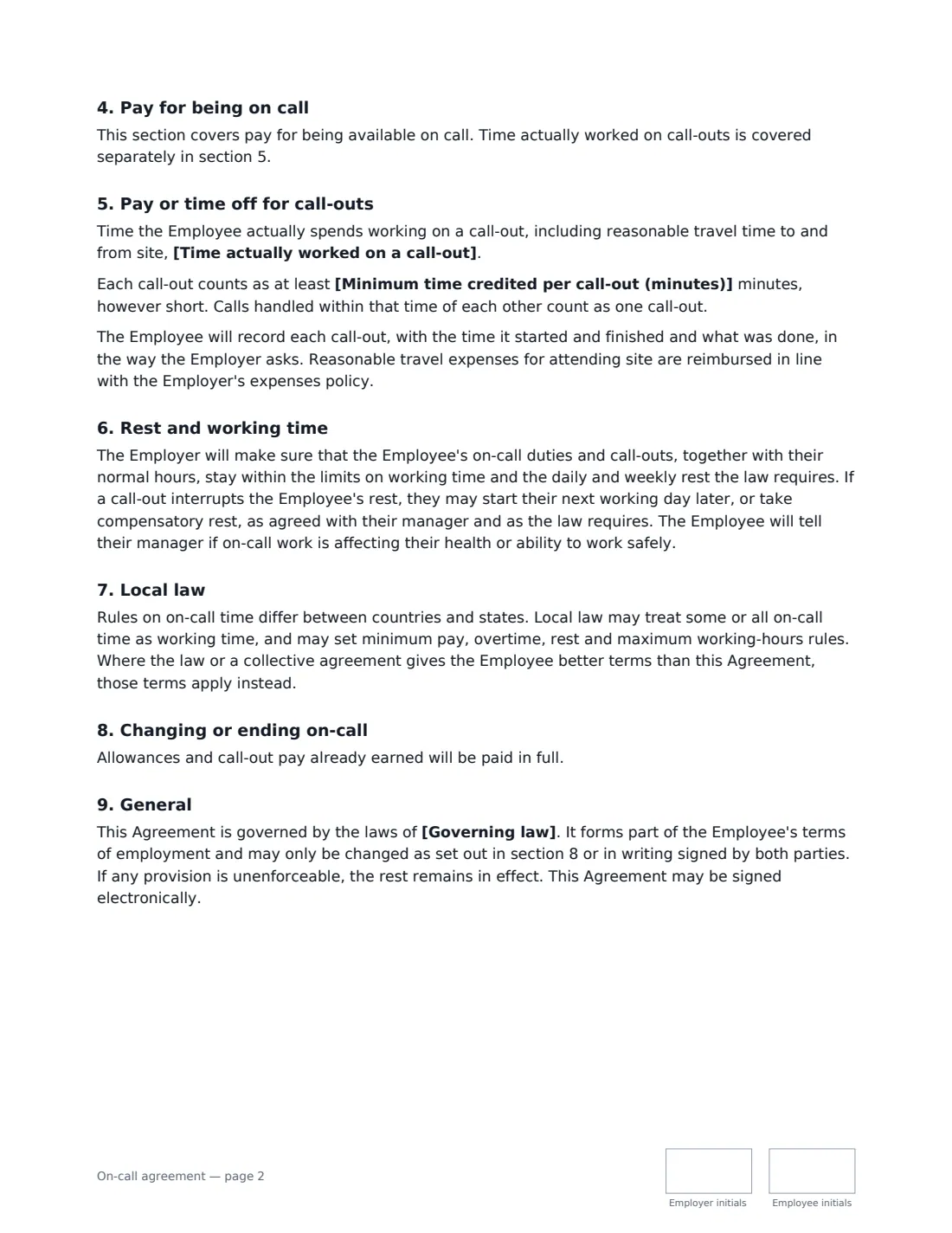
This template covers the on-call pattern and how far ahead the rota is published, what on-call covers, how quickly to acknowledge an alert and whether call-outs are handled remotely or on site, equipment and phone costs, pay for being on standby, pay or time off in lieu for call-outs, minimum call-out time, rest after a disturbed night, and how on-call can be changed or ended. Because rules on on-call time differ a lot between countries and states, it says that where local law or a collective agreement gives the employee better terms, those apply.
- Best for
- IT, engineering, maintenance, facilities and care teams with an out-of-hours rota
- Signed by
- The employer and the employee
- Pay options
- Flat allowance per period, hourly standby rate, or included in salary — plus call-out pay or time off in lieu
- Length
- 2-3 pages, initialled on every page
When to Use a on-call agreement
- An engineer joins the incident-response rota for a production system
- A maintenance technician covers weekend call-outs for a building or site
- A small business asks a manager to take out-of-hours calls one week a month
- You're changing on-call pay and want each employee to sign the new terms
- An employee volunteers for an on-call role that isn't part of their job
What You Fill In
21 blanks, then the name and email of each person who signs: employer, employee.
1 The parties
- Employer (company name)*
- Employee's full name*
- Employee's job title*
- On-call starts on*
2 The rota
- Is on-call part of the job?* On-call is a requirement of the Employee's role · On-call is voluntary for this role
- On-call pattern*
- Most on-call periods in any month
- Rota published at least (days ahead)*
3 Responding
- What on-call covers*
- Acknowledge a call or alert within (minutes)*
- Where call-outs are handled* remotely, using the equipment provided · on site · remotely where possible, and on site when the issue cannot be fixed remotely
- Reach the site within (minutes)
- Equipment provided
4 Pay and time off
- Currency*
- Pay for being on call* A flat allowance for each on-call period · An hourly standby rate · No separate standby payment — it is reflected in the Employee's salary
- Standby allowance or rate
- Time actually worked on a call-out* is paid at the rate below · is given back as paid time off in lieu, hour for hour · is paid as overtime under the Employee's employment contract
- Call-out rate
- Minimum time credited per call-out (minutes)
5 Other terms
- Notice to change or end on-call (days)*
- Governing law*
6 Who signs
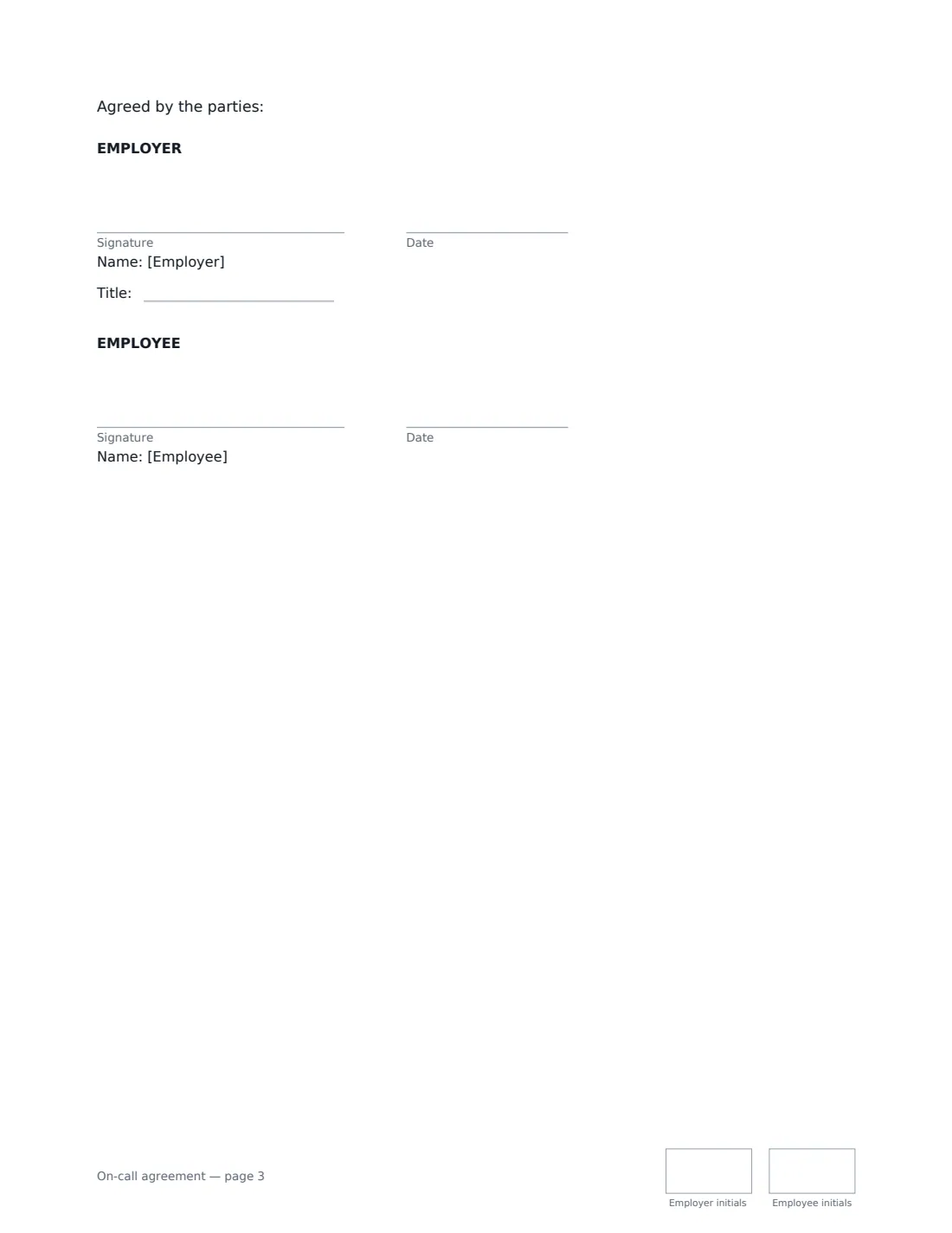
- Employer signature and date, job title, initials on every page · A manager or HR representative authorised to agree working arrangements.
- Employee signature and date, initials on every page
What the on-call agreement Covers
- The on-call rota
- What on-call covers
- Responding to a call
- Pay for being on call
- Pay or time off for call-outs
- Rest and working time
- Local law
- Changing or ending on-call
- General
Using the on-call agreement, step by step
1 Say whether on-call is part of the job
Choose whether on-call is a requirement of the role or voluntary. It changes how the arrangement can be ended: a voluntary employee can leave the rota with notice; a required one can have the terms changed after consultation and notice.
2 Describe the rota and the duties
Write the pattern in plain words — for example one week in four, Monday 18:00 to Monday 09:00 — and what the person on call is responsible for. Add a monthly cap if you want one, and how far ahead the rota is published.
3 Set response times and equipment
Enter how quickly an alert must be acknowledged and whether call-outs are remote, on site or both. If a site visit may be needed, add a travel time. List the equipment you provide; call and data costs are reimbursed.
4 Agree the pay
Choose standby pay (a flat allowance, an hourly rate or none because salary covers it) and how time actually worked is rewarded: a call-out rate, hour-for-hour time off in lieu, or overtime under the contract. Add a minimum call-out time if you use one.
5 Sign it
Send it to the employee to sign. Both of you initial every page, and the signed copy is filed in Files alongside their employment contract.
Tips Before You Send It
- Check local working-time rules before choosing "no separate standby payment" — some places count on-call time, especially when the employee must stay near the workplace, as working time.
- Share the rota well ahead. People with childcare or caring duties need to plan around it.
- Keep call-out logs. They are how you pay correctly and spot a rota that is burning people out.
- Make it safe to say "I'm not fit to respond" — the agreement says doing so in good faith isn't a disciplinary matter.
Sign It Online In Minutes
- Fill in the blanks. Names, dates and amounts go straight into the agreement — the preview shows exactly where.
- Name who signs. Tick “This is me” for your own part. VergeHR builds the PDF with every signature, date and initials box on the right line, and you can check or move anything before sending.
- Send it. Each signer gets a secure link and signs from any device — no account needed. The signed PDF, with an audit trail and a Certificate of Completion, is filed in Files and emailed to everyone.
On-call agreement: frequently asked questions
Is time spent on call working time?
It depends on where you are and how restrictive the on-call is. In some places time on call counts as working time, particularly when the employee must stay at or near the workplace; in others only time actually worked counts. The agreement doesn't decide this — it says local law applies where it is more favourable to the employee.
Do employees get rest after being called out at night?
The agreement says the employer will keep on-call and call-outs within the legal limits on working time and rest, and that an employee whose rest is interrupted may start later or take compensatory rest, as agreed and as the law requires.
Can on-call be stopped or changed later?
Yes. If on-call is voluntary, either side can end it with the notice you set. If it's part of the role, the employer can change the pattern, response times or pay with that notice after consulting the employee, to the extent the employment contract allows.
Can an employee sign this electronically?
Yes. In most countries, including the US (ESIGN Act and UETA), the UK, the EU (eIDAS) and Canada, an electronic signature is generally valid for an ordinary employment document like this. VergeHR keeps an audit trail and a Certificate of Completion with the signed PDF as evidence of who signed and when.
Is this template free?
Yes. The template is free to use with the eSignature app in VergeHR. Signers don't need a VergeHR login.