

What is a roofing contract?
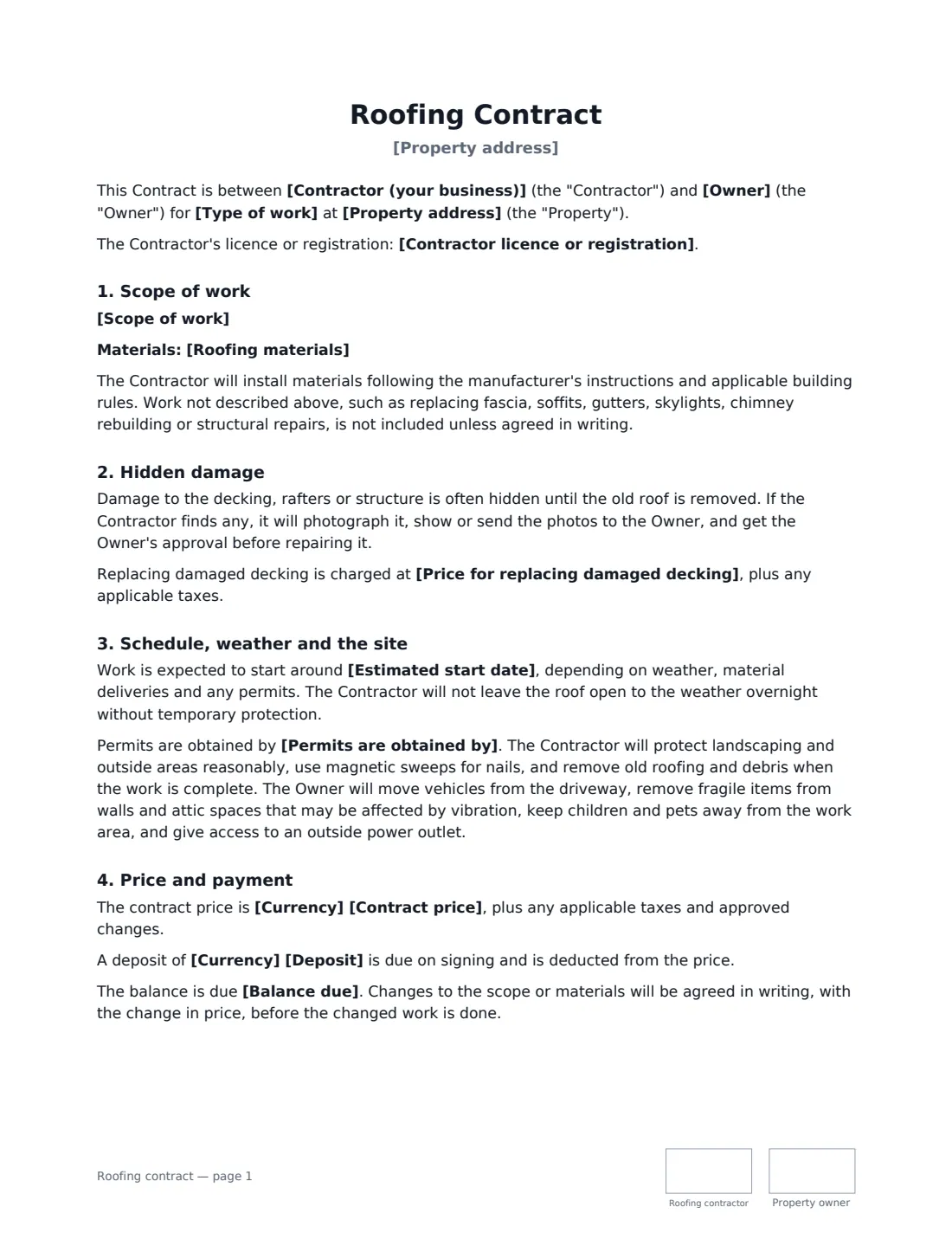
A roofing contract sets the terms for a roof replacement, repair, re-roof or flat-roof job between a roofing contractor and a property owner. Roofing has its own recurring flashpoints: rotten decking that nobody could see until the shingles came off, storms delaying the work, nails in the lawn, and insurance claims where the deductible and the settlement need careful handling.
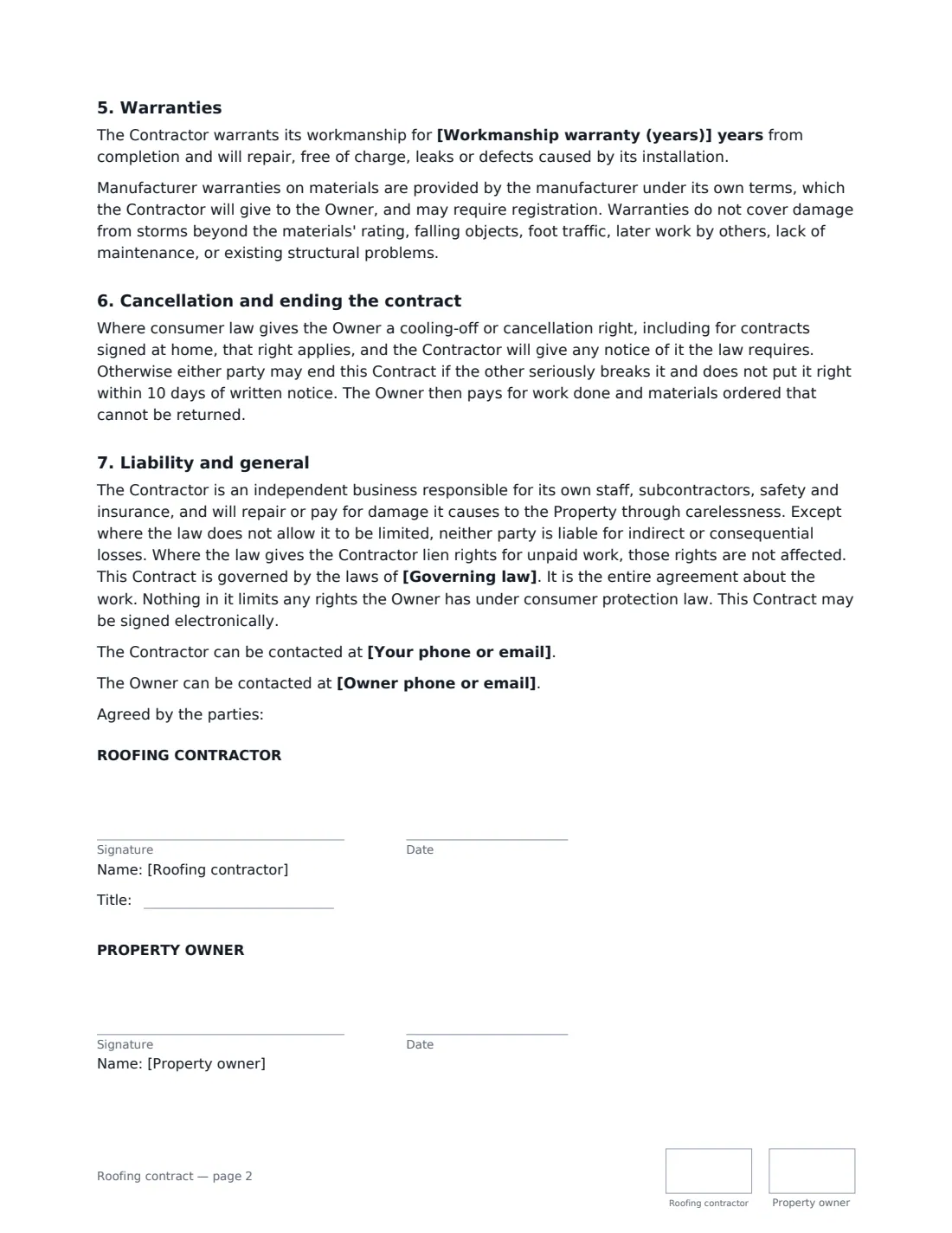
This template covers the scope and materials, a photo-and-approve process with an optional per-sheet price for hidden decking damage, who pulls permits, temporary protection overnight, site protection and debris removal, and what the owner should move before work starts. It sets the contract price, an optional deposit and the balance terms, and has an optional insurance-claim clause that keeps the owner responsible for the deductible and in charge of the claim. Workmanship and manufacturer warranties are kept separate, and cancellation rights for home-signed contracts are preserved.
- Best for
- Roofing contractors doing replacements, repairs, re-roofs and flat roofs
- Signed by
- The roofing contractor and the property owner
- Covers
- Hidden damage, permits, weather, debris, insurance claims, two warranties
- Length
- About 2 pages, initialled on every page
When to Use a roofing contract
- A full shingle roof replacement on a family home
- Storm damage repair paid through the owner's insurance
- A flat roof membrane replacement on a commercial building
- Repairing leaks around a chimney and valleys
- A new roof on an extension or new build
What You Fill In
19 blanks, then the name and email of each person who signs: roofing contractor, property owner.
1 The parties
- Contractor (your business)*
- Your phone or email*
- Contractor licence or registration
- Owner*
- Owner phone or email
2 The work
- Property address*
- Type of work* a full roof replacement · a roof repair · a re-roof over the existing roof · a new roof on new construction · flat roof works
- Scope of work*
- Roofing materials*
3 Price and payment
- Currency*
- Contract price*
- Price for replacing damaged decking
- Deposit
- Balance due* on completion and final inspection · on delivery of materials (half) and on completion (the rest) · within 7 days of completion
- Paid through an insurance claim?* No · Yes
4 Schedule and warranty
- Estimated start date*
- Permits are obtained by* the Contractor, included in the price · the Contractor, charged at cost · the Owner · not required for this work
- Workmanship warranty (years)
- Governing law*
5 Who signs
- Roofing contractor signature and date, job title, initials on every page · The roofing company.
- Property owner signature and date, initials on every page · The owner, or someone authorised by the owner.
What the roofing contract Covers
- Scope of work
- Hidden damage
- Schedule, weather and the site
- Price and payment
- Warranties
- Cancellation and ending the contract
- Liability and general
Using the roofing contract, step by step
1 Describe the job
Choose the type of work and describe the scope — tear-off, underlayment, flashing, ventilation — and the roofing materials and colour.
2 Price hidden damage
Enter a per-sheet decking price if you have one. Either way, the contract requires photos and the owner's approval before hidden damage is repaired.
3 Set price, permits and insurance
Enter the contract price, any deposit and the balance terms. Choose who obtains permits, and answer whether the job is paid through an insurance claim to add the claim clause.
4 Add warranties and send
Set your workmanship warranty in years and the governing law, then send the contract for signature.
Tips Before You Send It
- Many places license roofers and some cap deposits or require specific notices for contracts signed at home — check local rules before you send.
- Photograph rotten decking before replacing it and send the photos to the owner; it's the approval trail the contract describes.
- Never offer to waive or absorb an insurance deductible — the template's insurance clause rules it out, and in many places it's unlawful.
- Hand over the manufacturer warranty paperwork and remind the owner if it needs registering.
Sign It Online In Minutes
- Fill in the blanks. Names, dates and amounts go straight into the agreement — the preview shows exactly where.
- Name who signs. Tick “This is me” for your own part. VergeHR builds the PDF with every signature, date and initials box on the right line, and you can check or move anything before sending.
- Send it. Each signer gets a secure link and signs from any device — no account needed. The signed PDF, with an audit trail and a Certificate of Completion, is filed in Files and emailed to everyone.
Roofing contract: frequently asked questions
What happens if rotten decking is found?
The contractor photographs it, shows the owner and gets approval before repairing it. If you set a per-sheet price it's charged at that rate; otherwise the repair is priced and approved first.
How does the insurance claim clause work?
If you answer Yes, the contract states that the owner remains responsible for paying the contractor, including the deductible and anything the insurer doesn't cover, that the contractor won't waive the deductible, and that the owner decides whether to accept the settlement.
Are workmanship and manufacturer warranties the same thing?
No. The workmanship warranty is the contractor's promise about the installation, for the years you choose. The manufacturer warranty covers the materials under the manufacturer's own terms and may need registration.
Can I sign a roofing contract electronically?
Electronic signatures are generally valid for ordinary construction and home improvement contracts in the US, UK, EU and Canada, though some places add specific notice requirements for home improvement work. VergeHR keeps an audit trail and Certificate of Completion with the signed PDF.