

What is a safeguarding code of conduct?
A safeguarding code of conduct is the short, practical set of rules that everyone who works with children in an organisation agrees to follow. Sports clubs, youth groups, schools' extracurricular programmes, churches, tutoring and activity businesses and charities use one alongside their full safeguarding or child protection policy: the policy explains how the organisation keeps children safe, and the code tells each adult exactly what is expected of them personally.
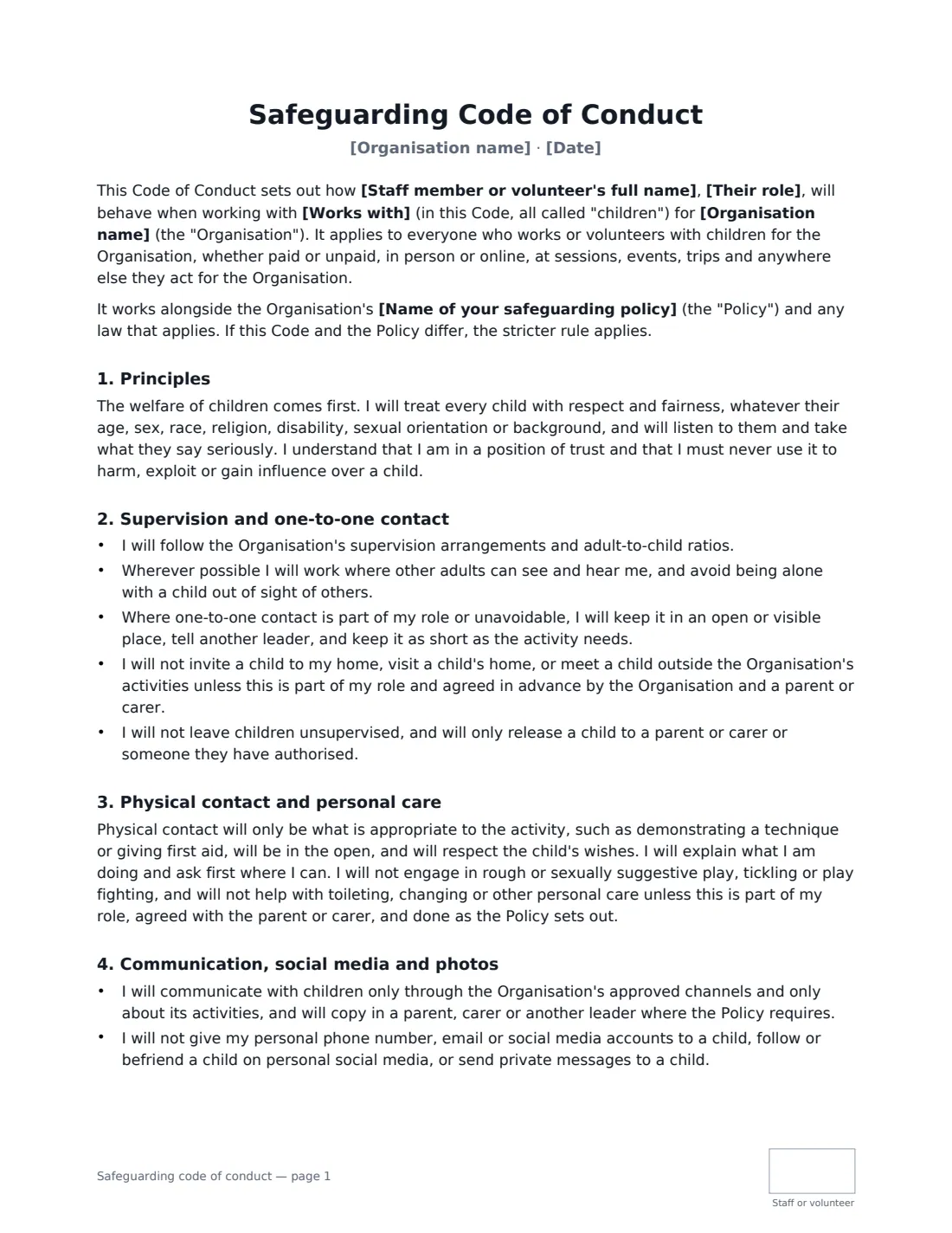
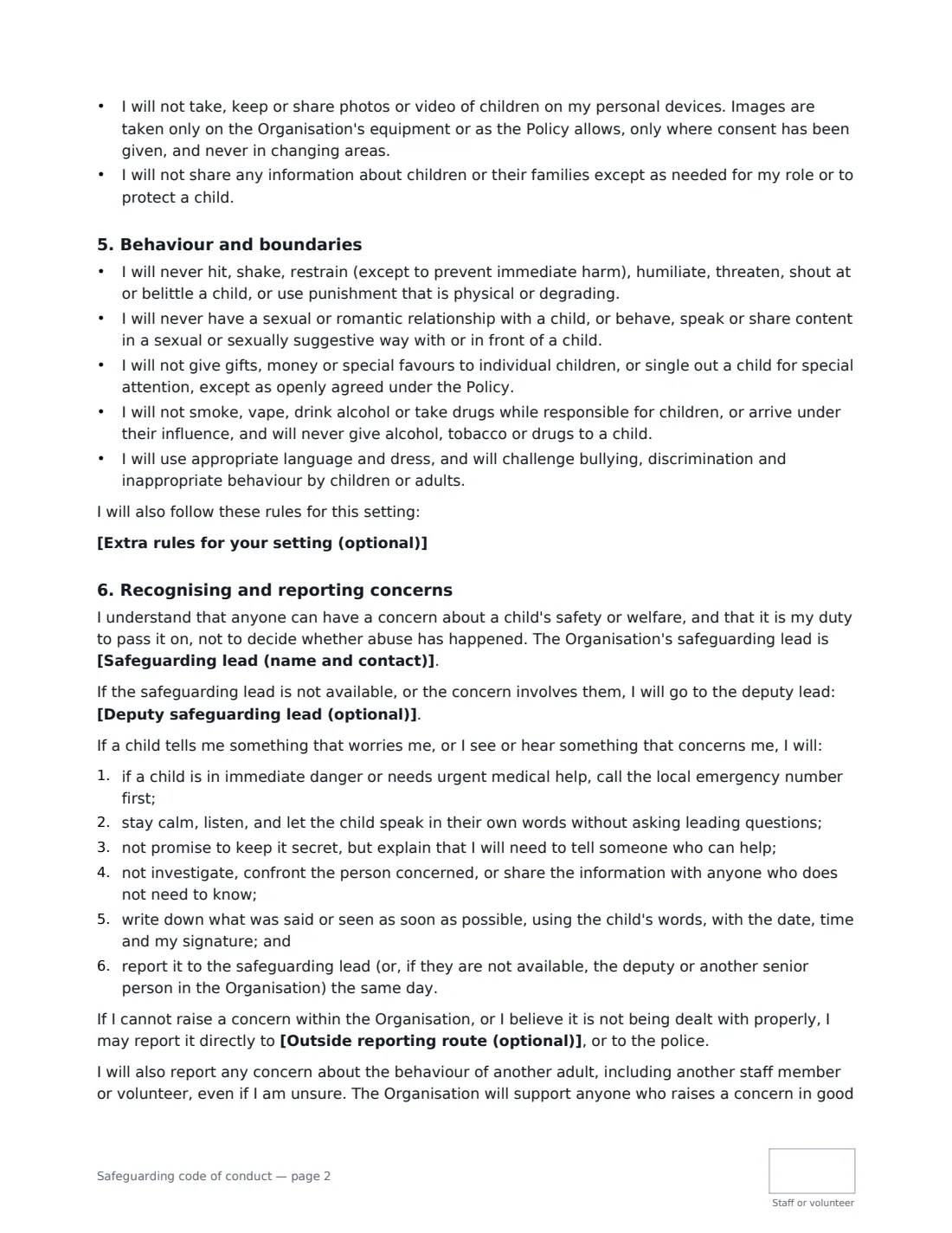
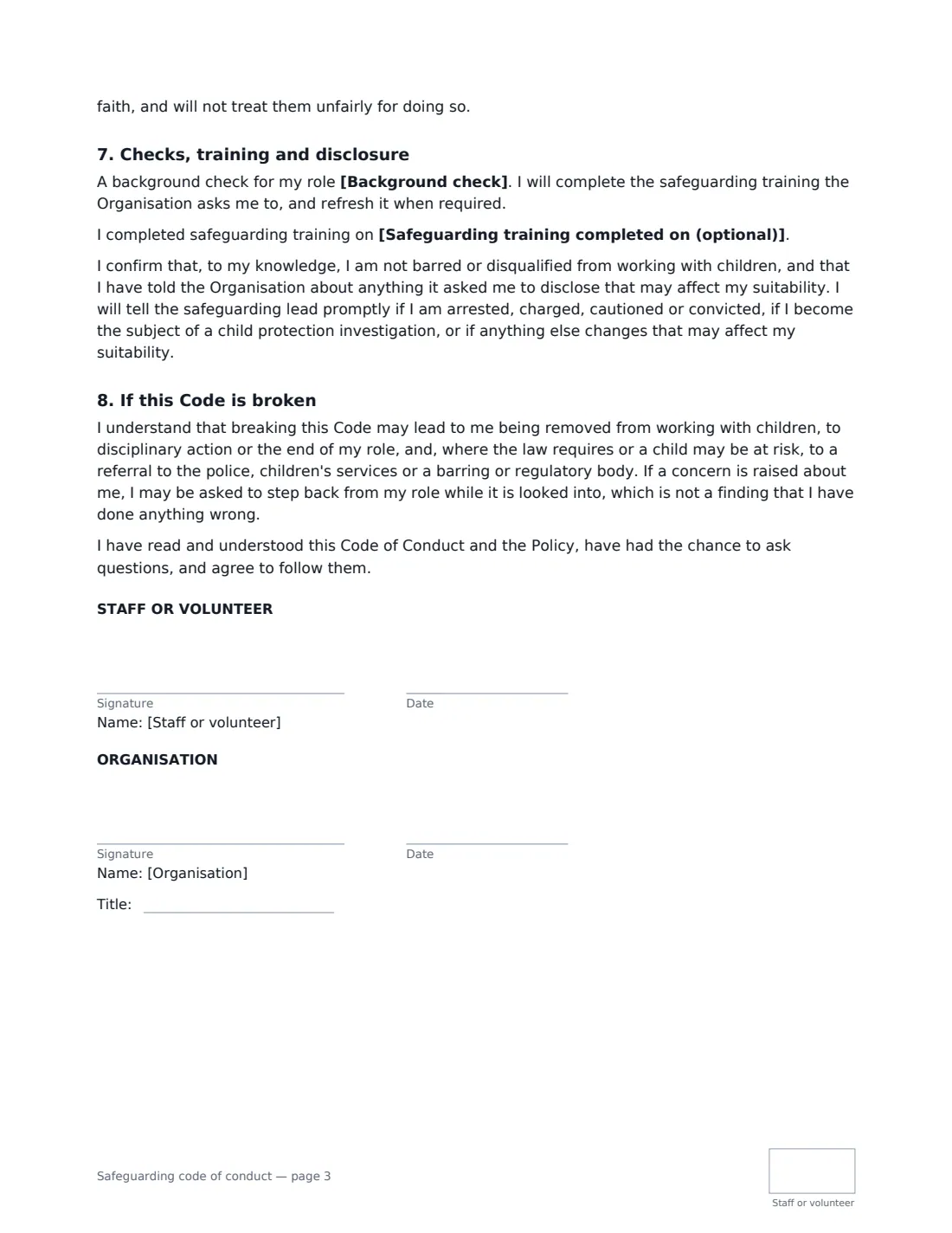
This template is written in the first person, so the staff member or volunteer reads each commitment as their own. It covers supervision and one-to-one contact, physical contact and personal care, communication, social media and photos, behaviour and boundaries, alcohol and drugs, and transport. It explains step by step what to do when a child discloses something or an adult's behaviour causes concern, names your safeguarding lead and optional deputy and outside reporting route, records the background check and training, and asks the person to tell you about anything that later affects their suitability. You can add rules specific to your setting.
- Best for
- Sports clubs, youth groups, tutoring and activity providers, faith groups, charities and camps
- Signed by
- The staff member or volunteer, and the safeguarding lead or a manager
- Covers
- Supervision, contact, online communication, photos, boundaries, transport, reporting concerns
- Length
- About 3 pages, initialled by the staff member or volunteer on every page
When to Use a safeguarding code of conduct
- Signing up a new volunteer coach or team manager at a youth sports club
- Onboarding tutors, instructors or activity leaders who work with children
- Camp and holiday programme staff before the season starts
- Youth group, scout, faith or community volunteers
- Getting every existing adult to re-sign after you update your safeguarding policy
What You Fill In
13 blanks, then the name and email of each person who signs: staff or volunteer, organisation.
1 The organisation
- Organisation name*
- Name of your safeguarding policy*
- Safeguarding lead (name and contact)*
- Deputy safeguarding lead (optional)
- Outside reporting route (optional)
2 The staff member or volunteer
- Staff member or volunteer's full name*
- Their role*
- Works with*
- Background check* has been completed · will be completed before I work with children unsupervised · is not required under local law
- Safeguarding training completed on (optional)
- Date*
3 Rules for this setting
- Transporting children* Not allowed · Allowed only with the Organisation's and a parent's prior agreement
- Extra rules for your setting (optional)
4 Who signs
- Staff or volunteer signature and date, initials on every page · The employee, coach, tutor, leader or volunteer who will work with children.
- Organisation signature and date, job title, initials on every page · Usually the safeguarding lead, manager or chair who signs for the organisation.
What the safeguarding code of conduct Covers
- Principles
- Supervision and one-to-one contact
- Physical contact and personal care
- Communication, social media and photos
- Behaviour and boundaries
- Recognising and reporting concerns
- Checks, training and disclosure
- If this Code is broken
Using the safeguarding code of conduct, step by step
1 Name your policy and your safeguarding lead
Enter the name of your safeguarding or child protection policy and the name and contact details of the person concerns go to. Add a deputy and an outside reporting route — such as your local children's services — so people know where to go if the lead is unavailable or is the subject of the concern.
2 Add the person and their role
Enter their name and role, and who they work with. Record whether the background check for the role has been done, will be done before they work unsupervised, or is not required under local law, and the date they completed safeguarding training.
3 Set the rules for your setting
Choose whether staff and volunteers may transport children, and add anything specific to you — such as a two-adult rule at every session or rules for changing rooms. Each extra rule goes on its own line.
4 Send it for signature
Add the staff member or volunteer as a signer and sign for the organisation. They initial each page and sign at the end; the signed copy is filed in Files so you can show who has agreed to the code.
Tips Before You Send It
- Give people the full safeguarding policy with the code — the code refers to it and the stricter rule applies if they differ.
- Background check requirements depend on the country and the role. Check what your local law, your sport's governing body or your funder requires before someone works with children unsupervised.
- Walk new volunteers through section 6 in person: what to do if a child discloses something is the part people most need to remember.
- Keep the safeguarding lead's contact details current and re-issue the code when they change.
- Re-sign the code when you update your policy or at least every year, together with refresher training.
Sign It Online In Minutes
- Fill in the blanks. Names, dates and amounts go straight into the agreement — the preview shows exactly where.
- Name who signs. Tick “This is me” for your own part. VergeHR builds the PDF with every signature, date and initials box on the right line, and you can check or move anything before sending.
- Send it. Each signer gets a secure link and signs from any device — no account needed. The signed PDF, with an audit trail and a Certificate of Completion, is filed in Files and emailed to everyone.
Safeguarding code of conduct: frequently asked questions
Is a code of conduct the same as a safeguarding policy?
No. The policy sets out the organisation's overall approach and procedures. The code of conduct is the personal commitment each adult signs about how they will behave. Most organisations that work with children have both.
Does this replace background checks or training?
No. The code records whether the check required for the role has been done and when training was completed, but it doesn't replace them. What is required depends on local law and the role.
Can it cover work with vulnerable adults too?
Yes. Change the "Works with" field — for example to "children and young people under 18 and adults at risk" — and the code applies to both groups.
Is an electronically signed code of conduct valid?
Electronic signatures are generally valid for ordinary documents like this in the US (ESIGN Act and UETA), the UK, the EU (eIDAS) and Canada. VergeHR keeps an audit trail and a Certificate of Completion with the signed PDF as a record of who agreed and when.
Is this template free?
Yes. It is free to use with the eSignature app in VergeHR, and staff and volunteers don't need a VergeHR login to sign.