


What is a workplace relationship disclosure?
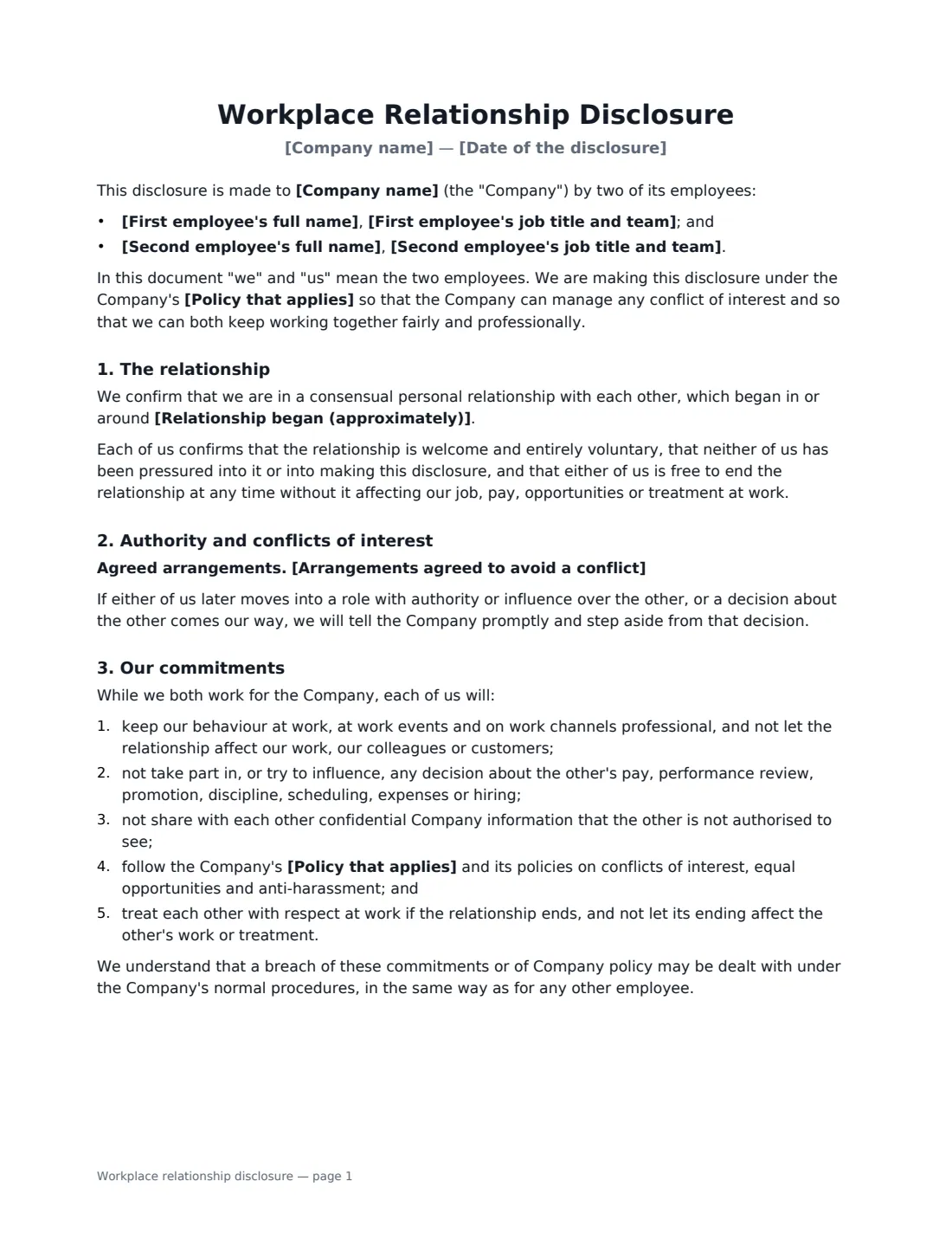
When two colleagues start a relationship, many employers ask them to tell HR — not to police anyone's private life, but so the company can make sure neither person makes decisions about the other's pay, performance or promotion. A workplace relationship disclosure (sometimes called a consensual relationship agreement or "love contract") puts that conversation in writing: both employees confirm the relationship is welcome and voluntary, and all three parties sign to record how any conflict will be handled.
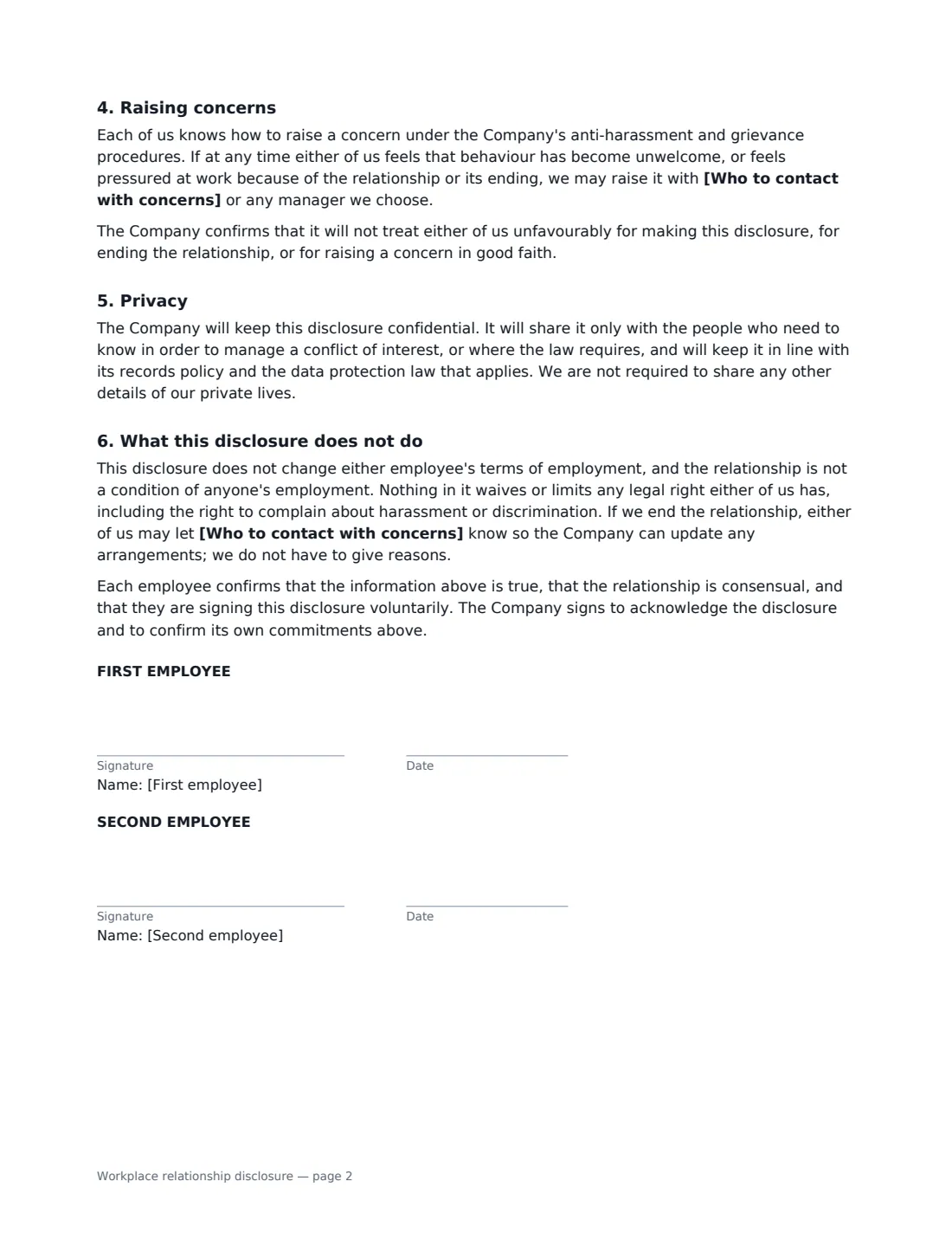
This template names both employees and their roles, records whether either has authority over the other, and — if one does — commits the company to changing reporting lines or decision-making, with space to write down exactly what has been agreed. Both employees agree to keep things professional, stay out of decisions about each other, keep confidential information separate and follow your conduct policy. The company promises confidentiality and no retaliation, and the document states plainly that it does not change anyone's terms of employment or waive the right to complain about harassment.
- Best for
- Colleagues in a relationship, especially where one could influence decisions about the other
- Signed by
- Both employees and a company representative (usually HR)
- Conflict of interest
- Choose "no authority either way" or "one has authority" — the wording changes to match
- Length
- About 2 pages
When to Use a workplace relationship disclosure
- A manager and someone in their department disclose a relationship and move pay and review decisions to another manager
- Two peers in different teams tell HR about their relationship, as the company's conduct policy asks
- Colleagues on the same client account agree how they will keep work decisions separate
- An employee is promoted into a role with authority over their partner, and the arrangements need updating
- A small business wants a clear, respectful record instead of an informal chat that no one remembers
What You Fill In
11 blanks, then the name and email of each person who signs: first employee, second employee, employer.
1 The company
- Company name*
- Date of the disclosure*
- Policy that applies*
- Who to contact with concerns*
2 First employee
- First employee's full name*
- First employee's job title and team*
3 Second employee
- Second employee's full name*
- Second employee's job title and team*
4 The relationship
- Relationship began (approximately)
- Does either employee have authority over the other?* No — neither manages or influences decisions about the other · Yes — one has authority or influence over the other
- Arrangements agreed to avoid a conflict
5 Who signs
- First employee signature and date · One of the two employees in the relationship
- Second employee signature and date · The other employee in the relationship
- Employer signature and date, job title · Usually HR or a senior manager outside both reporting lines
What the workplace relationship disclosure Covers
- The relationship
- Authority and conflicts of interest
- Our commitments
- Raising concerns
- Privacy
- What this disclosure does not do
Using the workplace relationship disclosure, step by step
1 Name the policy and a contact
Enter the company policy that covers relationships and conflicts of interest (the default is your Code of Conduct) and who the employees can go to with concerns. Choose someone outside both employees' reporting lines.
2 Add both employees
Enter each employee's full name, job title and team. The approximate start of the relationship is optional — a month is enough, and no other personal details are needed.
3 Record any authority and the arrangements
Say whether either employee manages, reviews, pays, schedules or disciplines the other. If one does, describe what changes — for example, who will now handle the performance reviews and pay decisions. The document commits the company to making those changes.
4 Send to all three signers
Tick "This is me" if you sign for the company, and add both employees' names and emails. Each signs separately, and the signed copy is filed in Files — keep it with confidential HR records, not the general personnel file.
Tips Before You Send It
- Talk to both employees before sending the form, together or separately. The document should record a conversation, not start one.
- Keep the disclosure confidential and limit who can see it — only the people who need to manage the conflict.
- Don't ask for more detail than you need. The form deliberately asks only for names, roles and whether one has authority over the other.
- Revisit the arrangements whenever either employee changes role, and let either of them update HR if the relationship ends — no reasons needed.
- Check your local law and your own policy before requiring disclosure; rules on employee privacy and off-duty conduct differ between countries and states.
Sign It Online In Minutes
- Fill in the blanks. Names, dates and amounts go straight into the agreement — the preview shows exactly where.
- Name who signs. Tick “This is me” for your own part. VergeHR builds the PDF with every signature, date box on the right line, and you can check or move anything before sending.
- Send it. Each signer gets a secure link and signs from any device — no account needed. The signed PDF, with an audit trail and a Certificate of Completion, is filed in Files and emailed to everyone.
Workplace relationship disclosure: frequently asked questions
Is this the same as a "love contract"?
Yes, that's the informal name. It is a written disclosure that a relationship between colleagues is consensual, plus an agreement to follow the company's conduct and conflict-of-interest rules. It is not a contract about the relationship itself.
Can an employer require employees to disclose a relationship?
Many employers ask for disclosure in their conduct or conflict-of-interest policy, especially where one person has authority over the other. How far an employer can go depends on local privacy and employment law, so check before making it mandatory and keep the questions to what you need to manage the conflict.
Does signing stop either employee from complaining about harassment later?
No. The template says so plainly: it does not waive or limit any legal right, including the right to complain about harassment or discrimination, and the company confirms it will not retaliate against either employee for raising a concern.
What if the relationship ends?
Either employee may let the named contact know so the company can update any arrangements, without giving reasons. Both have already agreed to treat each other with respect at work if the relationship ends.
Are electronic signatures valid for this?
Generally, yes. Electronic signatures are generally valid in the US (ESIGN Act and UETA), the UK, the EU (eIDAS) and Canada. VergeHR keeps an audit trail and a Certificate of Completion with the signed PDF.