

What is a software development agreement?
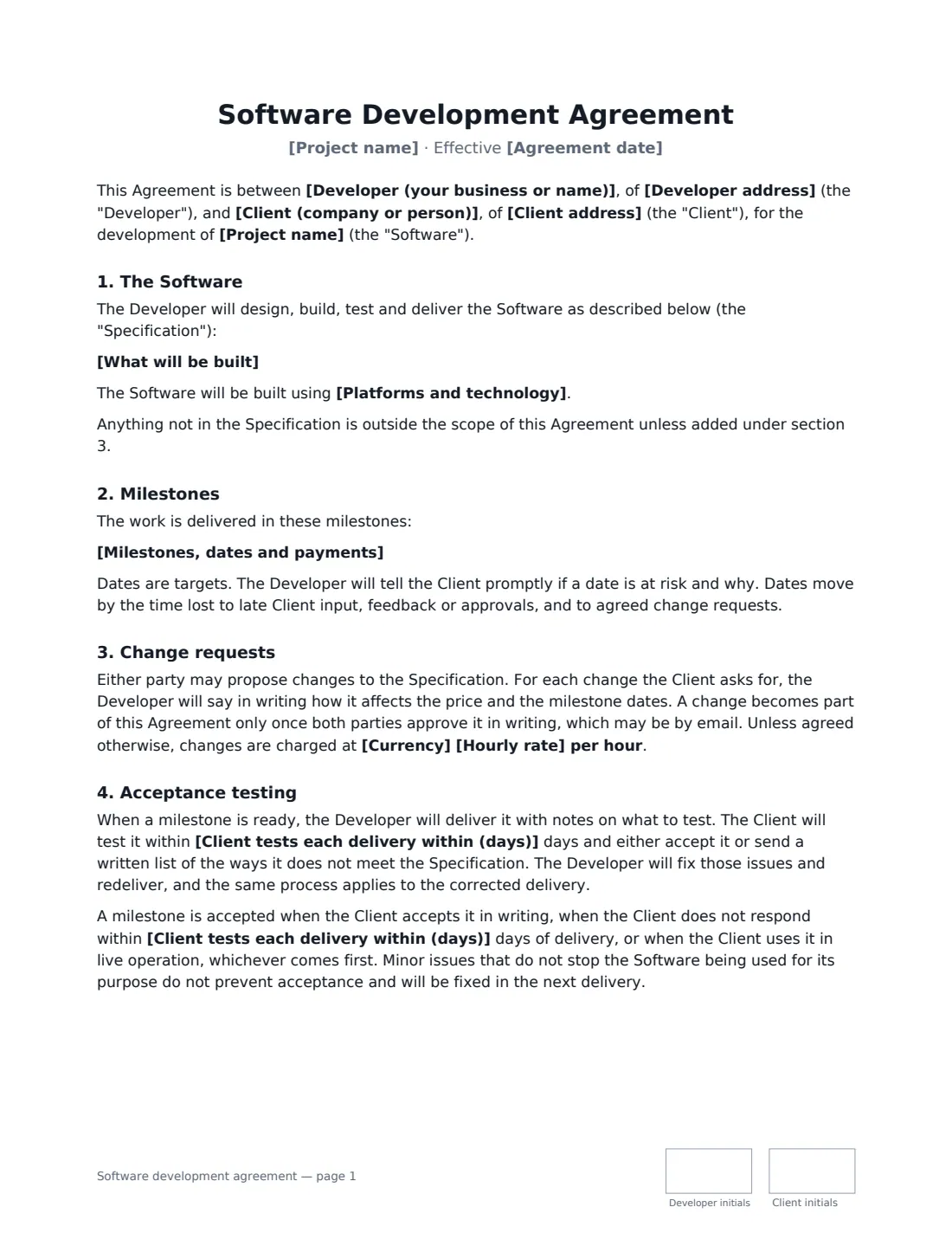
A software development agreement is the contract between a client and a developer, agency or studio building custom software — a mobile app, a web application, an internal tool or an integration. Custom software projects go wrong in predictable ways: the scope grows without the price changing, nobody agrees whether a delivery is "done", payments stall, and at the end it is unclear who owns the code. This template addresses each of those.
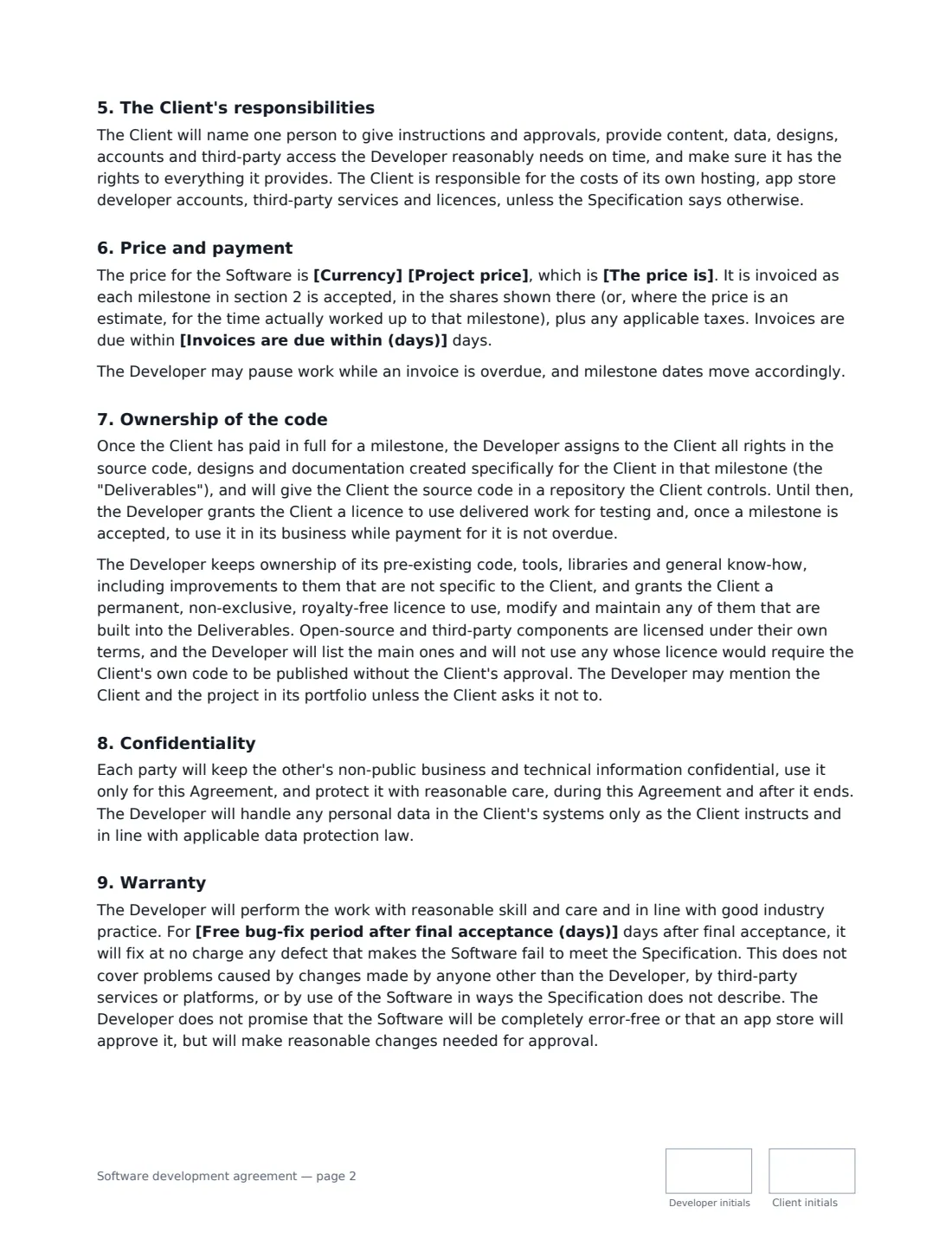
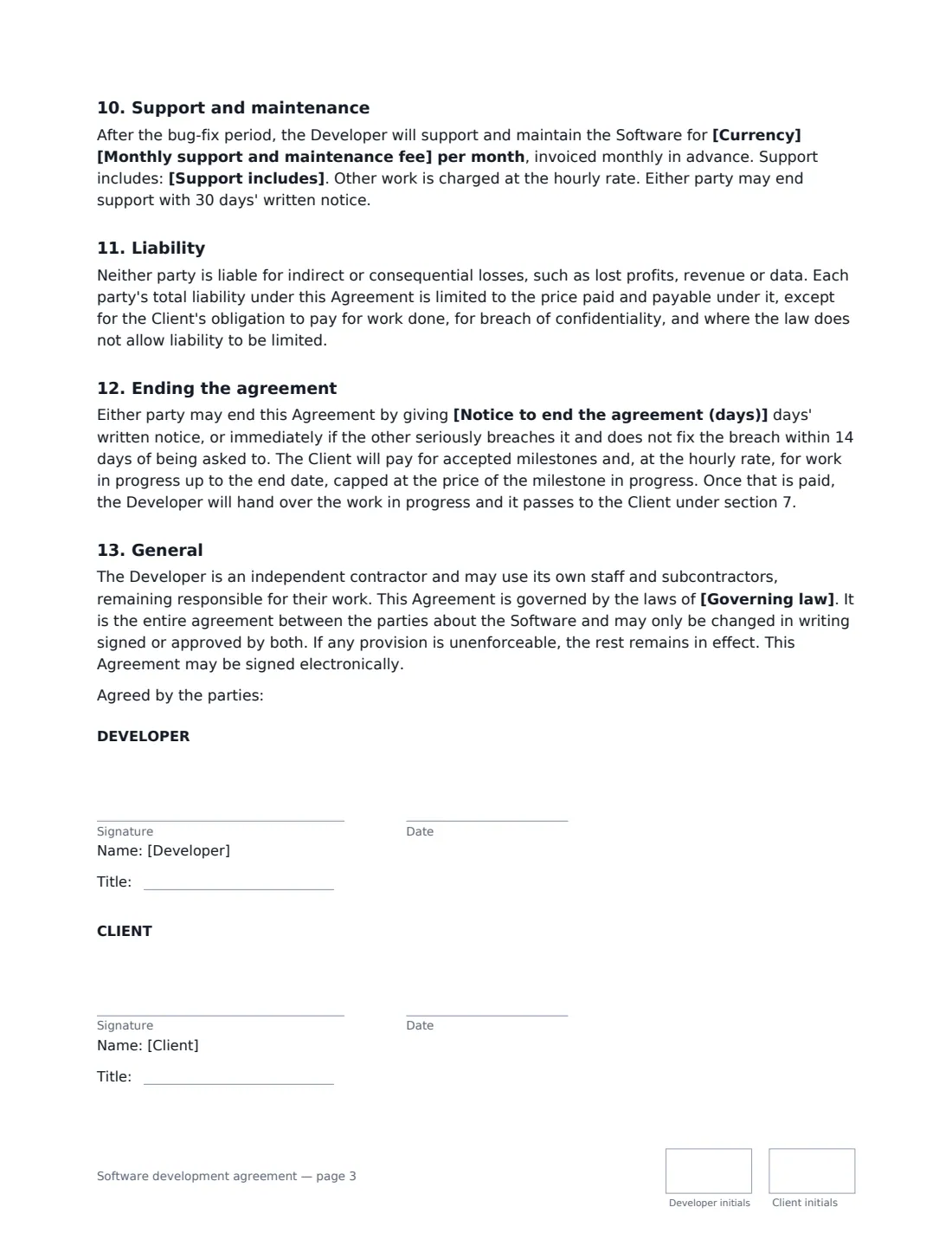
It ties the work to a specification and a milestone schedule with dates and payment shares, adds a written change-request process, and sets an acceptance-testing period after each delivery with deemed acceptance if the client doesn't respond. The price can be fixed or an estimate billed by the hour. The client owns the custom code once each milestone is paid, while the developer keeps its pre-existing tools and libraries and licenses them for the project; open-source components stay under their own licences. It also covers confidentiality, a free bug-fix period after launch, optional monthly support and maintenance, liability, and what happens to work in progress if the project stops early.
- Best for
- Freelance developers, agencies and studios building custom software or apps
- Signed by
- The developer and the client, each with a job title
- Pricing
- Fixed price or time-and-materials estimate, paid by milestone
- Length
- About 3 pages, initialled on every page
When to Use a software development agreement
- Building an iOS and Android app for a startup or small business
- Developing a custom web application, portal or internal tool
- An agency delivering a software project in milestones against a specification
- A freelance developer building an integration or automation for a client
- Rebuilding or modernising a legacy system in phases
What You Fill In
20 blanks, then the name and email of each person who signs: developer, client.
1 The parties
- Developer (your business or name)*
- Developer address
- Client (company or person)*
- Client address
2 The project
- Agreement date*
- Project name*
- What will be built*
- Platforms and technology
- Milestones, dates and payments*
- Client tests each delivery within (days)*
3 Price and payment
- Currency*
- Project price*
- The price is* a fixed price for the work in the specification · an estimate — the Client pays for time actually worked at the hourly rate
- Hourly rate*
- Invoices are due within (days)*
4 After launch
- Free bug-fix period after final acceptance (days)*
- Monthly support and maintenance fee
- Support includes
5 Other terms
- Notice to end the agreement (days)*
- Governing law*
6 Who signs
- Developer signature and date, job title, initials on every page · You, or the person who signs for your development business or studio.
- Client signature and date, job title, initials on every page · The person who can sign for the client — often a founder, director or product owner.
What the software development agreement Covers
- The Software
- Milestones
- Change requests
- Acceptance testing
- The Client's responsibilities
- Price and payment
- Ownership of the code
- Confidentiality
- Warranty
- Support and maintenance
- After the bug-fix period
- Liability
- Ending the agreement
- General
Using the software development agreement, step by step
1 Describe the software
Summarise what will be built and its main features, or refer to a specification document both sides have — and attach it to the envelope. Optionally name the platforms and technology stack.
2 Lay out the milestones
Write one milestone per line with what is delivered, the target date and the share of the price due when it is accepted — for example "Beta build for testing — 15 Dec — 35%". Set how many days the client has to test each delivery.
3 Set the price and rates
Enter the price and choose whether it is fixed or an estimate. Add your hourly rate, used for change requests and, for estimates, all work. Set the payment terms.
4 Choose what happens after launch
Set the free bug-fix period after final acceptance. If you offer ongoing support, enter a monthly fee and what it includes; otherwise the agreement says support is available separately. Then add the client's signer and send.
Tips Before You Send It
- The more precise the specification, the easier acceptance is. List the key user flows and platforms rather than describing the product in general terms.
- Put every change request in writing — an approving email is enough under this agreement — with its effect on price and dates.
- Tell the client which open-source components you use. The agreement says you won't use any whose licence would force the client to publish its own code without approval.
- Hand over the source code in a repository the client controls as each milestone is paid. It avoids ownership disputes later.
Sign It Online In Minutes
- Fill in the blanks. Names, dates and amounts go straight into the agreement — the preview shows exactly where.
- Name who signs. Tick “This is me” for your own part. VergeHR builds the PDF with every signature, date and initials box on the right line, and you can check or move anything before sending.
- Send it. Each signer gets a secure link and signs from any device — no account needed. The signed PDF, with an audit trail and a Certificate of Completion, is filed in Files and emailed to everyone.
Software development agreement: frequently asked questions
Who owns the code in a software development agreement?
Under this template, the client owns the custom code, designs and documentation created for it once each milestone is paid in full. The developer keeps its pre-existing code, tools and know-how and gives the client a permanent licence to use any that are built into the software.
What happens if the client doesn't test a delivery?
The client has the number of days you choose to test and report issues. If it doesn't respond in that time, or starts using the milestone in live operation, the milestone counts as accepted.
What if the project is cancelled halfway?
Either side can end the agreement with notice. The client pays for accepted milestones and for work in progress at the hourly rate, capped at the price of the milestone in progress, and then receives the work in progress.
Can a software development contract be signed electronically?
In most countries, including the US (ESIGN Act and UETA), the UK, the EU (eIDAS) and Canada, an electronic signature is generally valid for an ordinary commercial contract like this one. VergeHR keeps an audit trail and a Certificate of Completion with the signed PDF as evidence of who signed and when.
Is this template free?
Yes. The template is free to use with the eSignature app in VergeHR. Signers don't need a VergeHR login.